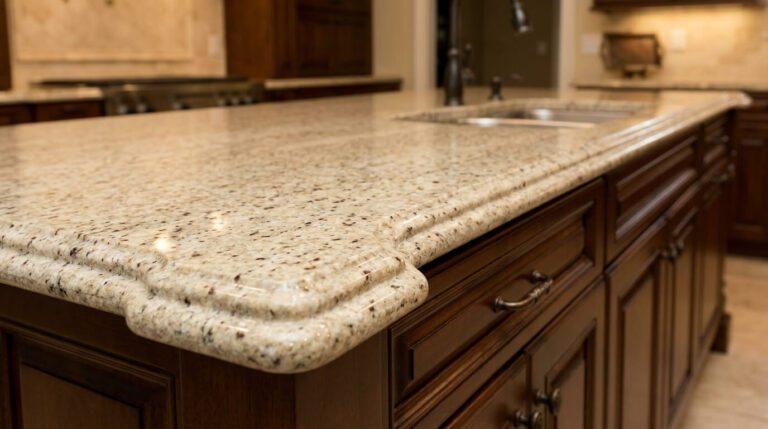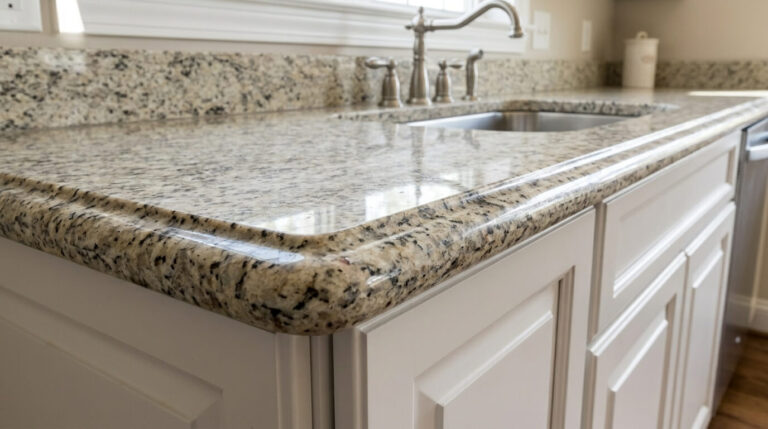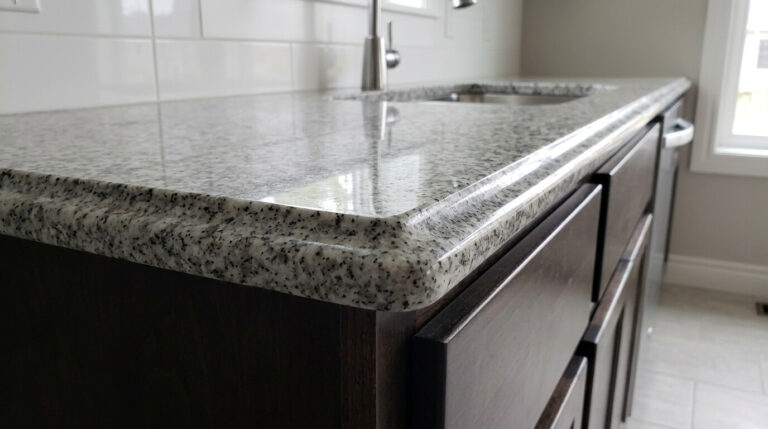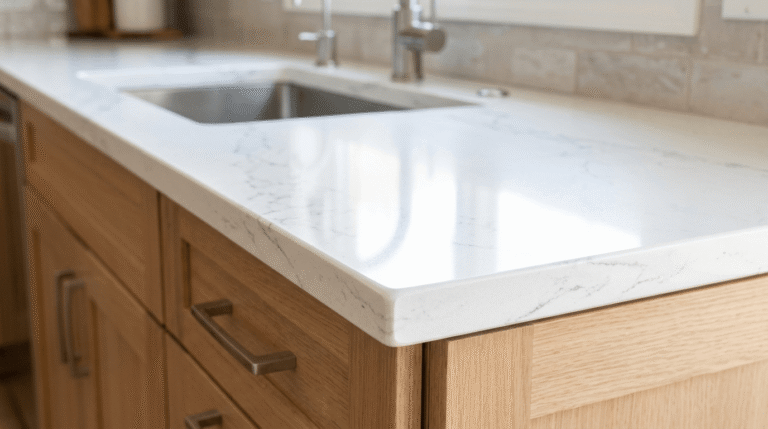
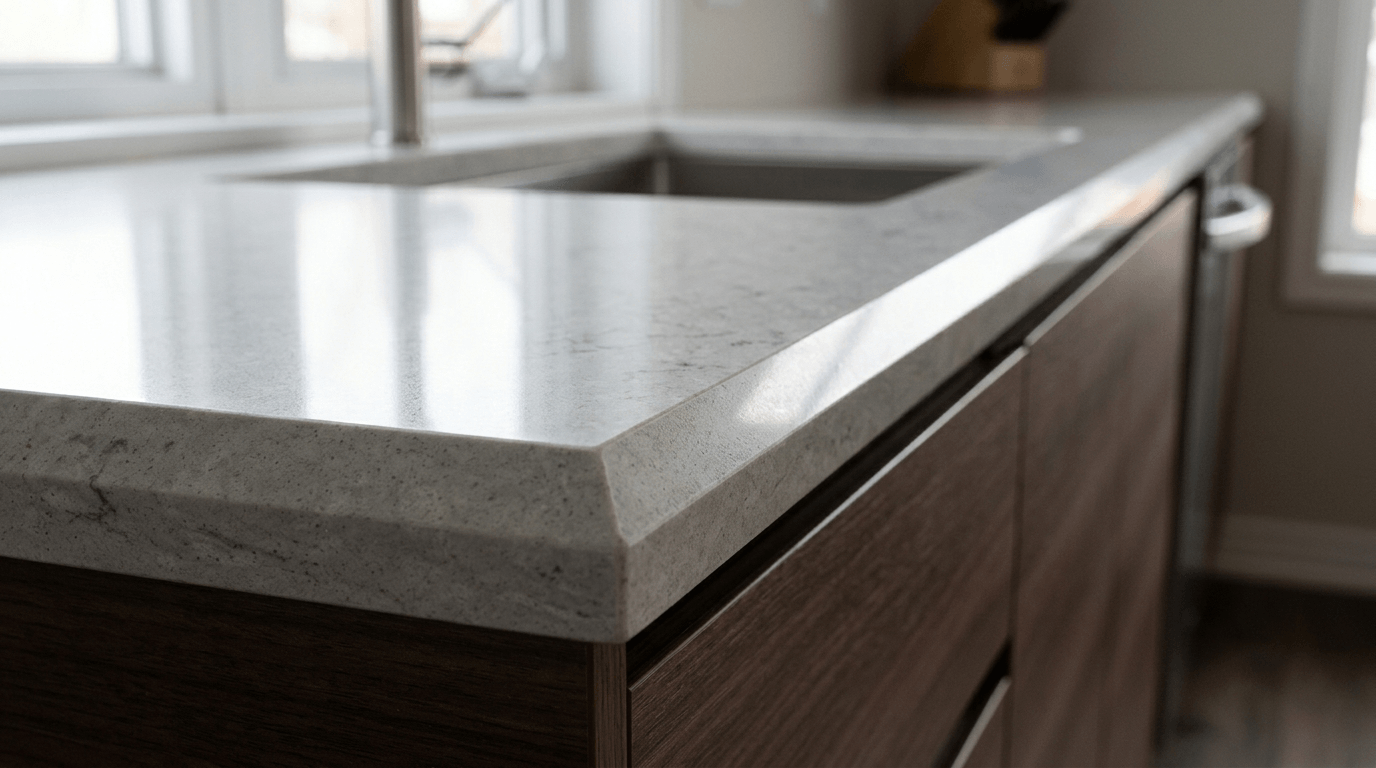
A beveled countertop edge cuts the top surface at an angle instead of leaving it flat or rounded, creating a faceted line where the countertop meets open air. Fabricators shape this profile during slab cutting, using diamond-tipped tools to grind and polish the angled face so it matches the finish of the rest of the countertop.
Homeowners choose beveled edges for their combination of visual definition and moderate cost. The angled cut catches light differently than a flat or curved edge, adding a subtle architectural detail without the expense of an ornate profile such as an ogee or a waterfall.
Edge profile selection affects three practical outcomes: appearance, cost, and daily use. A bevel changes how the countertop looks from the side, adds a modest amount to the total project price, and creates a firmer edge than a rounded profile in high-traffic areas such as kitchen islands.
This article defines the beveled edge, explains how it performs on quartz and granite, compares common bevel sizes and angles, contrasts the bevel against other edge profiles, and outlines typical costs so homeowners can select the right option for their countertop project.
What Is a Beveled Countertop Edge?
A beveled countertop edge is a countertop edge profile cut at an angle, typically 45 degrees, instead of remaining flat (a standard square edge) or curved (a bullnose or ogee edge). The cut removes the sharp 90-degree corner of the slab and replaces it with a flat, angled facet along the top rim.
Fabricators produce the bevel by grinding the top edge of the slab with a diamond blade set at the target angle, then polishing the new facet to match the countertop’s finish. The result is a straight diagonal line that runs the full length of the countertop’s exposed edge. The depth of the cut, usually measured in fractions of an inch, determines how prominent the angled facet appears from a standing viewpoint.
Where Beveled Edges Are Commonly Used
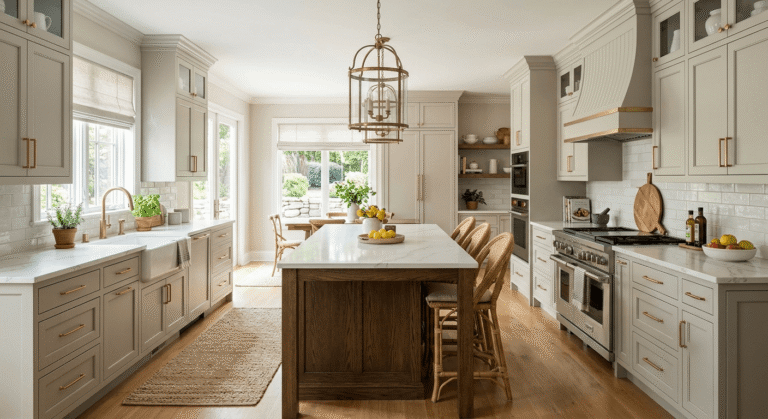
Beveled edges are most commonly used on kitchen islands, perimeter counters, and bathroom vanities where a defined but understated edge detail is desired. The angled cut works on any horizontal stone or engineered-stone surface, but it appears most often on these three applications because each benefits from a visible edge line without a rounded or ornate profile.
Kitchen islands use beveled edges to add a finished look to a surface viewed from multiple sides. Perimeter counters along walls use the profile for a consistent, budget-conscious upgrade over a plain square edge. Bathroom vanities use beveled edges to introduce a design detail on a smaller surface where a heavier profile, such as a double ogee, would look disproportionate.
Beveled Edges on Quartz Countertops
A beveled edge on a quartz countertop is produced by grinding and polishing the engineered slab’s top corner at an angle, most commonly 45 degrees, using the same fabrication equipment applied to natural stone. Quartz’s engineered, non-porous composition allows the cut and polished facet to hold a consistent finish across the full length of the edge.
Quartz slabs consist of crushed quartz minerals bound with polymer resin and pigment, which produces a uniform surface color and pattern from edge to edge. This uniformity means a beveled cut on quartz shows a consistent color band along the angled facet, without the natural veining variation found in stone. The polymer resin also allows fabricators to achieve a sharp, precise bevel line, since the material does not chip or flake as readily as some natural stones during grinding.
Beveled Edges on Granite Countertops
A beveled edge on a granite countertop is created by grinding the natural stone slab’s top corner at an angle and polishing the cut to match the surrounding finish. Granite’s natural mineral composition, primarily quartz, feldspar, and mica, produces visible grain and veining across the angled facet, so the bevel line displays the same natural pattern variation seen on the rest of the slab.
Because granite is a natural material with varying hardness and grain direction across a single slab, fabricators adjust cutting speed and blade pressure to avoid chipping along the beveled edge. Granite’s higher density compared with engineered quartz generally produces a durable, chip-resistant bevel once polished, provided the fabricator follows correct grinding technique for the specific granite variety.
How Granite Bevels Differ from Quartz
Granite bevels differ from quartz bevels primarily in surface consistency and cutting behavior: granite shows natural veining and color variation along the beveled facet, while quartz displays a uniform, engineered pattern. This difference stems from each material’s composition rather than the bevel angle itself, which remains the same across both materials.
Granite’s natural grain can require slower, more careful grinding to prevent chipping during the bevel cut, since mineral hardness varies within the same slab. Quartz’s engineered resin-and-mineral composition cuts more predictably, allowing a more uniform edge finish with less risk of chipping. Granite also requires periodic sealing to protect the beveled edge from liquid absorption, while quartz’s low-porosity surface does not require sealing.
Bevel Sizes and Types
Beveled countertop edges are available in several standard sizes and configurations, most commonly a 1/4-inch bevel, a double bevel, and variations on the standard 45-degree cutting angle. Fabricators select the size and type based on the countertop’s material thickness, the desired visual weight of the edge, and the homeowner’s design preference.
The bevel size refers to the depth of the angled cut, while the bevel type refers to how many angled facets appear on the edge and at what angle they are cut. A thicker countertop slab can accommodate a larger or double bevel, while a thinner slab typically limits the fabricator to a single, smaller bevel cut.
1/4″ Bevel Edge
A 1/4-inch bevel edge is a beveled countertop profile with an angled facet cut to a depth of one-quarter inch from the top corner of the slab. This is the most common bevel size for standard countertop thicknesses of 2 to 3 centimeters, producing a visible but subtle angled line along the edge.
The 1/4-inch depth keeps the bevel proportional to typical countertop thickness, so the angled facet remains a design accent rather than the dominant visual feature of the edge. Fabricators commonly pair this size with both quartz and granite, since the shallow cut requires less material removal and correspondingly less fabrication time than a larger or double bevel.
Double Bevel Edge
A double bevel edge is a countertop profile with two angled facets, one cut into the top corner and a second cut into the bottom corner of the slab, producing a symmetrical faceted appearance on both sides of the edge. This configuration requires a thicker slab, typically 3 centimeters or more, to accommodate both angled cuts without weakening the edge.
The double bevel creates a more pronounced, dimensional look than a single bevel, since light reflects off two angled surfaces instead of one. Fabricators use the double bevel on premium countertop projects, such as waterfall-edge islands or feature counters, where the additional visual weight of the edge is a deliberate design choice.
Standard 45° Bevel vs. Custom Angles
A standard bevel edge is cut at a 45-degree angle, while custom bevel angles range from shallower cuts, such as 30 degrees, to steeper cuts approaching 60 degrees, depending on the fabricator’s equipment and the homeowner’s specification. The 45-degree angle is the industry default because it produces a balanced, consistent facet width across most standard countertop thicknesses.
A shallower custom angle produces a wider, more gradual facet that reads as a softer transition from the top surface to the edge. A steeper custom angle produces a narrower facet with a sharper visual break. Custom angles typically require additional fabrication time and a shop with adjustable cutting equipment, which can increase both lead time and cost compared with the standard 45-degree bevel.
Beveled Edge vs. Other Countertop Edge Profiles
A beveled edge differs from other common countertop edge profiles, including the eased edge, the bullnose edge, and the ogee edge, primarily in its flat angled facet, compared with the rounded or curved surfaces used by these alternative profiles. Each profile produces a distinct visual line and requires a different amount of fabrication work.
The comparison below evaluates each profile against the beveled edge using two consistent criteria: surface shape and relative fabrication complexity, since these two factors most directly affect appearance and cost.
Beveled vs. Eased Edge
A beveled edge is cut at a flat angle, while an eased edge has a slightly rounded, softened corner that removes the sharpness of a 90-degree cut without introducing a distinct angled facet. The eased edge is the standard, no-additional-cost profile offered by most fabricators, while the bevel is an upgraded profile that typically adds to the base price.
Visually, the eased edge reads as a subtle softening of a square edge, while the beveled edge creates a clearly visible diagonal line along the countertop’s length. Homeowners who want a minimal, understated edge typically choose the eased profile, while those who want a defined design detail choose the bevel.
Beveled vs. Bullnose Edge
A beveled edge has a flat angled facet, while a bullnose edge has a fully rounded, convex profile with no flat surfaces along the edge. The bullnose comes in half-bullnose, which rounds only the top of the edge, and full-bullnose, which rounds both the top and bottom.
The bullnose profile suits households with young children or accessibility concerns, since its rounded shape removes all sharp corners along the countertop edge. The beveled edge retains a defined corner line at the top and bottom of the angled facet, which produces a more architectural appearance but does not offer the same rounded safety profile as the bullnose.
Beveled vs. Ogee Edge
A beveled edge is a single flat angled facet, while an ogee edge is a decorative S-curve profile combining a concave and a convex curve along the edge. The ogee requires substantially more fabrication time than the bevel because the S-curve shape demands multiple grinding passes at varying angles.
The ogee edge produces a traditional, ornate appearance suited to formal kitchen designs, while the bevel produces a cleaner, more contemporary line. Because of its added fabrication complexity, the ogee edge typically costs more per linear foot than the beveled edge across both quartz and granite.
Cost of a Beveled Countertop Edge
A beveled countertop edge typically adds $5 to $25 per linear foot to the base cost of the countertop, depending on the material, the fabricator, and the region. This range reflects national average pricing reported by sources including Angi and Fixr; regional rates can fall outside this range depending on local labor costs and fabricator pricing structures.
The bevel is priced as an upgrade over the standard eased or squared edge, which most fabricators include in the base countertop price at no additional charge. The final edge cost depends on the linear footage of exposed edge requiring the bevel cut, since only visible, non-wall-adjacent edges typically receive the upgraded profile.
Cost by Material (Quartz vs. Granite)
A beveled edge on quartz typically costs $10 to $25 per linear foot, while a beveled edge on granite typically costs closer to $10 per linear foot, based on national pricing data from Angi and Today’s Homeowner. Quartz pricing tends to span a wider range because engineered-stone fabricators often price edge upgrades as part of broader customization tiers, while granite fabricators more often quote a flat per-linear-foot rate for a standard 45-degree bevel.
These figures apply to a single bevel cut on a standard-thickness slab. Regional labor rates, slab thickness, and the specific fabricator’s pricing structure can shift the final cost above or below these national averages, so homeowners should confirm current pricing with local suppliers before budgeting a project.
Cost by Bevel Complexity (Single vs. Double)
A single bevel edge costs less than a double bevel edge because the double profile requires a second angled cut and additional polishing time. National pricing sources place a single bevel at roughly $5 to $25 per linear foot, while a double bevel typically falls at the higher end of that range or above it, since the added facet increases both material removal and labor time.
The double bevel also requires a thicker slab, which can raise the base material cost independent of the edge-cutting charge. Homeowners planning a double bevel on a long countertop run should budget for both the higher per-linear-foot edge rate and any material upgrade needed to reach the required slab thickness.
How to Choose the Right Bevel for Your Countertop
Choosing the right beveled edge depends on three factors: the countertop material, the slab thickness, and the desired visual weight of the edge. Quartz and granite both accept standard 45-degree bevels, so material choice mainly affects surface appearance and cutting behavior rather than which bevel sizes are available.
Slab thickness determines whether a single or double bevel is feasible; a standard 2 to 3-centimeter slab typically supports only a single 1/4-inch bevel, while a double bevel requires a thicker slab of 3 centimeters or more. Homeowners planning a double bevel should confirm slab thickness with their fabricator before finalizing the design.
Visual weight is a design preference: a 1/4-inch single bevel at the standard 45-degree angle produces a subtle accent suited to most kitchen and bathroom counters, while a double bevel or a custom angle produces a more pronounced, dimensional edge suited to feature countertops such as islands. Budget also factors into this decision, since double bevels and custom angles typically cost more per linear foot than the standard single bevel.