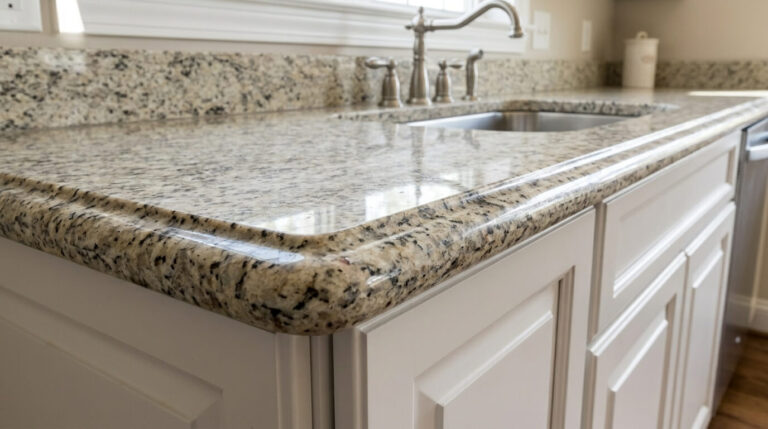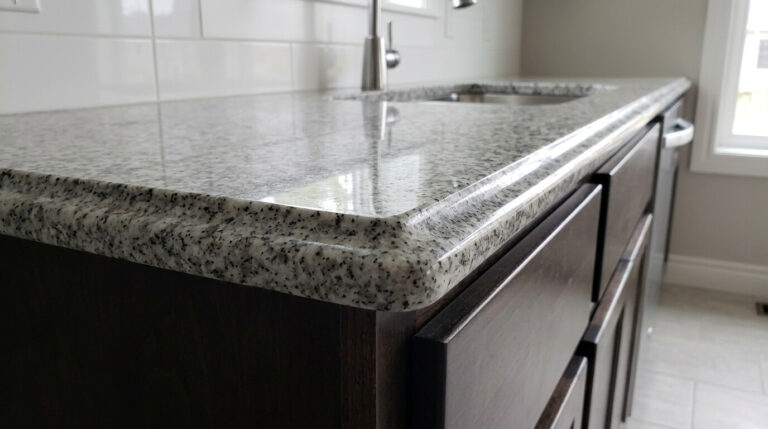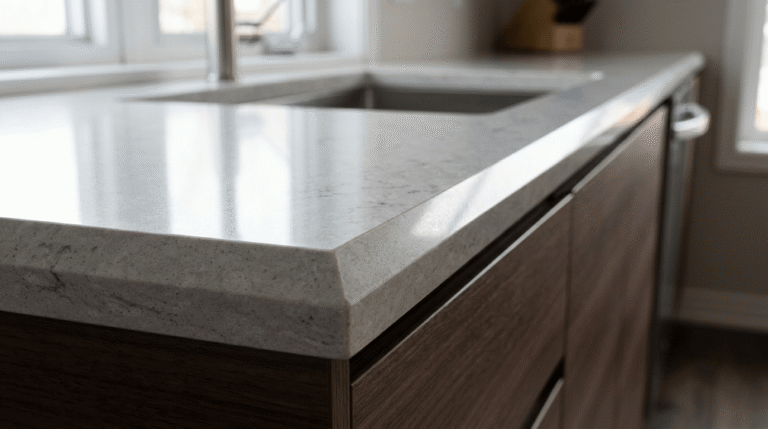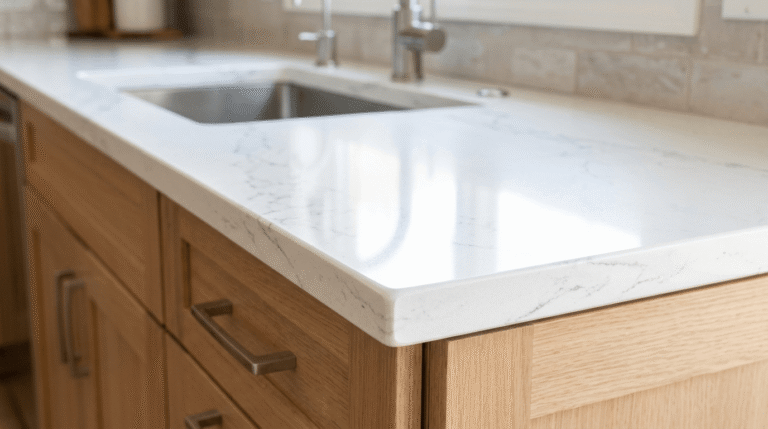
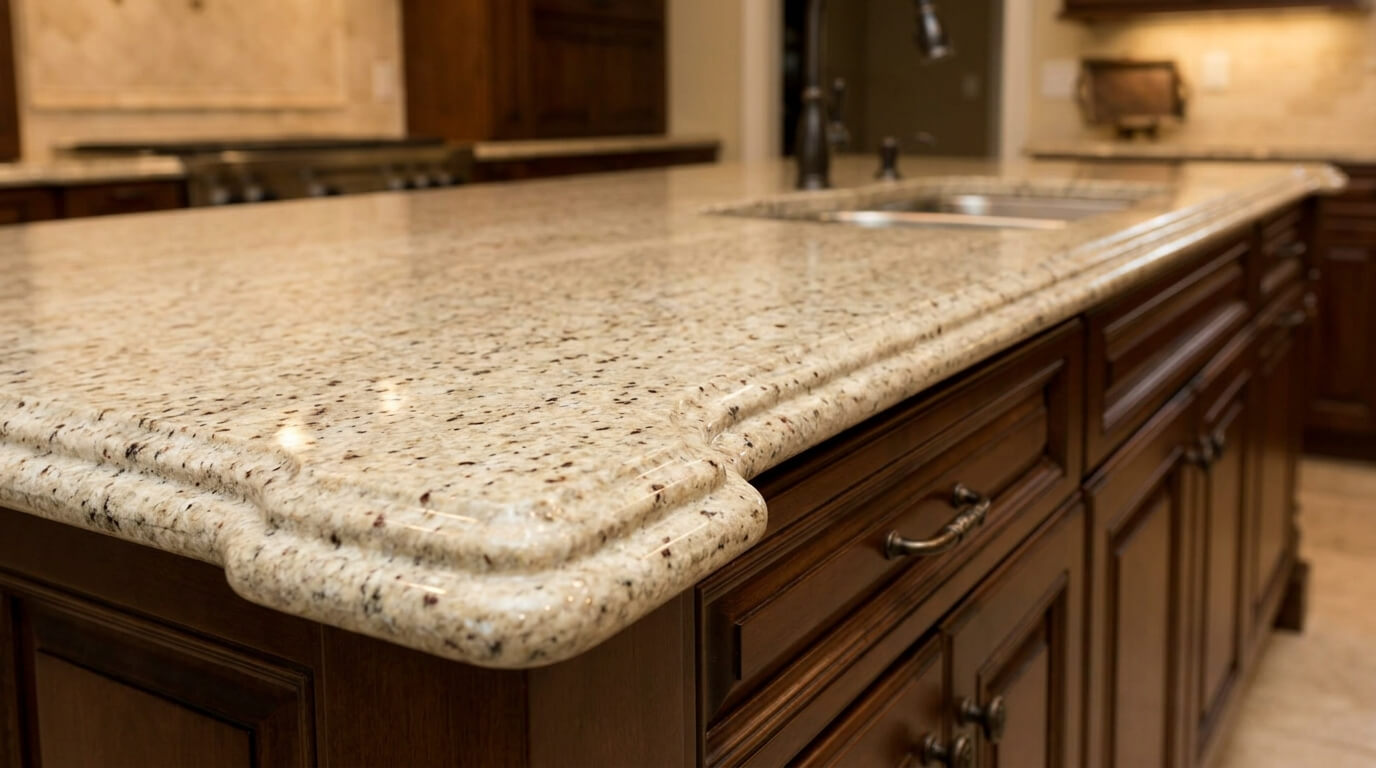
An ogee countertop edge is a decorative edge profile shaped in a continuous S-curve, combining a convex arc and a concave arc along the same edge line. Fabricators cut this profile into the front and exposed edges of a countertop slab to replace the flat, unshaped edge left after cutting.
The ogee profile originates from classical molding design used in architecture, furniture, and picture frames. Stonemasons and cabinetmakers adapted the same curved-molding logic to slab edges once diamond router bits made curved stone profiles practical for kitchen and bathroom production.
Fabricators apply ogee edges to kitchen islands, perimeter counters, bathroom vanities, and bar tops where a raised, sculpted edge adds visual weight to the slab. The profile contrasts with flat-ground edges such as the eased edge and rounded edges such as the bullnose, both of which remove material rather than sculpt a layered curve.
This article covers the ogee edge definition, its main profile variations, how different countertop materials affect its fabrication, its use on backsplashes and other surfaces, its comparison against alternative edge profiles, and the factors that determine which ogee variation suits a given countertop.
What Is an Ogee Countertop Edge?
An ogee countertop edge is a curved edge profile that alternates between a convex and a concave arc to form a continuous S-shaped line along the slab’s perimeter. The profile is a subtractive cut: a router or edge-profiling machine removes stone or engineered material from the raw slab edge to create the layered curve.
The defining attribute of the ogee edge is its double curvature. A single flowing line rises outward, then curves back inward, producing a shadow line where the two curves meet. This shadow line separates the ogee edge from single-curve profiles such as the bullnose, which uses one continuous convex arc.
Fabricators classify the ogee edge as a decorative, high-detail profile rather than a functional or safety profile. Builders commonly select it for countertops in formal kitchens, traditional-style homes, and bathroom vanities where the edge itself functions as a visible design element.
Types of Ogee Edge Profiles
Ogee edge profiles fall into three main categories: the single ogee, the double ogee, and the ogee bullnose. Each category differs in the number of curves, the total edge height, and the level of fabrication detail required to cut it.
Single Ogee Edge
A single ogee edge contains one S-curve: one convex arc followed by one concave arc along the slab’s edge height. The profile produces a moderate decorative effect without the added bulk of a multi-curve edge.
Fabricators cut the single ogee into slabs of standard thickness, typically two to three centimeters, without requiring a laminated or built-up edge. The single curve keeps the edge profile close to the slab’s natural thickness, which limits material waste and fabrication time compared with multi-curve variants.
Double Ogee Edge
A double ogee edge contains two stacked S-curves, doubling the number of convex and concave arcs found in a single ogee edge. The repeated curvature increases the total visible edge height and produces a more elaborate, layered appearance.
Because the double ogee requires greater edge height to display both curve sets clearly, fabricators often laminate a second strip of the same material beneath the slab edge before cutting the profile. The lamination step and the additional router passes increase both material use and labor time relative to the single ogee edge.
Ogee Bullnose Edge
An ogee bullnose edge combines an ogee’s S-curve with a rounded bullnose curve at the top of the edge, blending the two profile types into a single continuous line. The rounded top softens the sharp transition points that a standard ogee edge leaves at the top corner of the slab.
This hybrid profile appears most often on bathroom vanities and pool-adjacent surfaces, where the rounded upper section reduces the number of sharp edges near frequent hand contact while retaining the ogee’s decorative shadow line.
Ogee Countertop Edge by Material
The material composing a countertop slab determines how cleanly a fabricator can cut an ogee edge, how much material the process removes, and how the finished profile performs under daily use. Natural stone, engineered stone, and other slab materials each respond differently to the router passes required to shape the curve.
Ogee Edge on Granite Countertops
Granite supports a well-defined ogee edge because its high hardness and crystalline structure hold sharp curve transitions without crumbling. Granite’s mineral composition of quartz, feldspar, and mica gives the stone the density needed to resist chipping along the raised outer curve of the profile.
Granite’s hardness also increases fabrication time relative to softer materials, since diamond router bits must make slower passes to cut the profile cleanly. The finished edge resists scratching and everyday wear, which supports long-term retention of the ogee’s sharp shadow line.
Ogee Edge on Marble Countertops
Marble accepts an ogee edge with a smooth, polished finish because its softer calcite structure cuts cleanly under a router bit. The resulting profile displays a refined, uniform curve that matches marble’s traditional use in formal kitchen and bathroom designs.
Marble’s lower hardness relative to granite increases the risk of chipping along the raised points of the ogee curve during fabrication, transport, and daily use. Fabricators reduce this risk by chamfering the sharpest transition points slightly or by recommending a single ogee edge over a double ogee edge on marble slabs.
Ogee Edge on Quartz Countertops
Quartz countertops accept an ogee edge with consistent results because the material’s engineered composition of crushed quartz and polymer resin produces uniform density across the slab. This uniformity allows router bits to cut the curve without the natural veining or soft mineral pockets that can affect natural stone.
Router passes generate friction heat during quartz edge fabrication, and excessive heat can soften or discolor the polymer resin binding the slab. Fabricators control cutting speed and use water-cooled equipment to prevent resin damage while shaping the ogee profile on quartz.
Ogee Edge for Backsplashes and Other Applications
Fabricators apply the ogee edge to backsplashes, furniture tabletops, fireplace mantels, and reception desks wherever a raised, decorative edge suits the surrounding design. On a backsplash, the ogee profile typically runs along the top edge, where the curve remains visible above the counter surface.
The same profile also appears on freestanding furniture such as dining tables, sideboards, and desks fabricated from stone or engineered slab material. Builders select the ogee edge for these applications for the same reason they select it for countertops: the curved shadow line adds a finished, furniture-grade appearance to an otherwise flat slab edge.
Ogee Edge vs. Other Countertop Edge Profiles
The ogee edge differs from other countertop edge profiles in curve complexity, fabrication cost, and visual style. Comparing the ogee edge against alternative profiles requires evaluating each option by the same criteria: shape, fabrication difficulty, maintenance, and suitable design context.
Ogee vs. Eased Edge
An eased edge is a flat vertical edge with slightly rounded top and bottom corners, while an ogee edge is a fully curved, multi-plane S-shaped profile. The eased edge requires a single light pass to soften the raw slab corners, whereas the ogee edge requires multiple router passes to shape its layered curve.
The eased edge suits contemporary and minimalist kitchen designs because its flat plane keeps the countertop’s visual line simple. The ogee edge suits traditional and formal designs because its curved shadow line adds decorative detail that the eased edge does not provide.
Ogee vs. Bullnose (standalone)
A standalone bullnose edge uses one continuous convex curve across the full edge height, while an ogee edge alternates between a convex and a concave curve. The bullnose profile produces a smooth, rounded edge with no shadow line, whereas the ogee profile produces a layered edge with a visible transition between its two curves.
The bullnose edge suits households prioritizing rounded, low-injury-risk corners, since its single curve removes all sharp transition points. The ogee edge suits households prioritizing decorative detail over a fully rounded profile, since its shadow line remains its primary visual feature.
How to Choose the Right Ogee Edge for Your Countertop
Choosing the right ogee edge variation depends on the countertop material, the kitchen or bathroom design style, the fabrication budget, and the level of decorative detail desired. A single ogee edge suits softer materials such as marble and budget-conscious projects, since it requires fewer router passes and no edge lamination.
A double ogee edge suits granite and quartz slabs in formal or traditional kitchens where the additional height and layered curve reinforce a more elaborate design. An ogee bullnose edge suits bathroom vanities and family kitchens where a softened top curve reduces sharp contact points while preserving the ogee’s decorative shadow line.
Homeowners should also confirm the selected material’s compatibility with the chosen ogee variation before fabrication, since softer stones carry a higher chipping risk on multi-curve profiles than harder engineered or granite slabs.