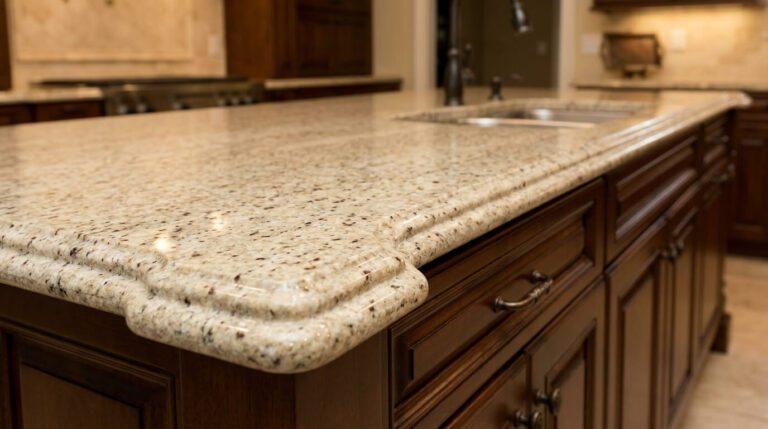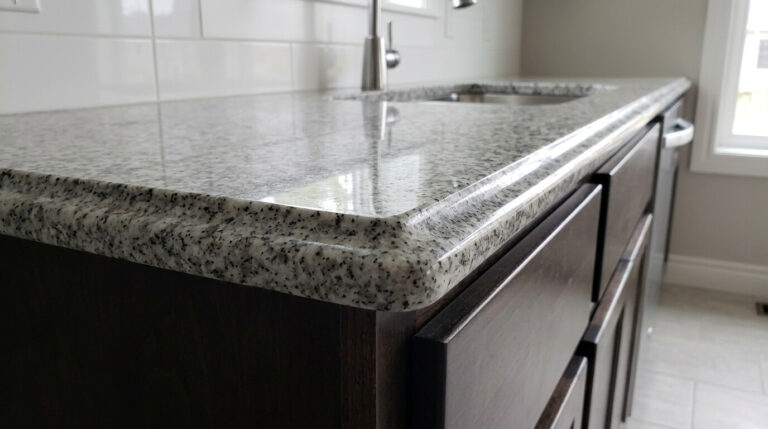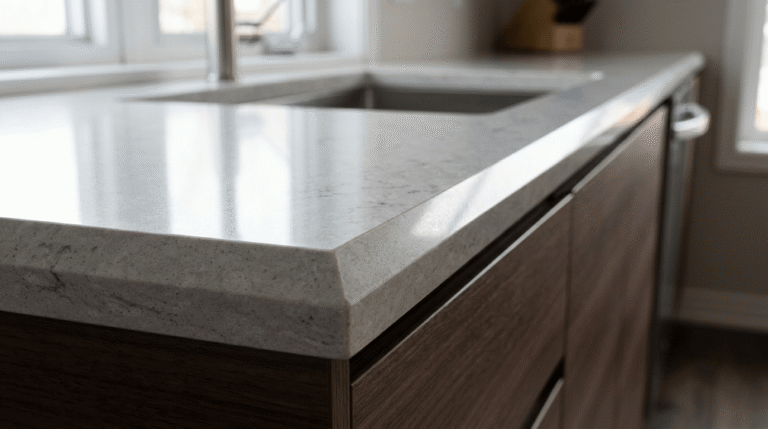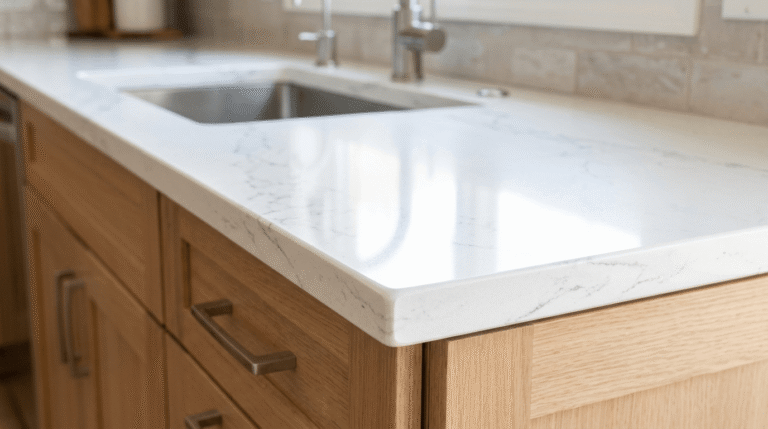
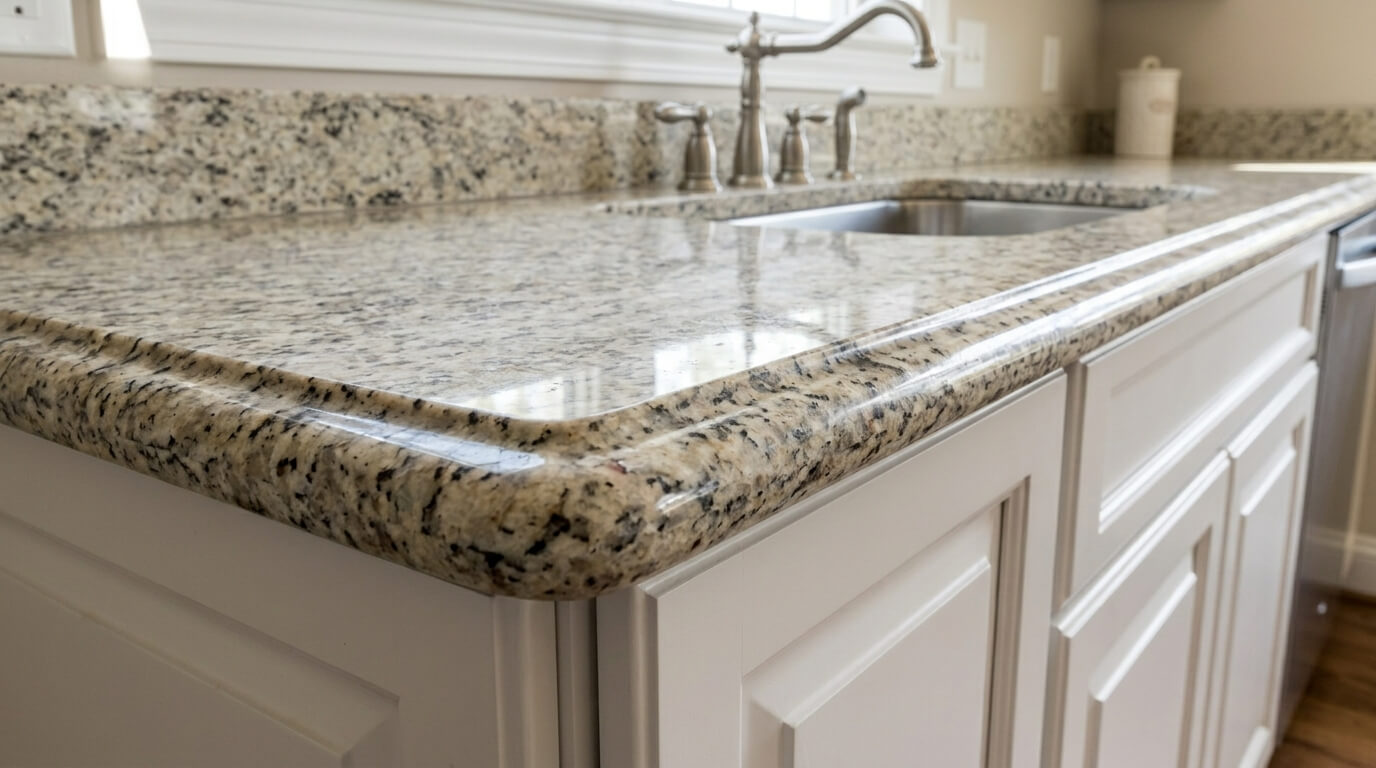
A bullnose countertop edge rounds the top and bottom corners of a countertop’s front edge into a continuous curve. Fabricators shape this profile by grinding and polishing the raw edge of the slab or panel until both corners disappear into a smooth arc. The result removes the sharp 90-degree corner found on a standard square edge.
Countertop edge profiles affect three practical factors: safety, cleaning, and visual style. A rounded edge such as the bullnose eliminates the corner most likely to cause impact injuries in kitchens, bathrooms, and other high-traffic work areas. The curved surface also has no seam or groove where the edge meets the top of the counter, which reduces the number of spots where crumbs, liquid, and dust can collect.
Fabricators cut bullnose edges from natural stone, engineered stone, solid surface, laminate, and tile-based countertops. Each material responds differently to the shaping and polishing process, and the achievable curve depends on the material’s thickness, hardness, and structural composition. Granite and quartz slabs typically use diamond-tipped tools during edge profiling, while laminate and tile installations use edge pieces or bullnose trim tiles manufactured for that purpose.
This article explains the bullnose edge profile, its main variations, how it performs across common countertop materials, its corner and detailing options, and how it compares with other edge profiles. It also outlines the factors that determine whether a bullnose edge fits a specific countertop project.
What Is a Bullnose Countertop Edge?
A bullnose countertop edge is a rounded edge profile that curves the front face of a countertop from the top surface to the underside in a single, continuous arc. The profile removes both the top and bottom corners of the slab, leaving no flat vertical face along the edge.
Fabricators classify the bullnose as a rounded-edge profile, distinct from square, beveled, or ogee profiles that retain flat or angled sections. The defining attribute of the bullnose is the absence of any corner along the visible edge; the curve extends the full height of the countertop’s thickness.
Countertop fabricators apply the bullnose profile using edge-profiling router bits or CNC-controlled polishing equipment. The tool follows the edge of the slab and removes material symmetrically from the top and bottom until the cross-section forms a half-circle or a similar rounded shape, depending on the specific bullnose variation used.
Types of Bullnose Countertop Edges
Bullnose edges fall into three main categories: full bullnose, half bullnose, and double bullnose. Each category differs in the shape of the curve, the portion of the edge it rounds, and the resulting visual thickness of the countertop’s front face.
Fabricators select among these variations based on the desired appearance, the countertop’s thickness, and the level of edge rounding the client requests. All three variations remove sharp corners, but they differ in how much of the edge surface remains flat versus curved.
Full Bullnose Edge
A full bullnose edge rounds the entire edge of the countertop into a single, uniform half-circle from the top surface to the bottom surface. The curve has no flat section anywhere along its height.
The full bullnose produces a continuous, symmetrical arc when viewed from the side. Fabricators shape this profile by removing an equal amount of material above and below the edge’s midpoint, so the top and bottom corners disappear at the same rate. Countertops with a full bullnose edge typically use this profile on thinner slabs, where a complete curve fits proportionally within the counter’s overall thickness. The profile suits areas where corner impact is a primary concern, including countertops near high-traffic walkways and edges at wheelchair-accessible height.
Half Bullnose Edge (Demi Bullnose)
A half bullnose edge, also called a demi bullnose, rounds only the top corner of the countertop into a curve while leaving the bottom corner and the vertical face below it flat. The edge profile presents a quarter-circle curve at the top that transitions into a straight vertical face.
This profile retains more of the edge’s original vertical face than a full bullnose, which gives the countertop a visually thicker appearance from the front. The half bullnose softens the corner most exposed to hand and body contact—the top corner—while preserving a flat lower edge that some fabricators find easier to align with cabinet faces and toe-kick trim during installation. Kitchens and bathrooms that combine a bullnose look with a more substantial visual edge commonly specify this profile.
Double Bullnose Edge
A double bullnose edge stacks two curved sections along the height of the countertop’s edge, separated by a thin flat reveal line between them. The profile produces two distinct rounded bands rather than a single continuous arc.
Fabricators create the double bullnose by machining two half-circle or quarter-circle curves into the edge, one above the other, with a narrow flat step marking the transition between them. This layered appearance increases the visual thickness of the countertop edge, since the eye reads the stacked curves as a thicker, more substantial slab. The double bullnose appears most often on natural stone and engineered stone countertops where the fabricator builds up the edge with a laminated strip to achieve the layered profile.
Bullnose Edge by Countertop Material
Countertop material affects how a bullnose edge is shaped, how the finished curve appears, and how the edge performs over time. Natural stone, engineered stone, laminate, solid surface, and tile each require different fabrication methods to achieve a bullnose profile.
Material hardness and porosity determine the tools and polishing steps a fabricator uses to shape the curve, as well as how the finished edge resists chipping, staining, and wear at the rounded surface.
Bullnose Edge on Granite Countertops
A bullnose edge on a granite countertop is shaped using diamond-tipped router bits and polishing pads that grind the slab’s edge into a rounded profile and then buff it to match the slab’s overall finish. Granite’s hardness requires multiple passes with progressively finer diamond abrasives to reach a polished bullnose surface.
Granite’s crystalline structure gives the finished bullnose edge high resistance to chipping and scratching under normal kitchen use. Because granite is a natural stone, the color and veining pattern continue across the curved edge, so the bullnose surface displays the same mineral pattern visible on the countertop’s top face. Fabricators typically match the edge polish level—honed, polished, or leathered—to the finish used on the rest of the slab.
Bullnose Edge on Tile and Other Stone Countertops
A bullnose edge on a tile countertop uses manufactured bullnose trim tiles, which are produced with one factory-finished rounded edge, rather than grinding the profile from a flat tile on site. Installers place these trim pieces along the exposed front edge of the countertop during tile setting.
Bullnose trim tiles match the color, glaze, and thickness of the field tiles used across the countertop’s top surface, which keeps the finished edge visually consistent with the rest of the installation. Other natural stone types, including marble, quartzite, soapstone, and travertine, follow the same edge-grinding process used on granite, though each material’s hardness and porosity affects the polishing time and the finished edge’s resistance to etching and staining.
Bullnose Edge Corners and Detailing
Bullnose edge corners require additional shaping at the point where two edges meet, since a straight bullnose profile does not automatically continue around a 90-degree corner. Fabricators round the corner point itself, typically using a small radius that blends the two intersecting bullnose edges into a single curved corner.
Countertop corners finished with a bullnose edge commonly use one of two detailing approaches: a radius corner, which rounds the outside point of the corner to match the edge’s curve, or an eased corner, which softens the sharp point without fully rounding it. Radius corners eliminate the pointed corner entirely and suit countertops where corner impact safety is a priority, such as kitchen islands and bathroom vanities in homes with young children. Eased corners retain a more defined corner shape while removing the sharp point, which some fabricators use to preserve a squared visual line at the countertop’s outside edges.
Sink cutouts and other openings along a bullnose-edged countertop also receive edge detailing where the bullnose profile meets the cutout’s border, though fabricators commonly finish cutout edges with a smaller eased or pencil profile rather than a full bullnose, since the curved profile is harder to execute cleanly on tight interior radii.
Bullnose vs. Other Countertop Edge Profiles
Countertop edge profiles differ primarily in corner shape, edge silhouette, and the amount of flat versus curved surface along the front face. The bullnose profile removes all corners with a continuous curve, while alternative profiles such as square, beveled, ogee, and eased edges retain flat sections, angled cuts, or decorative curve combinations.
A square edge keeps a flat, 90-degree corner along the top and bottom of the countertop’s front face, producing sharp corners that a bullnose edge eliminates. A beveled edge cuts a single flat angle across the top corner, which softens the corner’s sharpness without introducing a curve, unlike the rounded profile of a bullnose. An ogee edge combines a concave curve above a convex curve to create an S-shaped decorative profile, in contrast to the bullnose’s single, uniform arc. An eased edge removes only the sharpness of the corner with a small radius while keeping most of the edge’s face flat, resulting in a subtler rounding than a full or half bullnose.
Fabrication cost and material waste also vary by profile. A bullnose edge generally requires more grinding and polishing time than a square or eased edge, since the fabricator removes material across the entire height of the edge rather than at a single corner. Ogee and other multi-curve decorative profiles typically require the most fabrication time among common edge options, due to the number of distinct curves shaped into the edge.
How to Choose the Right Bullnose Edge for Your Countertop
Choosing the right bullnose edge depends on the countertop’s location, the material used, the desired visual thickness, and the level of corner safety required. These four factors determine which bullnose variation and corner detail fit a specific installation.
Countertop location affects the safety priority assigned to corner rounding. Kitchen islands, bathroom vanities, and countertops in homes with young children or elderly residents benefit from a full bullnose edge with radius corners, since this combination removes both flat corners and pointed edge intersections. Countertops along a single wall with limited foot traffic can use a half bullnose edge, which softens the top corner while keeping installation and cabinet alignment simpler.
Material selection narrows the available bullnose options. Natural stone and engineered stone countertops support all three bullnose variations, since fabricators shape the profile directly from the slab. Tile countertops require bullnose trim tiles, which limits the edge shape to whatever profile the tile manufacturer produces for that tile line. Laminate countertops use a manufactured bullnose edge strip applied during fabrication, which typically matches a full or half bullnose shape depending on the laminate system.
Desired visual thickness guides the choice between a full bullnose and a double bullnose. A full bullnose edge suits countertops where a slimmer, continuously curved front face fits the overall design. A double bullnose edge suits countertops where a thicker, more substantial front face is the goal, since the stacked curve profile visually increases the edge’s apparent depth.
Budget and fabrication time affect the final decision when multiple bullnose variations otherwise meet a project’s safety and material requirements. A full or half bullnose edge generally costs less to fabricate than a double bullnose edge, since the double bullnose requires shaping two separate curves and, on many natural stone installations, laminating an additional strip to build up the edge’s visual thickness.