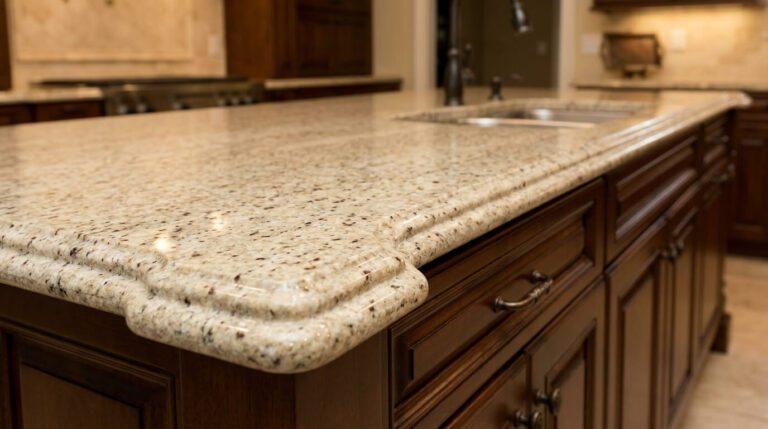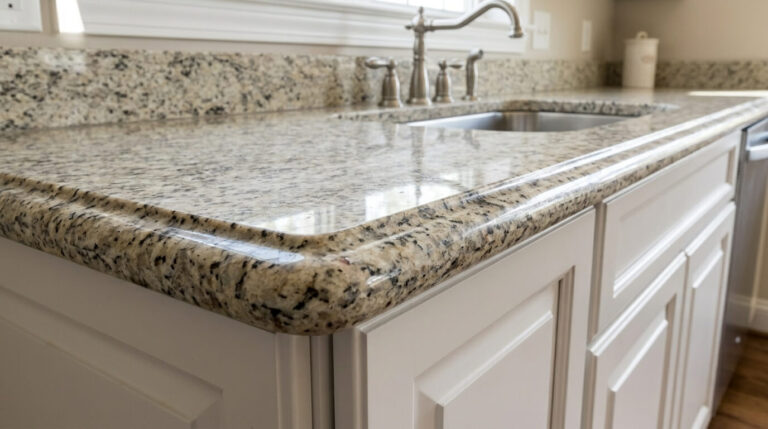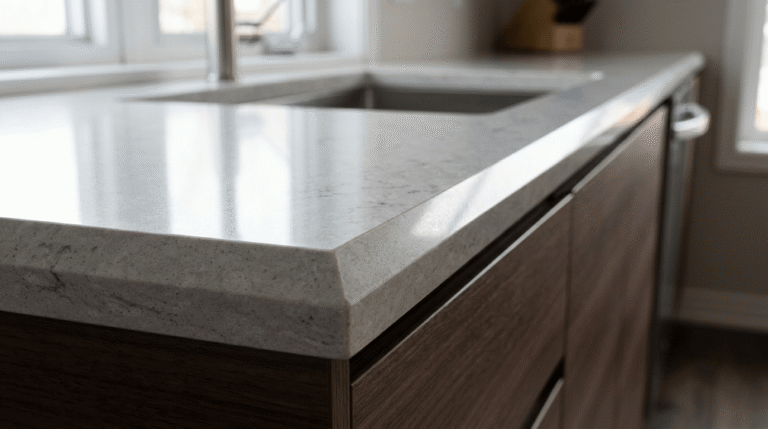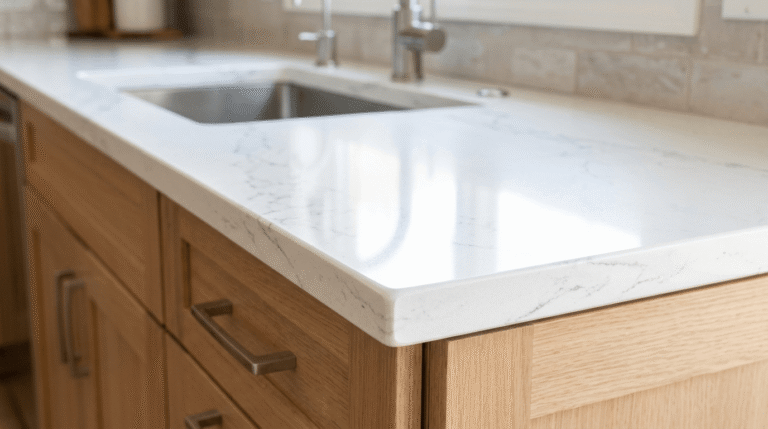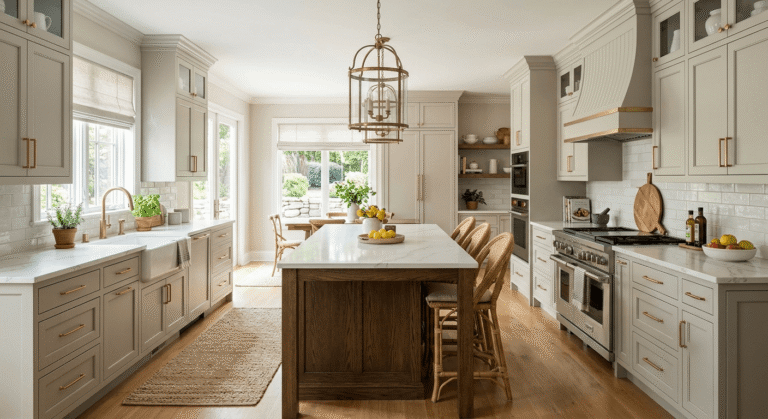
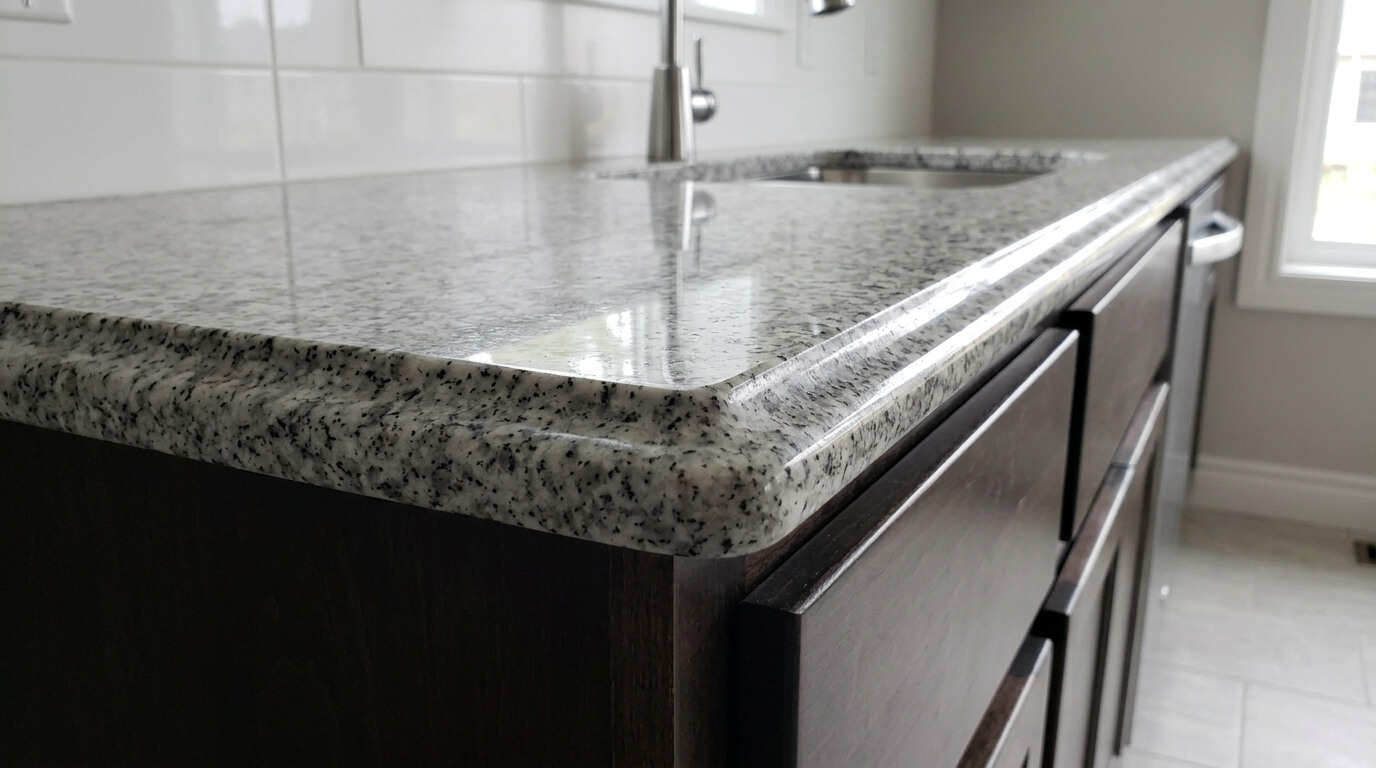
A double radius countertop edge is a rounded edge profile with two curved arcs stacked along the countertop’s vertical face. Fabricators use it on kitchen islands, bathroom vanities, and commercial counters where a soft, rounded appearance is required. The profile removes the sharp 90-degree corner found on a standard square edge and replaces it with two connected curves.
The double radius edge belongs to a broader category of rounded countertop profiles that includes the bullnose, half bullnose, and ogee. Each profile changes the countertop’s appearance, safety characteristics, and fabrication cost. Material choice affects how cleanly a fabricator can cut and polish the double radius shape, since dense, uniform materials hold a curved edge more consistently than porous or layered materials.
This article defines the double radius edge, compares it with related edge profiles, and identifies the materials best suited to the shape. It also covers typical cost ranges, the advantages and disadvantages of the profile, and the factors relevant to choosing an edge profile for a specific countertop project.
What Is a Double Radius Countertop Edge?
A double radius countertop edge is a profile that curves outward from the top surface, reaches a rounded midpoint, and curves back inward toward the bottom surface. The edge forms two connected arcs rather than a single continuous curve. This distinguishes it from a full bullnose, which uses one uniform radius across the entire edge thickness.
The profile requires two separate radius cuts, one for the upper arc and one for the lower arc, joined at a visible or near-visible midline. Fabricators produce the double radius edge using an edge-profiling router or a CNC edge-polishing machine set to the specified radius dimensions for each arc. The resulting edge has no flat vertical section and no sharp corner along its length.
Countertop fabricators apply the double radius edge to islands, vanities, bar tops, and dining counters where users and passersby contact the edge directly. The rounded double-arc shape reduces the risk of impact injury compared with a square or eased edge.
Common Terms for the Same Profile
The double radius edge is also called the “double bullnose” edge in some fabrication catalogs, though the two terms describe slightly different curve ratios. Industry suppliers also list the profile as “full bullnose double” or “dual radius” edge, depending on the manufacturer’s naming convention.
These alternate terms refer to the same two-arc curved structure but may vary in the radius measurement used for the upper and lower curves. A fabricator’s sample catalog remains the most reliable source for confirming which radius dimensions a specific supplier assigns to each name. Buyers who reference a specific term when requesting a quote reduce the risk of receiving a different curve ratio than intended.
Double Radius Edge vs. Other Countertop Edge Profiles
A double radius edge differs from other rounded and angled profiles in curve count, corner treatment, and light reflection. The double radius edge uses two stacked arcs, while related profiles use a single arc, an angled cut, or a minimal chamfer. These structural differences affect the edge’s appearance, cost, and suitability for specific countertop uses.
Double Radius vs. Double Bullnose Edge
A double radius edge and a double bullnose edge share a similar two-arc structure but differ in how symmetrically the arcs are proportioned. The double bullnose edge typically uses two equal, fully rounded arcs that meet at a centered midline, producing a symmetrical, pill-shaped profile. The double radius edge allows the upper and lower arcs to use different radius measurements, producing a less symmetrical curve.
Fabricators sometimes use the two names interchangeably because the visual difference between a symmetrical and a slightly asymmetrical double-arc edge is minor at close range. Buyers who require an exact match to an existing countertop or cabinet detail should request the specific radius measurements rather than relying on the profile name alone.
Double Radius vs. Double Ogee Edge
A double radius edge uses two convex arcs, while a double ogee edge combines a concave curve with a convex curve in an S-shaped profile. The double ogee edge produces a more decorative, traditional appearance with a raised lip section near the top of the edge. The double radius edge produces a smoother, more contemporary appearance without a raised lip.
The double ogee edge requires additional routing passes to cut both the concave and convex sections, which increases fabrication time compared with the double radius edge. The double radius edge fits contemporary and transitional kitchen designs, while the double ogee edge fits traditional and formal designs.
Double Radius vs. Eased Edge
A double radius edge is fully rounded along both the top and bottom of the countertop thickness, while an eased edge is a nearly flat, square edge with only the sharp corners lightly softened. The eased edge retains a visible flat vertical face between the two softened corners. The double radius edge has no flat vertical face.
The eased edge requires minimal fabrication time and represents the standard edge included with most countertop installations at no additional cost. The double radius edge requires additional shaping time and typically adds a per-linear-foot upcharge. Buyers who prioritize a rounded, contact-safe edge at minimal cost typically select a single bullnose or half bullnose instead of a double radius edge, reserving the double radius profile for projects where the fuller, two-arc appearance is a design requirement.
Best Materials for a Double Radius Edge
Dense, uniform materials produce the cleanest double radius edge because the profile requires two precise, connected curves without chipping or inconsistent polish. Engineered stone and hard natural stone hold the double radius shape most reliably, while layered or highly porous materials require additional finishing steps to achieve a consistent curve.
Granite and Quartz
Granite and quartz produce a clean, durable double radius edge because both materials have high density and low porosity, which allows the profiling tool to cut a smooth, consistent curve without fracturing the stone. Granite’s natural crystalline structure resists chipping during the two-arc cutting process, and quartz’s engineered composition provides uniform hardness across the entire slab.
Both materials accept a polished finish on the curved surface, which highlights the double radius shape and matches the polished finish typically applied to the countertop’s top surface. Granite and quartz remain the most commonly selected materials for the double radius edge in kitchen and bathroom applications.
Marble and Natural Stone
Marble and other natural stones such as soapstone and travertine can accept a double radius edge, though their lower hardness and higher porosity relative to granite and quartz increase the risk of chipping during the profiling process. Marble’s calcite composition is softer than granite’s quartz-based composition, which requires fabricators to use slower cutting speeds to prevent edge fractures.
Natural stones with visible veining or layering, such as certain travertine and slate varieties, can show inconsistent color or texture along a curved edge because the profiling cut exposes internal mineral layers at different angles. Buyers selecting marble or a similarly veined stone for a double radius edge should request a physical edge sample before fabrication to confirm the finished appearance.
Laminate and Solid Surface
Laminate countertops cannot support a true double radius edge because the material consists of a thin decorative layer bonded to a particleboard or MDF substrate, and cutting a curved profile through the layered structure exposes the substrate along the edge. Solid surface material, in contrast, has a uniform composition throughout its thickness and accepts a double radius edge without exposing a different substrate layer.
Solid surface fabricators can also thermoform or seam the material to build up edge thickness before profiling, which allows a more pronounced double radius curve than the sheet’s original thickness would otherwise support. Laminate installations that require a rounded edge typically use a pre-manufactured bullnose laminate edge strip rather than a true double radius profile.
Cost of a Double Radius Countertop Edge
A double radius countertop edge typically costs an additional $10 to $40 per linear foot above the base countertop material and installation price, depending on the material, the fabricator’s regional labor rates, and the complexity of the specific radius dimensions requested. This upcharge applies specifically to the edge profiling step and does not include the cost of the countertop slab or standard installation.
Engineered quartz and granite typically fall at the lower to middle portion of this range because their consistent hardness allows faster, more predictable machine profiling. Natural stones that require slower cutting speeds, such as marble, and custom or non-standard radius measurements typically fall at the higher portion of the range due to increased labor time and a higher risk of material waste.
Fabricators calculate the double radius edge cost per linear foot of exposed edge, so an island countertop with edge exposure on all four sides costs more for the edge profile than a countertop installed against a wall with only one or two exposed edges. Buyers should request an itemized quote that separates the material cost, standard fabrication cost, and edge profile upcharge to compare pricing accurately across fabricators.
Pros and Cons of a Double Radius Edge
A double radius edge provides a rounded, contact-safe surface and a distinct two-arc appearance, while requiring additional fabrication cost and time compared with simpler edge profiles. The profile suits high-traffic areas such as kitchen islands and bar tops where users frequently lean against or brush past the countertop edge.
The rounded double-arc shape removes the sharp corner associated with square and eased edges, which reduces the risk of impact injury for children and passersby. The profile also reflects light along its curved surface, which can create a more prominent visual line than a single-radius bullnose edge. This visual prominence benefits countertops where the edge detail functions as a design feature.
The double radius edge requires more fabrication time than a standard square or eased edge because the profiling tool must cut and polish two separate arcs rather than one flat or single-curved surface. This additional labor increases the total project cost. The two-arc structure can also be more difficult to match exactly across separate slab pieces on a large countertop, which can produce a visible inconsistency at seams if the fabricator does not calibrate each cut to the same radius specifications.
How to Choose the Right Countertop Edge Profile
Choose a countertop edge profile by evaluating the intended use of the countertop, the surrounding cabinet and trim style, the selected material’s hardness and porosity, and the project budget. A countertop edge used in a high-traffic area with young children present benefits from a fully rounded profile such as the double radius or bullnose edge, while a countertop in a low-traffic formal space can accommodate a more angular profile such as an ogee or beveled edge without the same safety consideration.
Match the edge profile to the surrounding design elements, since a double radius edge suits contemporary and transitional cabinetry, while a double ogee edge suits traditional or formal cabinetry with detailed trim work. Confirm that the selected material supports the chosen profile, since dense materials such as granite and quartz accommodate a double radius edge more reliably than porous or layered materials such as certain marble varieties or laminate.
Request a physical edge sample from the fabricator before finalizing the profile, since a sample shows the exact curve proportions, polish quality, and light reflection that a written profile name or a small catalog image cannot fully convey. Compare itemized quotes across the material cost, base fabrication cost, and edge profile upcharge to determine the total cost impact of the selected profile before approving the final countertop order.