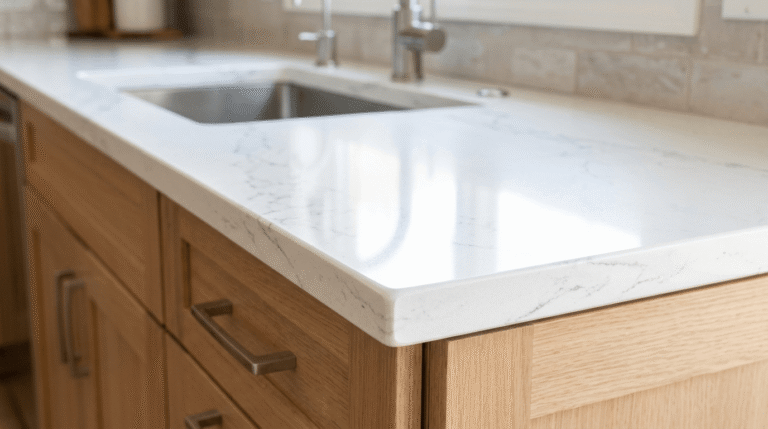
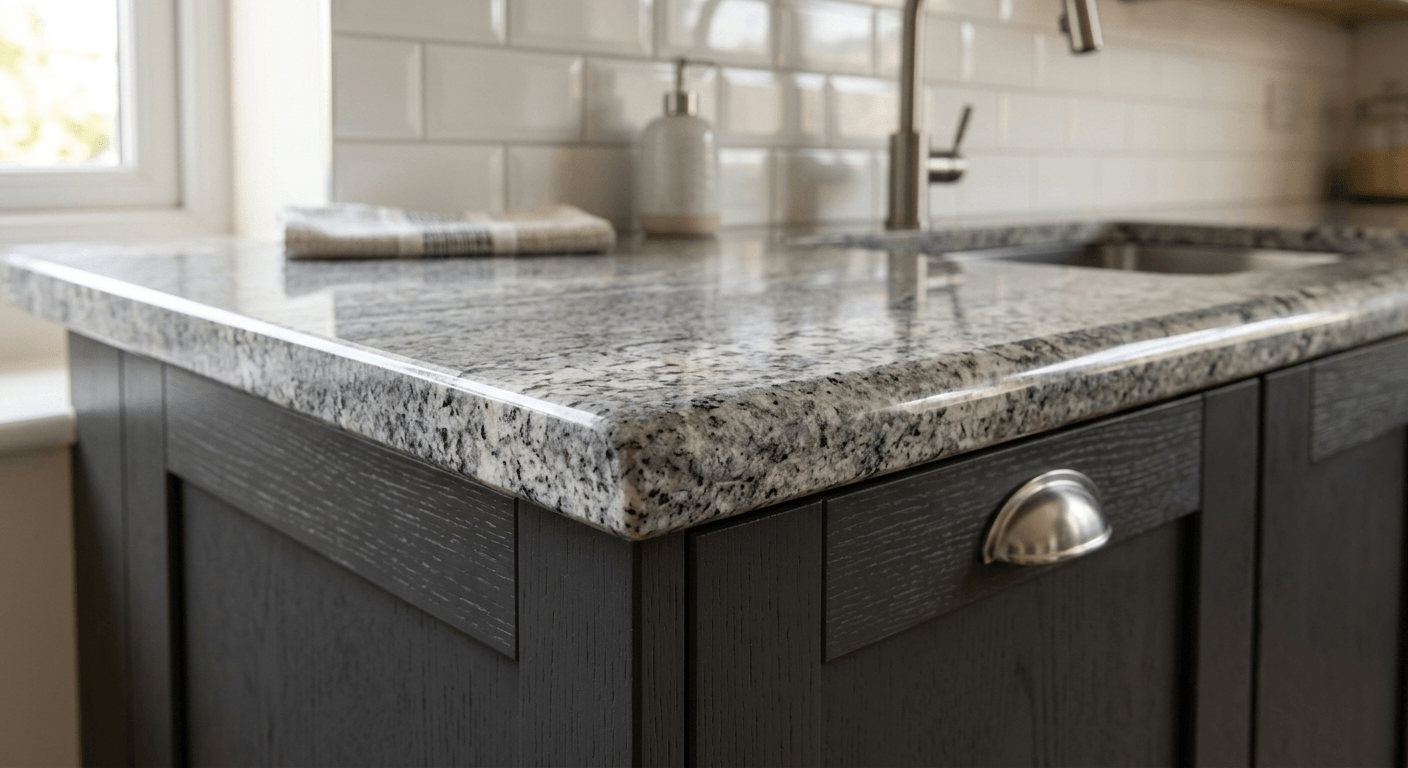
A countertop edge profile is the shaped border along the visible perimeter of a countertop slab. The profile determines the countertop’s silhouette, safety characteristics, cleaning requirements, and overall fabrication cost. Kitchen countertops use edge profiles on every exposed side, including the front edge, island edges, and any peninsula or bar overhang.
Edge profiles fall into several groups based on shape and complexity. Simple profiles, such as the eased edge, require minimal shaping and suit contemporary kitchens. Decorative profiles, such as the ogee or bullnose, require additional fabrication steps and suit traditional or transitional kitchens. Specialty profiles, such as the waterfall or mitered edge, serve functional or structural purposes beyond appearance.
This guide explains each major edge profile, how edge selection interacts with countertop material, how edge style affects cost and fabrication, common problems that occur with countertop edges, and the criteria for selecting an edge style for a specific kitchen.
What Is a Countertop Edge Profile?
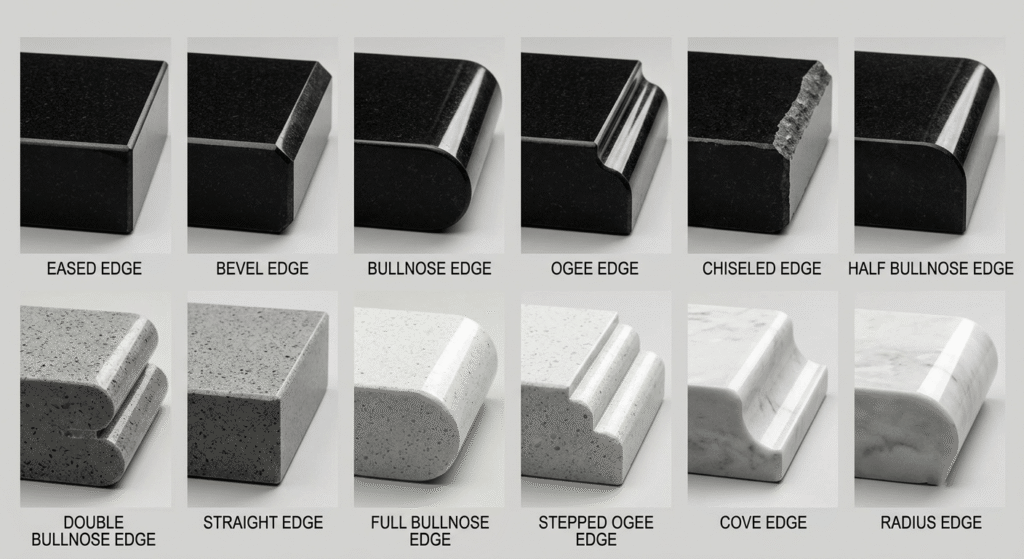
A countertop edge profile is the shaped finish applied to the exposed vertical face of a countertop slab. The profile defines the cross-sectional shape of the edge, ranging from a flat, squared finish to a curved, layered, or angled finish.
Fabricators cut and shape the edge profile using diamond blades, router bits, or CNC (computer numerical control) machines, depending on the material and the complexity of the chosen profile. The profile affects three practical elements of a countertop: the tactile feel of the edge, the visual weight of the slab, and the surface area exposed to impact and moisture. A countertop edge profile applies to any exposed edge, including front edges, end edges, and edges around cutouts for sinks or cooktops.
Types of Countertop Edge Styles
Countertop edge styles fall into ten primary categories, distinguished by their cross-sectional shape and the number of fabrication steps required to produce them. Each category includes one or more edge names that share the same general profile shape.
The following list identifies each primary edge style before its individual explanation:
- Eased edge
- Bullnose edge (full, half, and demi bullnose)
- Bevel edge
- Ogee edge
- Mitered edge and Dupont edge
- Radius, round, and quarter-round edges (including corner radius)
- Pencil edge
- Cove edge
- Chiseled and rough-cut edge
- Specialty and functional edges (waterfall, knife, shark nose, no-drip)
Each profile differs in shape, fabrication complexity, and typical application, as detailed in the sections below.
Eased Edge
An eased edge is a squared countertop edge with slightly softened, rounded corners along the top and bottom edges. The softened corners remove the sharp 90-degree line that a plain square edge would otherwise produce.
Fabricators create an eased edge by lightly sanding or routing the top and bottom corners of a square-cut slab, typically to a radius of 1.6 millimetres (1/16 inch). The eased edge requires the least fabrication time among common profiles, which keeps its cost lower than curved or layered alternatives. The profile suits contemporary and minimalist kitchens because its flat vertical face maintains a clean, linear appearance. An eased edge remains a standard default option across most fabricators and most countertop materials.
Bullnose Edge (Full, Half, and Demi Bullnose)
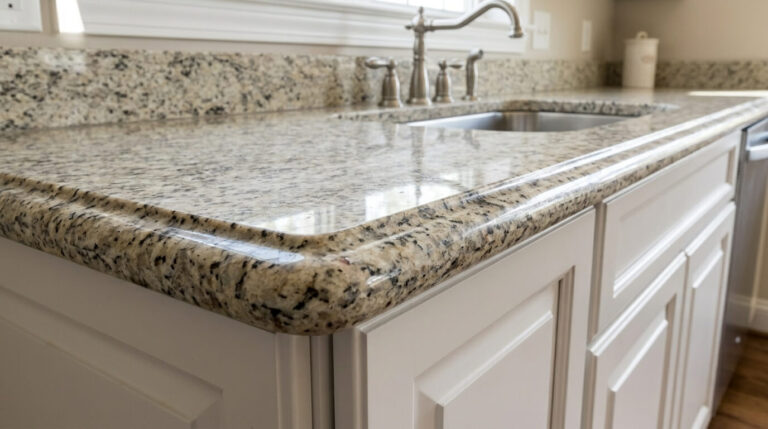
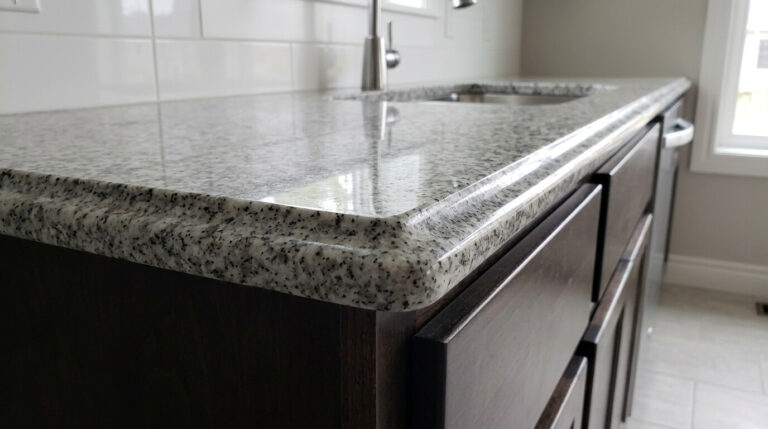
A bullnose edge is a fully or partially rounded edge profile that eliminates all sharp corners along the countertop’s face. The profile appears in three variations that differ by the degree of curvature applied to the edge.
A full bullnose rounds the entire edge into a single continuous half-circle, removing both the top and bottom corners completely. A half bullnose rounds only the top corner while keeping the bottom edge flat or squared. A demi bullnose applies a partial curve that rounds the corner without extending the curve into a full half-circle. The bullnose profile removes sharp edges entirely, which reduces the risk of impact injury in households with young children. Fabrication requires additional shaping time compared with an eased edge because the rounded profile must be ground and polished across the entire curved surface.
Bevel Edge
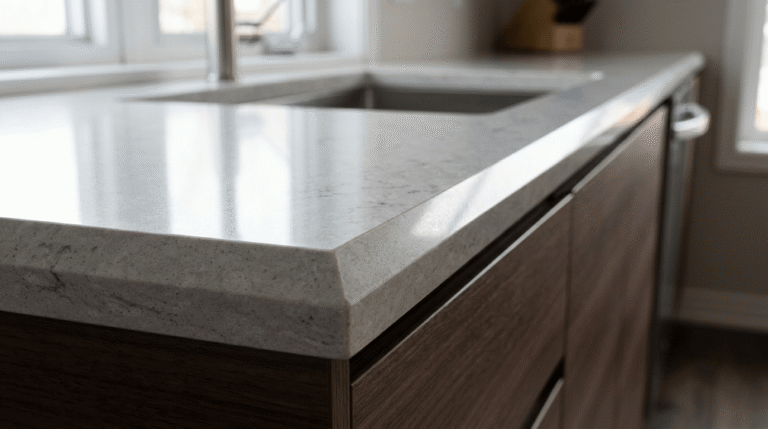
A bevel edge is an angled edge profile cut at a consistent angle, most commonly 45 degrees, between the top surface and the vertical face of the countertop. The angled cut removes the top corner in a straight diagonal line rather than a curve.
The bevel edge produces a faceted, geometric appearance that suits modern and industrial kitchen designs. Fabricators can adjust the bevel angle and the width of the angled cut, which allows for a subtle bevel or a more pronounced, wide-faceted bevel. A bevel edge requires precise angle-cutting equipment, and the angled surface catches light differently than a flat or curved edge, which creates a visible line where the bevel meets the top surface.
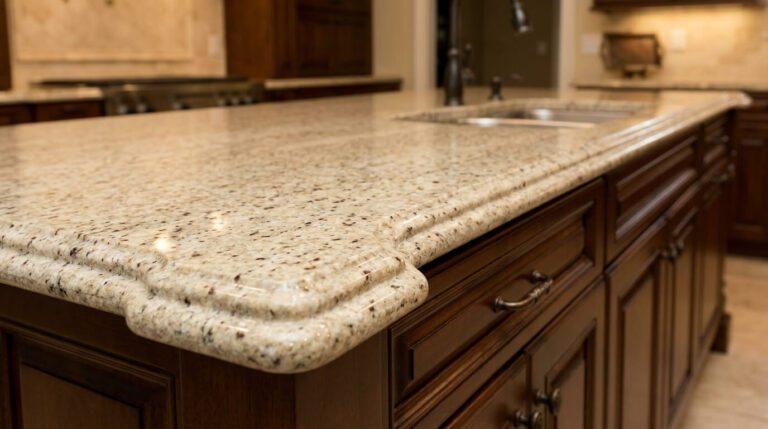
Ogee Edge
An ogee edge is a decorative, S-shaped profile that combines a concave curve and a convex curve along the edge of the countertop. The double curve creates a raised lip along the top of the edge before curving inward and outward toward the bottom.
Fabricators produce an ogee edge using a specialized router bit or CNC profile designed to cut the compound curve in a single pass or multiple passes, depending on the equipment. The ogee edge suits traditional, classic, and ornate kitchen designs, particularly those with raised-panel cabinetry or detailed millwork. The profile requires more fabrication time than an eased, bullnose, or bevel edge because of its compound curvature, which increases labor cost relative to simpler profiles.
Mitered Edge and Dupont Edge
A mitered edge is a countertop edge built by joining two pieces of material at a 45-degree angle to create the visual appearance of a single, thick slab. A Dupont edge is a specific mitered configuration that combines a thickened, mitered front edge with a bullnose or eased top profile.
Fabricators cut two matching 45-degree angles on separate slab pieces, then bond them together with adhesive along the seam, which is typically finished flush and color-matched so the joint remains difficult to detect. The mitered edge allows a standard 20-millimetre (3/4-inch) or 30-millimetre (1 1/4-inch) slab to appear as a 40- to 60-millimetre-thick countertop without the material cost of a solid thick slab. A Dupont edge adds a rounded or eased profile to the visible top corner of the mitered build-up, combining the thickened appearance with a softened edge line. Both configurations require precise cutting and bonding, which increases fabrication time and labor cost compared with a single-piece edge.
Radius, Round, and Quarter-Round Edges (Including Corner Radius)
A radius edge is a curved edge profile cut to a specific, measurable curve radius along the length or corner of the countertop. A quarter-round edge applies a curve equal to one-quarter of a full circle, typically along the top corner of the slab.
Fabricators specify the radius edge by radius measurement, commonly ranging from 3 millimetres for a subtle curve to 20 millimetres or more for a pronounced curve. Corner radius refers specifically to the curvature applied at the outside corners of a countertop, such as the front corners of an island, where a rounded corner reduces the risk of impact injury compared with a sharp 90-degree corner. Fabricators frequently combine a radius edge along the front face with a matching corner radius at each outside corner to maintain a consistent curved appearance around the entire perimeter.
Pencil Edge
A pencil edge is a narrow, uniformly rounded edge profile that produces a thin, consistent curve resembling the rounded tip of a pencil. The profile maintains a slim vertical face rather than the wider curve found on a full bullnose.
Fabricators shape the pencil edge to a small, even radius across the full height of the slab edge, which preserves the visual thickness of the slab while removing sharp corners. The pencil edge suits kitchens that require a rounded profile without the heavier, more rounded appearance of a bullnose edge. The narrow curve also reduces the visible shadow line that a flat eased edge produces under certain lighting conditions.
Cove Edge
A cove edge is a concave edge profile that curves inward along the top of the countertop before meeting the vertical face. The inward curve creates a recessed groove line near the top surface.
Fabricators cut the cove profile using a router bit shaped to produce the inward curve, which requires controlled depth and consistent pressure to maintain a uniform groove along the full length of the edge. The cove edge appears in traditional and transitional kitchen designs, often paired with furniture-style cabinetry. The concave shape can collect dust or debris along the groove line, which increases the cleaning attention the edge requires compared with a flat or convex profile.
Chiseled and Rough-Cut Edge
A chiseled edge, also called a rough-cut edge, is an irregular, hand-finished edge profile that leaves the natural fracture texture of the stone visible along the countertop’s face. The profile intentionally avoids a smooth, machined finish.
Fabricators produce a chiseled edge by manually breaking or splitting the material along the edge using a hammer and chisel, rather than cutting the edge with a saw or router. The technique works only with natural stone materials, such as granite or certain limestone varieties, because the material must fracture along natural grain lines to produce the rough texture. The chiseled edge suits rustic, farmhouse, and natural-stone-forward kitchen designs. The irregular surface creates more texture for dust and liquid to collect in, which requires more thorough cleaning than a polished, smooth profile.
Specialty and Functional Edges (Waterfall, Knife, Shark Nose, No-Drip)
A specialty or functional edge is an edge profile designed primarily to serve a structural or practical purpose rather than a decorative one. This category includes the waterfall edge, knife edge, shark nose edge, and no-drip edge.
A waterfall edge extends the countertop material vertically down the side of a cabinet or island to the floor, creating a continuous, uninterrupted surface without a visible seam at the corner. A knife edge is a thin, tapered profile cut to a minimal thickness at the outer face, which creates the visual impression of an extremely thin countertop. A shark nose edge combines a slight downward taper with a rounded underside, producing a low-profile, ergonomic edge for surfaces where users lean or rest their forearms. A no-drip edge includes a small groove or lip cut along the underside of the front edge, which redirects liquid drips downward instead of allowing them to run beneath the countertop and onto cabinetry. Each of these profiles requires specialized fabrication techniques, and material choice affects which specialty edges a fabricator can produce reliably.
Countertop Edge Options by Material
Countertop material determines which edge profiles a fabricator can produce and how well a given profile performs over time. Material composition affects hardness, brittleness, and porosity, which together influence the structural feasibility of a curved, angled, or built-up edge on that specific material.
Quartz Countertop Edges
Quartz countertops support nearly every edge profile because the engineered material has a consistent composition and uniform hardness throughout the slab. This consistency allows fabricators to cut eased, bullnose, bevel, ogee, mitered, and radius edges with predictable results.
Quartz’s engineered composition, made from crushed quartz minerals bound with polymer resin, resists chipping during the cutting and polishing process better than some natural stones. This resistance allows fabricators to produce detailed profiles, such as the ogee or Dupont edge, with fewer material failures during fabrication. Quartz does not support a chiseled or rough-cut edge, because the material’s engineered structure does not fracture along natural grain lines the way natural stone does.
Granite Countertop Edges
Granite countertops support most standard edge profiles, including eased, bullnose, bevel, ogee, and mitered edges, because the stone’s natural hardness allows for clean, precise cuts. Granite also supports the chiseled or rough-cut edge, which is not available on engineered materials.
Granite’s mineral composition varies by quarry source, which means hardness and grain structure differ between granite varieties and affect how cleanly a given slab accepts a detailed profile. Some granite varieties contain natural fissures or softer mineral veining that can chip during the fabrication of a compound-curve profile, such as an ogee edge, which requires a fabricator to inspect the slab before committing to a complex edge design. Granite’s durability makes it a common choice for radius and bullnose edges on kitchen islands, where rounded corners reduce impact risk.
Marble Countertop Edges
Marble countertops support most edge profiles, including eased, bullnose, ogee, and bevel edges, though marble’s comparative softness requires additional care during fabrication. Marble does not perform as well with heavy chiseled or rough-cut edges as granite does, because marble fractures less predictably along uneven lines.
Marble’s calcium carbonate composition makes it softer and more prone to chipping at thin, sharp corners than granite or quartz. This characteristic makes rounded profiles, such as the bullnose or pencil edge, a practical choice for marble because rounded edges eliminate the thin, vulnerable corners that a sharp eased or squared edge would expose. Ogee and other decorative profiles remain common on marble countertops used in traditional kitchen designs, since marble’s classic appearance pairs with detailed edge shaping.
Laminate Countertop Edges
Laminate countertops support a limited range of edge profiles compared with stone or quartz, because the material consists of a thin decorative layer bonded to a particleboard or medium-density fiberboard (MDF) substrate. Standard laminate edge options include a square eased edge, a bullnose edge, and a beveled edge.
The substrate beneath the laminate surface limits the depth and complexity of any curved or built-up profile, since the core material does not carry the same structural properties as solid stone or engineered quartz. Fabricators apply a matching or contrasting edge banding strip to cover the exposed substrate along the profile, which requires the edge design to accommodate a visible seam between the top laminate layer and the edge banding. Laminate does not support a waterfall, mitered Dupont, or chiseled edge, because the substrate cannot replicate the solid, continuous appearance those profiles require.
Quartzite and Porcelain Countertop Edges
Quartzite countertops support most profiles available to granite, including eased, bullnose, bevel, and radius edges, because quartzite’s natural hardness resists chipping during fabrication. Porcelain countertops support a narrower range of profiles, typically limited to eased, mitered, and beveled edges, because porcelain slabs are manufactured in thin sheets.
Quartzite is a natural metamorphic stone with a hardness that exceeds granite in most varieties, which allows for detailed edge work similar to granite fabrication. Porcelain slabs are manufactured at a standard thickness of 6 to 12 millimetres, which is thinner than typical granite or quartz slabs, so fabricators commonly use a mitered edge to build up the visible thickness of a porcelain countertop rather than shaping a thick, single-piece profile. This thinness also limits porcelain’s ability to support a full bullnose or deep ogee profile, since those shapes require more material depth than a thin porcelain slab provides on its own.
How Edge Style Affects Cost, Thickness, and Fabrication
Edge style affects countertop cost through the number of fabrication steps, the equipment required, and the labor time needed to complete the profile. A simple eased edge requires the least fabrication time and therefore adds the lowest cost among common profiles, while compound-curve or built-up profiles, such as the ogee or Dupont edge, require more machine passes and hand-finishing time, which increases labor cost.
Edge style also affects the apparent thickness of a countertop independent of the slab’s actual thickness. A mitered or Dupont edge increases the visible thickness of the front edge without increasing the material cost of a full-thickness slab, because the technique bonds two pieces of standard-thickness material together only along the visible edge. A waterfall edge increases material cost more directly, since the profile requires an additional full panel of matching material to cover the side of the cabinet or island.
Fabrication method also depends on edge complexity. Fabricators cut simple profiles, such as the eased or bevel edge, using a straight router pass or a single blade setting. Compound profiles, such as the ogee or cove edge, require a shaped router bit matched to the exact curve, and some profiles require multiple passes at different depths to achieve the finished shape. Chiseled edges require manual hand-finishing rather than machine cutting, which extends fabrication time beyond any machine-cut profile. Fabrication time and equipment requirements directly influence the labor portion of the total edge cost, independent of the material selected for the slab itself.
Common Problems With Countertop Edges
Countertop edges develop several recurring problems related to impact damage, moisture exposure, and fabrication inconsistency. These problems vary by edge profile, material, and installation quality.
- Chipping: Sharp or squared edges chip more easily than rounded profiles when struck by cookware, dishes, or furniture, particularly on natural stone with pre-existing fissures.
- Seam visibility: Mitered and Dupont edges can develop a visible seam line if the fabricator does not match the color and grain pattern precisely during bonding.
- Water pooling: Cove and other concave profiles can trap water or debris along the recessed groove, which requires more frequent cleaning to prevent buildup.
- Uneven polishing: Compound-curve profiles, such as ogee or bullnose edges, can develop inconsistent shine or texture along the curve if the fabricator does not polish the entire profile evenly.
- Cracking at thin points: Knife edges and other thin, tapered profiles carry a higher risk of cracking under pressure because the reduced material thickness lowers the edge’s structural strength.
- Drip staining: Countertops without a no-drip groove allow liquid to run along the underside of the front edge and drip onto cabinetry, which can stain wood cabinets over time.
How to Choose the Right Countertop Edge Style for Your Kitchen
Choosing the right countertop edge style requires evaluating kitchen design style, household safety needs, countertop material, and budget together, since each factor narrows the range of practical edge options. A kitchen with young children benefits from a rounded profile, such as a bullnose or radius edge, which removes sharp corners along islands and peninsulas.
Design style affects which profile fits the surrounding cabinetry and hardware. Contemporary kitchens typically pair with eased, bevel, or pencil edges, since these profiles maintain clean, linear lines. Traditional and classic kitchens typically pair with ogee, full bullnose, or cove edges, since these profiles complement raised-panel cabinetry and detailed trim. Material selection also limits available options, since laminate and porcelain support fewer complex profiles than granite, marble, or quartz.
Budget affects the decision because profile complexity adds labor cost independent of the material cost. A kitchen renovation with a fixed budget benefits from selecting a simpler profile, such as an eased or bevel edge, to reserve budget for material selection or other renovation costs. A kitchen with more fabrication budget can accommodate a mitered, Dupont, or ogee edge without reducing the material budget for the slab itself.
Countertop Edge Styles FAQ
What is the most common countertop edge style?
The eased edge is the most common countertop edge style because it requires the least fabrication time and suits the widest range of kitchen designs.
Which countertop edge is safest for kids?
A full bullnose or radius edge is the safest countertop edge for households with young children because the rounded profile removes all sharp corners along the countertop’s face and at outside corners.
What is the difference between a bullnose edge and a bevel edge?
A bullnose edge uses a rounded, curved profile, while a bevel edge uses a straight, angled cut, typically at 45 degrees, between the top surface and the vertical face.
Does edge style affect countertop price?
Edge style affects countertop price because more complex profiles require additional fabrication steps, specialized equipment, and longer labor time compared with a simple eased or squared edge.
Can any countertop material support a waterfall edge?
Not every countertop material supports a waterfall edge; quartz, granite, marble, and quartzite support the profile reliably, while laminate does not support a waterfall edge because the substrate cannot replicate a continuous, seamless panel.
What edge style suits a traditional kitchen?
An ogee, full bullnose, or cove edge suits a traditional kitchen because these profiles include decorative curves that complement raised-panel cabinetry and classic design details.