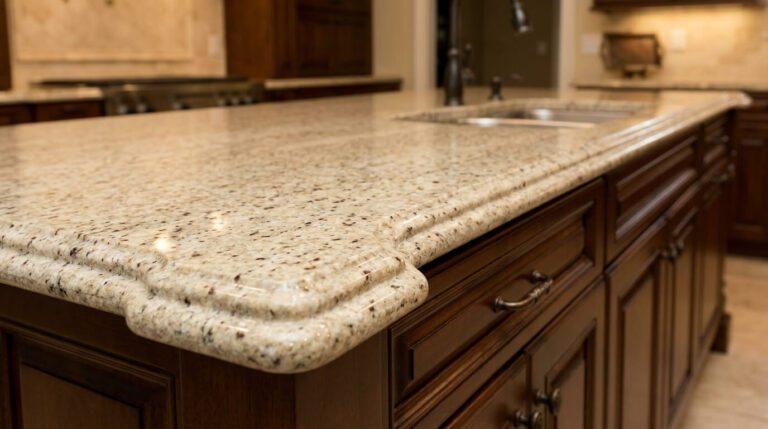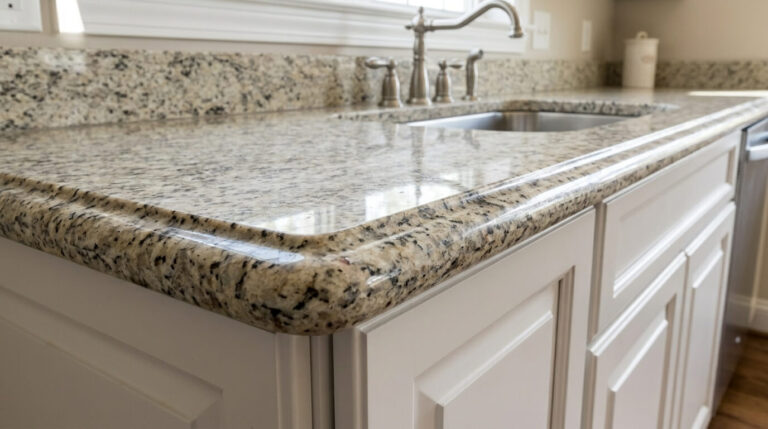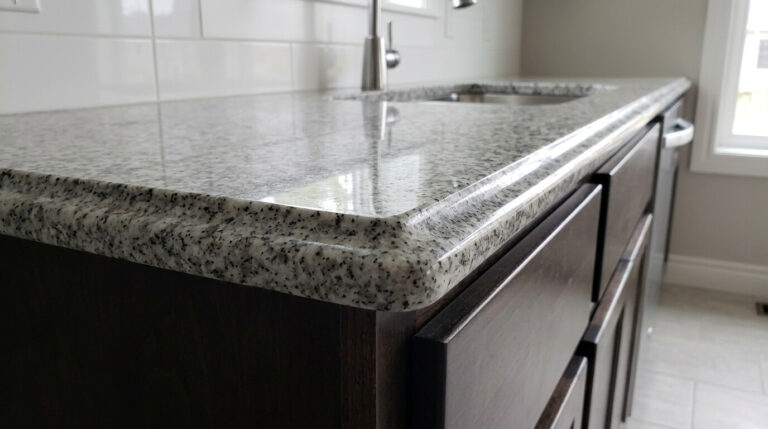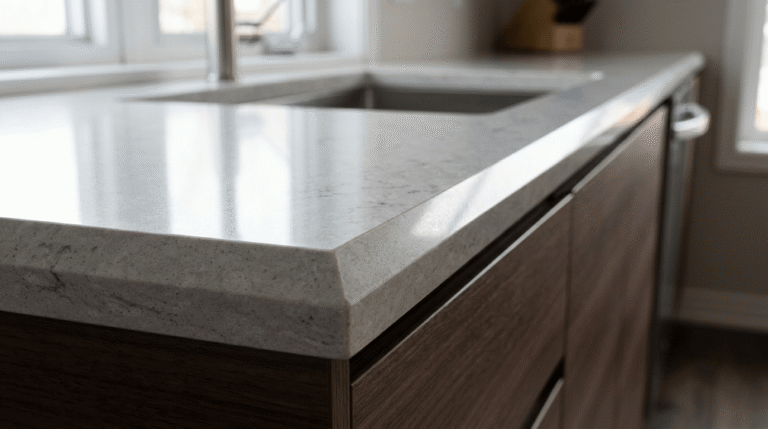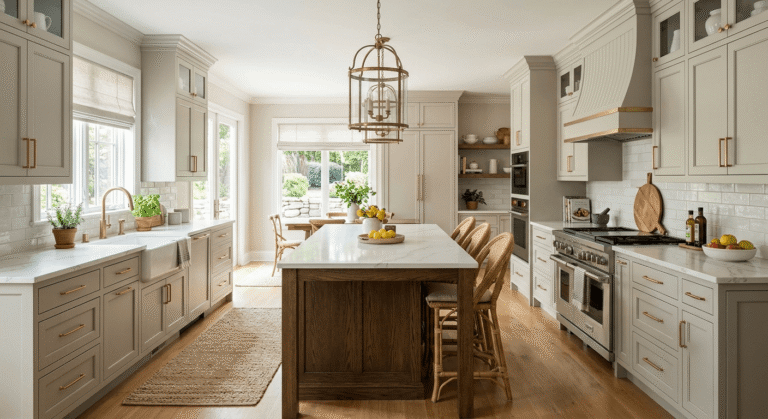
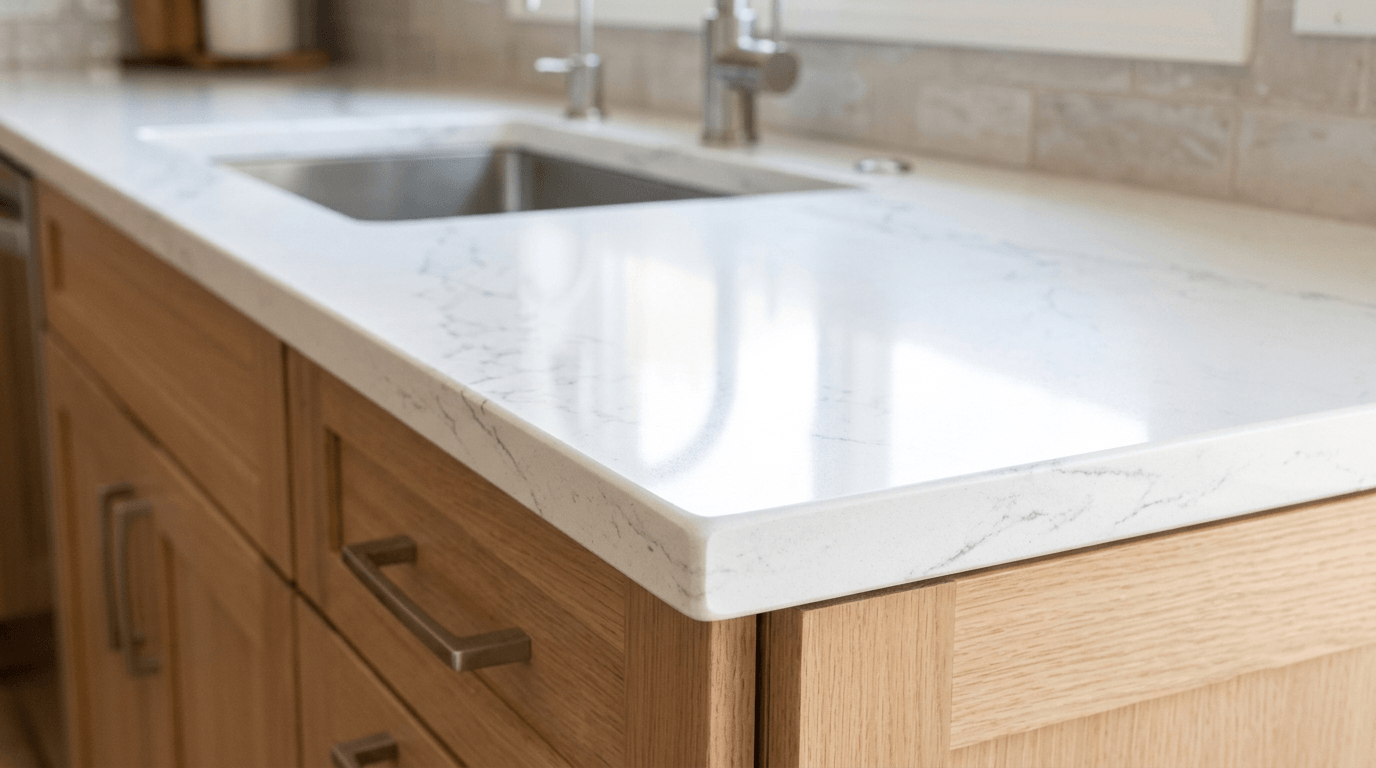
An eased edge countertop is a work surface finished with a slightly rounded transition between the top and side faces rather than a sharp, 90-degree corner. The edge profile removes the raw, angular feel of a freshly cut slab while keeping the overall shape close to a straight, rectangular line. Fabricators apply the eased edge to natural stone, engineered stone, and porcelain surfaces during the final finishing stage of countertop production.
The eased edge is one of the most widely used edge profiles in residential kitchens and bathrooms because it balances a clean, modern appearance with practical safety and cost benefits. Unlike decorative profiles such as bullnose, ogee, or waterfall edges, the eased edge requires minimal additional shaping, which keeps fabrication time and material waste low.
This guide explains what an eased edge is, how it compares with a sharp square edge, its standard dimensions, and how it performs on granite, quartz, and porcelain surfaces. It also compares the eased edge with other common edge profiles and outlines the factors that affect edge selection for a specific space.
What Is an Eased Edge?
An eased edge is a countertop edge profile in which the top corner of the slab is lightly rounded or chamfered to remove its sharp point, while the edge remains visually straight and flat. The rounding typically extends only a small distance from the top corner, so the edge retains the appearance of a square profile from a normal viewing distance.
Fabricators create an eased edge by grinding and polishing the top corner of the slab with a router or hand tool fitted with a rounding bit. The process softens the corner without altering the overall thickness or the flat vertical face of the edge. An eased edge applies to the exposed perimeter of a countertop, including front edges, side returns, and cutout areas such as sink openings, when specified.
Eased Edge vs. a Sharp Square (Arrised) Edge
An eased edge differs from a sharp square edge in that the eased edge removes the sharp top corner through light rounding, while a square edge, also called an arrised edge, keeps a fully angular 90-degree corner. Both profiles maintain a flat, straight vertical face and a flat top surface, so the two edges look similar from a distance.
The practical difference appears at the point of contact. A square edge retains a crisp corner that can chip more easily and feels sharp to the touch. An eased edge softens that corner, which reduces the risk of chipping during daily use and lowers the chance of injury from accidental contact. Fabricators can produce a square edge with less finishing work, since it requires no additional rounding pass, while an eased edge requires one extra grinding step to shape the corner.
The Eased Edge Profile: Shape and Specifications
The eased edge profile consists of a narrow, rounded bevel along the top corner of the countertop, with the remainder of the edge left flat and vertical. The rounded section forms a small radius rather than a flat chamfer angle, which distinguishes the eased edge from a beveled edge that uses a straight angled cut.
The radius on an eased edge is applied only to the top corner in most residential installations, leaving the bottom corner of the edge either square or lightly eased to match. The visible edge thickness matches the slab thickness, commonly 2 centimeters or 3 centimeters for granite and quartz, since the eased profile does not require edge lamination to add apparent thickness.
Standard Eased Edge Size (Typically 1/8″)
The standard eased edge radius measures approximately 1/8 inch (3 millimeters) in most fabrication shops. This dimension represents the industry default when a project specification does not call for a custom radius size.
A 1/8-inch radius removes enough material to eliminate the sharp point of a square edge while preserving a mostly flat, linear appearance along the countertop perimeter. Fabricators can adjust the radius to a smaller or larger dimension on request, though sizes much beyond 1/4 inch begin to visually resemble a bullnose or half-bullnose profile rather than a true eased edge. The 1/8-inch standard applies consistently across granite, quartz, and porcelain fabrication, since the rounding process uses the same router and bit setup regardless of material.
Single vs. Double Eased Edge
A single eased edge rounds only the top corner of the countertop, leaving the bottom corner square, while a double eased edge rounds both the top and bottom corners of the same edge face. The single eased edge is the more common configuration in kitchen and bathroom installations because the top corner receives the most contact and visibility.
A double eased edge produces a more symmetrical, finished look along the exposed edge and slightly increases fabrication time, since the shop must grind and polish two corners instead of one. The double configuration suits countertops with an exposed underside, such as waterfall panels or islands viewed from multiple angles, where both the top and bottom corners remain visible to the user.
Eased Edge on Granite Countertops
An eased edge on a granite countertop softens the naturally sharp corner produced when granite slabs are cut and polished, while preserving the stone’s flat, straight profile. Granite fabricators commonly recommend the eased edge as a standard, no-additional-cost option because the material’s hardness allows a clean, consistent rounding without chipping during the grinding process.
Granite’s crystalline mineral structure, composed mainly of quartz, feldspar, and mica, produces a hard, dense edge that holds a polished eased profile well over time. The eased edge on granite resists chipping better than a square edge because the rounded corner removes the thin, vulnerable point that is most exposed to impact from cookware, dishes, or daily contact. Granite slabs finished with an eased edge typically match the polish level of the countertop’s top surface, producing a uniform sheen across the visible edge.
Eased Edge on Quartz Countertops
An eased edge on a quartz countertop rounds the top corner of the engineered slab using the same grinding and polishing process applied to natural stone, adjusted for quartz’s resin-based composition. Quartz countertops consist of crushed quartz minerals bound with polymer resin and pigment, which creates a denser and more uniform material than natural stone for edge shaping.
The polymer resin in quartz allows fabricators to produce a smooth, consistent eased radius with fewer surface irregularities than granite, since quartz lacks the natural veining and mineral variation found in stone. An eased edge on quartz maintains the surface’s color and pattern consistency along the visible edge, because quartz slabs are manufactured with uniform color distribution through the full slab thickness. Most quartz manufacturers list the eased edge as a standard fabrication option included in base slab pricing, without an added profile charge.
Eased Edge vs. Other Countertop Edge Profiles
The eased edge differs from other countertop edge profiles primarily in the shape and depth of the corner treatment applied to the slab. The following comparisons evaluate the eased edge against the pencil edge, mitered edge, and chiseled edge using corner shape, visual style, and typical application as the comparison criteria.
Eased Edge vs. Pencil Edge
An eased edge lightly rounds only the top corner of the countertop, while a pencil edge rounds the entire edge face into a uniform, fully curved profile resembling the rounded shape of a pencil. The pencil edge removes both the top and bottom corners in a single continuous curve, producing a softer, more rounded appearance than the eased edge’s narrow corner treatment.
The eased edge suits kitchens seeking a mostly flat, contemporary edge with a subtle safety softening, while the pencil edge suits spaces that call for a fully rounded, traditional appearance. Fabrication time for a pencil edge exceeds that of an eased edge because the full-face curve requires more material removal and a longer polishing pass.
Eased Edge vs. Mitered Edge
An eased edge finishes a single slab’s natural edge with a rounded corner, while a mitered edge joins two pieces of stone or quartz at a 45-degree angle to create the appearance of a thicker, solid edge. The mitered edge doubles the visible edge thickness by adhering a second strip of material beneath the front edge of the countertop, then finishing the seam to appear seamless.
The eased edge requires no additional material or seam work, keeping fabrication straightforward and cost-efficient. The mitered edge adds material cost and labor because it uses extra slab material and precise seam alignment, and it is typically selected to create a heavier, more substantial visual presence than a standard single-thickness eased edge can provide.
Eased Edge vs. Chiseled Edge
An eased edge produces a smooth, uniformly rounded corner, while a chiseled edge produces an irregular, hand-broken texture along the full edge face that mimics natural, quarried stone. The chiseled edge is created by manually fracturing the stone along the perimeter rather than grinding it to a consistent shape, resulting in a rustic, non-uniform surface.
The eased edge suits contemporary and transitional kitchen designs that call for clean, consistent lines, while the chiseled edge suits rustic, natural-stone-inspired designs where texture and irregularity are the desired visual effect. The chiseled edge is generally limited to natural stone, since engineered materials such as quartz do not fracture in the same irregular pattern as granite or marble.
How to Choose the Right Countertop Edge for Your Space
Choosing the right countertop edge depends on the kitchen or bathroom’s design style, the household’s safety needs, the countertop material, and the project budget. A contemporary or minimalist space generally suits a flat-profile edge such as the eased or square edge, while a traditional space suits a more decorative profile such as an ogee or bullnose.
Households with young children or frequent foot traffic near the countertop benefit from a rounded profile, such as an eased, pencil, or bullnose edge, because these profiles reduce the risk of injury from a sharp corner. The countertop material also affects edge selection, since engineered materials such as quartz support a wider range of profile shapes with consistent results, while natural stone profiles depend on the slab’s mineral composition and polish characteristics.
Budget plays a direct role in edge selection because standard profiles such as the square and eased edge typically carry no additional fabrication charge, while decorative profiles such as ogee, bullnose, or mitered edges add labor and material cost. A homeowner selecting an edge profile should weigh the visual style against the practical factors of safety, material compatibility, and cost before finalizing the choice.
Eased Edge on Porcelain Countertops
An eased edge on a porcelain countertop softens the top corner of the slab using a diamond-tipped grinding process suited to porcelain’s hardness and density. Porcelain countertops are manufactured from compressed clay, feldspar, and mineral pigments fired at high temperatures, producing a surface that is harder and less porous than natural stone.
Porcelain’s density requires specialized diamond tooling to achieve a clean eased radius without cracking the slab, since the material’s hardness exceeds that of granite and quartz. Because porcelain slabs are commonly manufactured in thinner formats, often 12 to 13 millimeters thick before lamination, fabricators frequently pair the eased edge with a laminated or mitered build-up to achieve a visually thicker finished edge while keeping the top corner rounded. The eased profile on porcelain maintains the material’s consistent color and pattern along the edge, since porcelain’s pigment runs through the full slab rather than sitting on the surface.