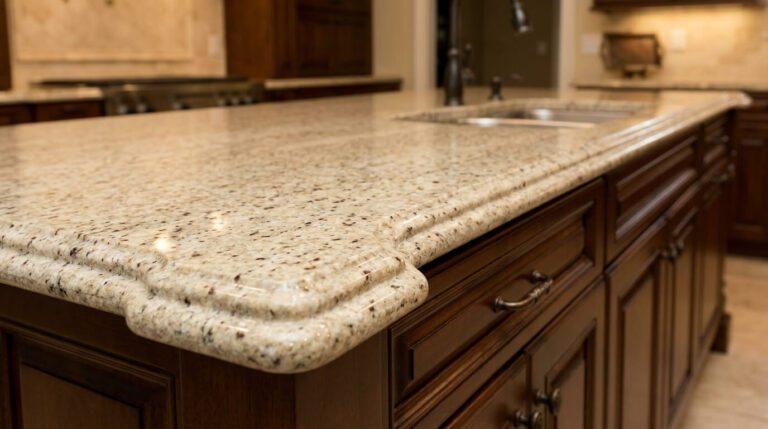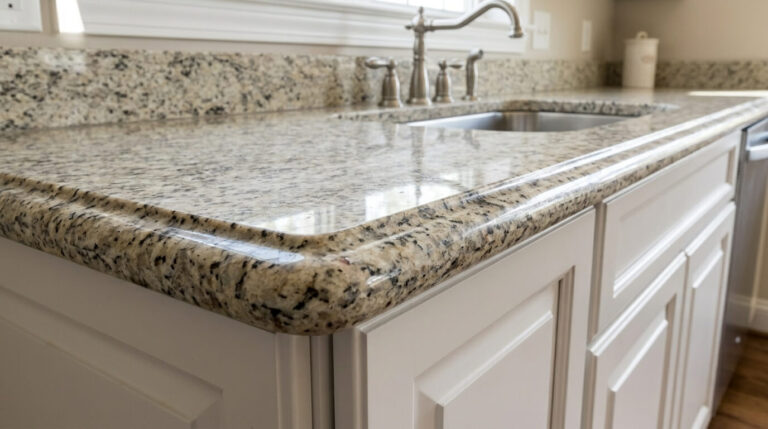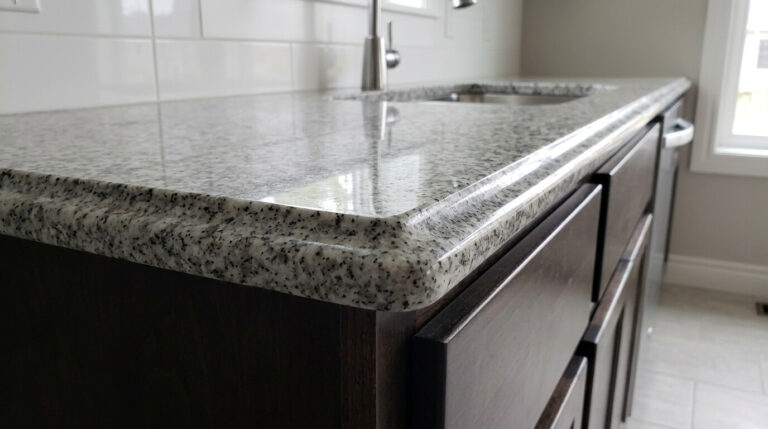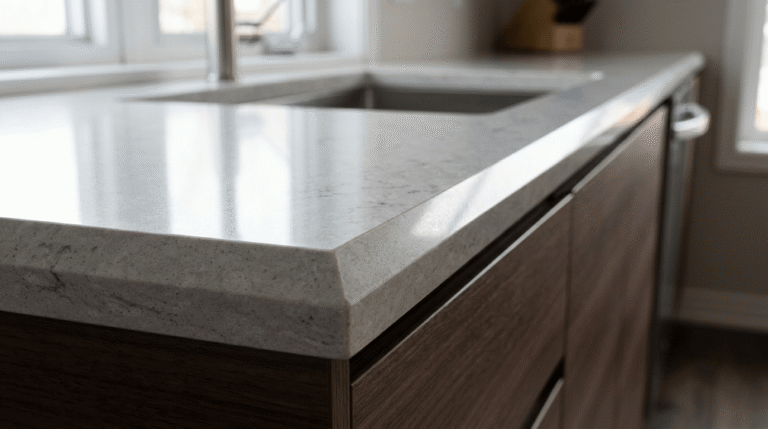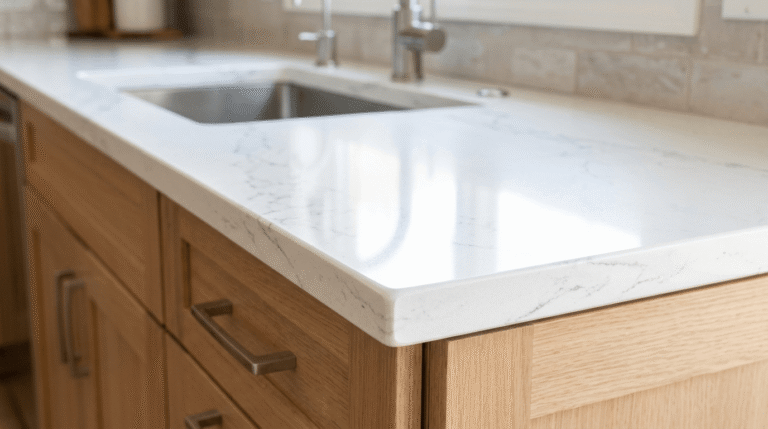
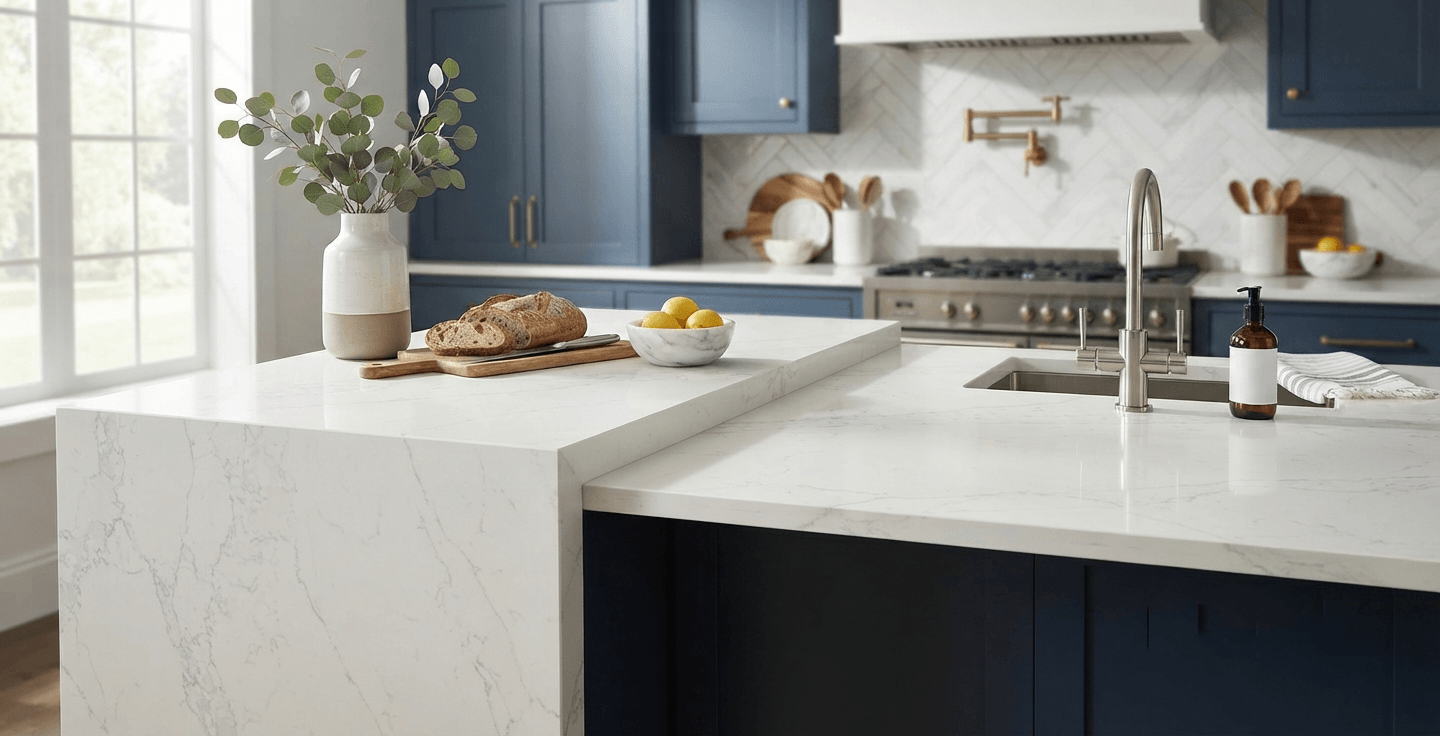
Kitchen countertop thickness ranges from 1.2 cm (0.47 in) to 6 cm (2.36 in), depending on the material, the cabinet support, and the intended edge design. Most kitchens use one of two standard stone thicknesses: 2 cm (¾ in) or 3 cm (1¼ in). Non-stone materials such as laminate, solid surface, wood, concrete, and porcelain follow separate thickness conventions specific to each category.
Thickness affects structural support, edge profile options, material cost, and overall appearance. This guide covers the standard thickness for each countertop material, the difference between 2 cm and 3 cm slabs, standard countertop depth and width, edge thickness and profiles, bathroom vanity thickness, and the factors that determine the right thickness for a specific kitchen.
What Is the Standard Thickness of a Kitchen Countertop?
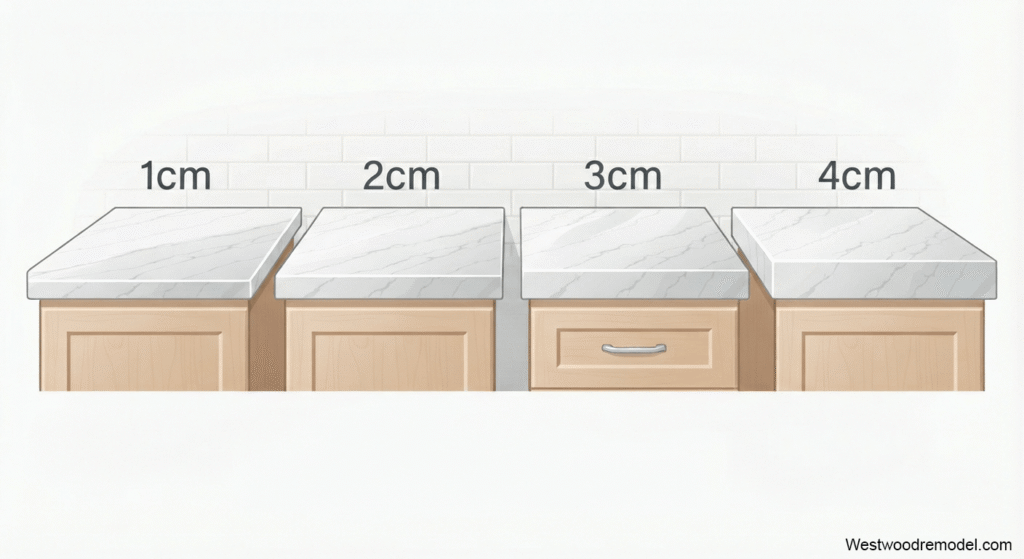
The standard thickness of a kitchen countertop is 3 cm (1¼ in), the most widely installed option in North American kitchens. A secondary standard of 2 cm (¾ in) remains common in Europe and in select residential applications where a slimmer profile is preferred.
A 3 cm slab rests directly on cabinets and a support frame without requiring a plywood underlayment, because its mass resists sagging and cracking under normal kitchen use. A 2 cm slab requires a plywood substrate beneath the stone to prevent flexing, particularly at unsupported overhangs. Stone and quartz fabricators cut both thicknesses from the same slab stock, so material availability rarely limits the choice between them. Thickness selection also depends on the specific material: engineered quartz and porcelain extend the available range down to 1.2 cm for accent and lightweight applications, while wood and concrete surfaces commonly exceed 3 cm because they rely on a solid, unlaminated mass for strength.
Kitchen Countertop Thickness by Material
Kitchen countertop materials fall into six categories by standard thickness: quartz, granite, laminate, marble, solid surface, and a group covering wood, concrete, and porcelain. Each material follows its own manufacturing and structural conventions, so the available thickness range differs by category even when two materials share a nominal size such as 2 cm or 3 cm.
Quartz Countertop Thickness
Quartz countertops come in three standard thicknesses: 1 cm (⅜ in), 2 cm (¾ in), and 3 cm (1¼ in). The 3 cm thickness is the U.S. standard for kitchen installations, chosen for its resistance to chipping and its substantial edge appearance. The 2 cm thickness is common in European kitchens and in U.S. bathrooms, offering a slimmer profile at a lower material cost. The 1 cm thickness is reserved for vertical backsplashes, wall cladding, or bathroom accents, since it lacks the structural mass required for a load-bearing kitchen surface.
Quartz is engineered from crushed quartz minerals, polymer resin, and pigment, which gives both thicknesses consistent density and eliminates the natural variation found in quarried stone. This consistency allows quartz fabricators to guarantee thickness tolerances more precisely than natural stone suppliers can.
Granite Countertop Thickness
Granite countertops are available in 2 cm (¾ in) and 3 cm (1¼ in) standard thicknesses, cut from quarried slabs. The 3 cm thickness has become the industry standard for kitchen installations because it supports its own weight over cabinet spans without a plywood substrate. The 2 cm thickness, once the more common choice, now typically requires a plywood underlayment and a laminated edge build-up to match the visual weight of a 3 cm slab.
Granite is an igneous rock composed primarily of quartz, feldspar, and mica, quarried in large blocks and cut into slabs before fabrication. Because granite is a natural material, exact slab thickness can vary by a few millimeters between quarries, so fabricators verify thickness during templating rather than assuming a uniform dimension across suppliers.
Laminate Countertop Thickness
Laminate countertops have a finished thickness of approximately 1⅛ to 1½ in (2.9 to 3.8 cm) at the front edge, built from a thin decorative laminate sheet bonded to a particleboard or MDF substrate. The laminate sheet itself measures roughly 0.03 to 0.05 in (0.8 to 1.3 mm) and contributes only a surface layer; the substrate provides the load-bearing thickness.
Post-formed laminate countertops, the most common residential type, use a rolled front edge that reaches approximately 1½ in (3.8 cm) at its thickest point, tapering to a thinner rear edge against the backsplash. Custom-fabricated laminate tops with square-cut edges maintain a more uniform thickness across the full substrate, typically ¾ to 1 in (1.9 to 2.5 cm) for the core panel before any edge build-up.
Marble Countertop Thickness
Marble countertops follow the same 2 cm (¾ in) and 3 cm (1¼ in) standard thicknesses as granite and quartz. The industry standard assigns 2 cm to bathroom applications and 3 cm to kitchen countertops, where higher structural demands and heavier daily use call for additional mass. A 2 cm marble installation requires a plywood base beneath the slab to reduce the risk of cracking, since marble is softer and more prone to fracture than granite at the same thickness.
Marble is a metamorphic rock composed mainly of recrystallized carbonate minerals, quarried and cut into slabs before polishing. Its lower hardness relative to granite makes edge chipping more likely at thinner dimensions, which reinforces the preference for 3 cm slabs in high-traffic kitchen zones.
Solid Surface Countertop Thickness
Solid surface countertops are manufactured in sheets approximately ½ in (12 mm) thick, the standard dimension for brands such as Corian and Wilsonart. Fabricators build up the visible front edge to ¾ to 1¼ in (1.9 to 3.2 cm) by laminating a second strip of the same material beneath the front lip, creating the appearance of a thicker slab while keeping material cost and weight lower than natural stone.
Solid surface material consists of acrylic or polyester resin combined with mineral fillers, formed into a homogeneous sheet with color consistent through its full thickness. This composition allows fabricators to sand out minor scratches and seams without exposing a different-colored substrate, an option not available with laminated stone edges.
Wood, Concrete, and Porcelain Countertop Thickness
Wood, concrete, and porcelain countertops each follow a distinct thickness standard shaped by their material properties.
- Wood (butcher block): Standard thickness is 1½ in (3.8 cm), with a typical range of 1¼ to 3 in (3.2 to 7.6 cm) depending on the number of laminated wood strips.
- Concrete: Poured concrete countertops typically measure 1½ to 2 in (3.8 to 5.1 cm) thick, reinforced internally with steel or fiber mesh to offset the material’s weight and reduce cracking.
- Porcelain: Large-format porcelain slabs are manufactured in 6 mm (0.24 in) and 12 mm (0.47 in) thicknesses, thinner than any standard stone slab. Fabricators often double-laminate the front edge of a 12 mm slab to create a 24 mm (0.94 in) finished edge that visually matches thicker stone countertops.
2cm vs 3cm Countertop Thickness: Which Is Right for You?
A 2 cm slab and a 3 cm slab differ in weight, required support, edge appearance, and cost, while both remain available in the same stone and quartz materials. A 3 cm slab weighs roughly 50% more per square foot than a 2 cm slab of the same material, which increases both material cost and the load placed on cabinets. A 2 cm slab costs less to purchase but often requires a plywood substrate and a laminated edge to reach the same visual thickness as an unmodified 3 cm slab, which can narrow the total installed cost difference between the two options.
When to Choose a 2cm Slab
A 2 cm slab suits bathroom vanities, accent surfaces, and kitchens where a slim, contemporary edge profile is the design priority. This thickness reduces material weight, which lowers shipping and handling costs and eases installation on cabinetry with limited load capacity. A 2 cm slab requires a plywood underlayment in kitchen applications to prevent flexing across unsupported spans, such as at a sink cutout or a seating overhang. Homeowners who prefer a minimalist, low-profile aesthetic and do not need a heavy visual edge typically select this thickness.
When to Choose a 3cm Slab
A 3 cm slab suits kitchen countertops subject to daily food preparation, heavy cookware, and frequent impact. This thickness supports its own weight over standard cabinet spans without a plywood substrate, which simplifies installation and reduces the risk of long-term sagging. A 3 cm slab also accommodates a wider range of edge profiles, including bullnose, ogee, and bevel cuts, without requiring a laminated build-up. Material cost for 3 cm stone typically runs 20% to 40% higher than the same material at 2 cm, a difference most fabricators attribute to the additional raw material and slab weight.
Standard Countertop Depth and Width
Standard kitchen countertop depth is 25 to 25.5 in (63.5 to 64.8 cm), and standard countertop width along a given run varies by kitchen layout rather than following a single fixed number. Depth is fixed by cabinet standards, while width depends on the length of cabinetry the countertop covers.
Standard Countertop Depth
Standard countertop depth is 25.5 in (64.8 cm), measured from the wall or backsplash to the front edge of the slab. This figure combines a 24 in (61 cm) standard base cabinet depth with a 1 to 1.5 in (2.5 to 3.8 cm) front overhang. The overhang protects cabinet doors and drawer fronts from spills, allows drawers to open without striking the counter edge, and gives users a defined edge to grip. Kitchen islands and peninsulas with seating commonly extend depth to 36 to 48 in (91 to 122 cm) to provide knee clearance beneath the overhanging section.
Standard Countertop Width
Countertop width refers to the side-to-side dimension of a given countertop run, measured along the cabinet line rather than front to back. Unlike depth, width has no single fixed standard because it depends on the total length of base cabinetry in a specific kitchen layout. Pre-cut laminate and post-formed countertops are commonly stocked in standard run lengths of 6, 8, 10, and 12 ft (72, 96, 120, and 144 in), which installers cut down and join with seams to match the cabinet run. Stone and quartz countertops are fabricated to the exact width of each cabinet section, since slab material is cut to order rather than sold in fixed pre-formed lengths.
Standard Slab Size
Standard slab size varies by material, with engineered quartz measuring approximately 120 to 126 in by 55 to 65 in (305 to 320 cm by 140 to 165 cm) in standard and jumbo formats. Granite slabs typically measure 108 to 132 in by 60 to 78 in (274 to 335 cm by 152 to 198 cm), while marble slabs run smaller, at approximately 100 to 120 in by 55 to 75 in (254 to 305 cm by 140 to 190 cm). Quartzite slabs reach some of the largest natural-stone dimensions, up to 138 in by 78 in (350 by 198 cm) in super-jumbo formats.
Slab size determines how many pieces a kitchen requires and where seams fall along the countertop run. A single jumbo slab can cover a full island or an entire perimeter run without a seam, while smaller natural-stone slabs may require a visible joint on a long countertop layout.
Countertop Edge Thickness and Profiles
Countertop edge thickness and available profile options depend directly on slab thickness, with 3 cm slabs supporting more edge designs without modification than 2 cm slabs. A 2 cm slab commonly receives a mitered, laminated edge that doubles its visible thickness to approximately 4 cm (1.5 in), concealing the seam on the underside to create the appearance of a solid 4 cm slab. A 3 cm slab can be shaped directly into a range of edge profiles without lamination, since its mass already provides sufficient material for detailed cutting.
Common countertop edge profiles include:
- Eased edge: A slightly rounded, minimal-radius edge that softens the sharp corner of a square cut.
- Bullnose: A fully rounded edge with no flat top or bottom line, common on stone and solid surface countertops.
- Bevel: An angled cut across the top edge, creating a faceted line rather than a curve.
- Ogee: A decorative S-curve profile combining a concave and convex line, typically reserved for thicker slabs.
- Waterfall: A vertical extension of the countertop material down the side of a cabinet or island, requiring matched thickness and grain between the horizontal and vertical sections.
Thicker slabs allow deeper, more elaborate profile cuts such as ogee and waterfall edges without the added fabrication step of lamination, while thinner slabs are typically limited to eased, bullnose, or built-up edge treatments.
Bathroom and Vanity Countertop Thickness
Bathroom and vanity countertops typically use 2 cm (¾ in) stone or quartz, thinner than the 3 cm standard applied to kitchen countertops. This thickness suits bathroom use because vanities carry lighter daily loads than kitchen work surfaces, without the repeated impact from cookware, cutting, or heavy appliance placement. Some fabricators offer 1 cm quartz for vanity backsplashes or decorative accent surfaces, though this thickness is not recommended for the primary vanity top due to its reduced impact resistance.
Vanity depth also differs from kitchen countertop depth, measuring approximately 19 to 22 in (48 to 56 cm) to match standard bathroom vanity cabinets, compared with the 25 to 25.5 in (63.5 to 64.8 cm) standard for kitchen base cabinets. A homeowner extending a kitchen’s 3 cm waterfall island into an adjoining bathroom design may specify matching 3 cm vanity tops for visual continuity, though this remains a design choice rather than a structural requirement.
How to Choose the Right Countertop Thickness
Choosing the right countertop thickness depends on material type, expected daily use, cabinet support, budget, and the intended edge profile. A kitchen subject to daily cooking, heavy cookware, and frequent impact benefits from a 3 cm slab in a durable material such as granite or quartz, since this thickness resists chipping and supports its own weight without added structural work. A bathroom vanity or a lightly used secondary surface can use a 2 cm slab, which lowers material cost and weight while still meeting the lower structural demands of that space.
Budget constraints affect the decision directly, since 3 cm stone typically costs 20% to 40% more per square foot than the same material at 2 cm. A homeowner working within a fixed budget may choose 2 cm with a laminated edge build-up to approximate the appearance of a thicker slab at a lower material cost. Edge design also narrows the choice: a waterfall edge or an ogee profile requires sufficient slab mass, which favors 3 cm, while a simple eased or bullnose edge performs well at either thickness. Cabinet support capacity sets a final constraint, since older or lighter-duty cabinetry may require the added support of a 2 cm slab with plywood backing rather than the full unsupported weight of a 3 cm installation.