To pick the right cabinet hardware for your kitchen, choose hardware that matches cabinet style, supports daily function, fits door and drawer proportions, feels comfortable in the hand, and coordinates with finishes, countertops, backsplash, lighting, faucets, and appliances.
Cabinet hardware includes knobs, pulls, handles, cup pulls, bar pulls, finger pulls, appliance pulls, hinges, backplates, and specialty latches. Each hardware type affects kitchen function and kitchen appearance. A cabinet knob changes how a door opens. A drawer pull changes grip comfort. A hardware finish changes contrast against cabinet color. A pull length changes visual proportion on small drawers, wide drawers, tall pantry doors, and oversized cabinet fronts.
The right cabinet hardware choice connects 6 main decisions:
- Hardware type: knobs, pulls, handles, or a mix.
- Hardware style: modern, traditional, farmhouse, transitional, minimalist, shaker, or contemporary.
- Hardware finish: brushed nickel, matte black, brass, chrome, bronze, stainless steel, or mixed metal.
- Hardware size: knob diameter, pull center-to-center measurement, total pull length, projection, and finger clearance.
- Hardware placement: upper cabinet placement, lower cabinet placement, drawer placement, tall-door placement, and visual alignment.
- Hardware comfort: grip depth, smooth edges, easy cleaning, hand clearance, and family-friendly use.
Kitchen cabinet hardware works best when the hardware looks intentional on every cabinet front. A small round knob can suit a light upper cabinet. A long pull can suit a wide drawer. A matte black pull can create contrast on white shaker cabinets. A brushed brass knob can warm navy or green cabinets. A stainless steel handle can connect with stainless steel appliances. The best choice is not one isolated knob or pull. The best choice is a complete hardware system for cabinet color, cabinet door profile, kitchen style, countertop movement, backsplash pattern, appliance finish, lighting finish, and faucet finish.
What role does cabinet hardware play in your kitchen design?
Cabinet hardware plays 4 roles in kitchen design: function, comfort, cabinet protection, and style coordination.
Hardware creates a grip point for cabinet doors and drawers. A grip point reduces direct contact with painted, stained, or laminated cabinet surfaces. Less direct contact protects cabinet fronts from fingerprints, hand oils, scratches, and worn finish areas near door corners. Hardware also improves access to heavy drawers, trash pull-outs, pantry doors, spice pull-outs, and deep base cabinets.
Cabinet hardware also affects hand comfort. A pull with enough projection gives fingers room behind the handle. A knob with a smooth rounded edge prevents pressure points. A cup pull can feel secure on drawers. A thin bar pull can look clean but may feel sharp, if the edge profile is narrow. Hardware that looks correct but feels uncomfortable creates daily friction in a busy kitchen.
Cabinet hardware also controls visual rhythm. Repeated knobs or pulls create alignment across cabinet rows. Long pulls emphasize horizontal drawer lines. Vertical pulls emphasize door height. Round knobs soften straight shaker rails and stiles. Square knobs sharpen modern slab cabinets. Hardware acts like the “jewelry” of the kitchen because the finish, shape, and placement add a final visible layer to cabinets, countertops, backsplash, lighting, and appliances.
Kitchen hardware is small by material volume, but large by visual frequency. A kitchen can contain 20, 30, 40, or more hardware pieces. Repetition makes hardware one of the most visible design elements after cabinet color, countertop material, backsplash tile, flooring, and lighting.
Should you choose knobs, pulls, or a mix of both?
Choose knobs, pulls, or a mix based on cabinet function, cabinet size, hand comfort, and kitchen style.
Knobs work best on cabinet doors, small drawers, upper cabinets, narrow cabinet fronts, and traditional or transitional kitchens. A knob uses 1 screw, takes less visual space, and creates a clean point of contact. Round knobs, oval knobs, mushroom knobs, square knobs, and faceted knobs each change the cabinet expression. Round knobs feel softer. Square knobs feel more architectural. Faceted knobs add traditional detail.
Pulls work best on drawers, wide drawer stacks, heavy lower cabinets, tall pantry doors, appliance panels, trash pull-outs, and modern kitchens. A pull uses 2 screws, spreads force across the hand, and gives better leverage than a small knob. Bar pulls, arch pulls, cup pulls, edge pulls, T-bar pulls, and appliance pulls all serve different cabinet motions. Long drawers benefit from pulls because the hand can grip the hardware without pinching the drawer face.
A mix of knobs and pulls works best when the kitchen uses doors and drawers in clear zones. A common balanced layout uses knobs on doors and pulls on drawers. Another layout uses knobs on upper doors, pulls on lower doors, and longer pulls on wide drawers. Mixed hardware creates structure, if each type has a repeated role.
Use this basic selection rule:
- Use knobs for light cabinet doors and small decorative fronts.
- Use pulls for drawers, heavy storage, tall doors, and high-use zones.
- Use mixed hardware when the kitchen has both detailed cabinet doors and large drawer banks.
- Use one hardware family when the kitchen needs a quiet, minimal, or seamless look.
The hardware system stays cohesive when knob shape, pull shape, finish, and installation pattern share the same design language.
Which cabinet hardware style matches your kitchen?
The cabinet hardware style matches your kitchen when the hardware shape, finish, scale, and detailing support the cabinet door profile and the room’s design style.
Modern kitchens use clean pulls, slim bar handles, flat edge pulls, square knobs, and low-profile hardware. Modern cabinets often use slab doors, flat fronts, integrated panels, and simple lines. Hardware with straight edges and minimal ornament supports that geometry. Matte black, chrome, stainless steel, and brushed nickel commonly fit modern kitchens.
Traditional kitchens use detailed knobs, arched pulls, cup pulls, backplates, bronze finishes, antique brass finishes, polished nickel finishes, and decorative shapes. Traditional cabinets often include raised panels, ogee profiles, crown molding, glass doors, and furniture-style details. Hardware with curves, ridges, or stepped bases supports those cabinet details.
Farmhouse kitchens use bin pulls, cup pulls, round knobs, latch hardware, aged brass, oil-rubbed bronze, matte black, and brushed nickel. Farmhouse cabinets often include shaker doors, apron-front sinks, open shelving, wood accents, and painted finishes. Hardware with practical shapes and visible substance fits the farmhouse context.
Transitional kitchens combine traditional cabinet profiles with cleaner hardware. Transitional hardware includes simple knobs, soft rectangular pulls, gently arched handles, brushed nickel, polished nickel, champagne bronze, and matte black. Transitional kitchens work best when hardware avoids heavy ornament and avoids ultra-thin modern shapes.
Minimalist kitchens use concealed pulls, edge pulls, tab pulls, touch-latch systems, slim bar pulls, and finish-matched hardware. Minimalist cabinets often use slab fronts, flat panels, plain surfaces, and reduced visual breaks. Hardware works best when it has low projection, clean lines, and consistent placement.
Shaker kitchens use almost every major hardware family because shaker cabinet doors have balanced rails, stiles, and recessed center panels. Round knobs create a classic shaker look. Bar pulls create a modern shaker look. Cup pulls create a farmhouse shaker look. Brass hardware warms white shaker cabinets. Matte black hardware adds contrast. Brushed nickel keeps the look neutral.
Contemporary kitchens use structured shapes, mixed finishes, oversized pulls, linear handles, and low-profile hardware. Contemporary style can include wood slab cabinets, two-tone cabinets, quartz countertops, large-format backsplash tile, and statement lighting. Hardware works best when the shape repeats the kitchen’s dominant lines.
How do you choose the right cabinet hardware finish?
Choose the right cabinet hardware finish by matching or contrasting cabinet color, faucet finish, lighting finish, appliance finish, countertop tone, and backsplash pattern.
Brushed nickel is a neutral silver finish with a soft surface. Brushed nickel works with white, gray, blue, wood, and two-tone cabinets. Brushed nickel also coordinates with stainless steel appliances without creating a high-shine look.
Matte black is a high-contrast finish. Matte black works with white shaker cabinets, natural wood cabinets, gray cabinets, green cabinets, and modern slab cabinets. Matte black also connects with black window frames, black lighting, black faucets, black range details, and dark tile grout.
Brass adds warmth. Brushed brass, satin brass, aged brass, and unlacquered brass all create different levels of yellow, gold, and patina. Brass works with navy cabinets, green cabinets, white cabinets, black cabinets, walnut cabinets, and marble-style countertops. Brushed brass creates a softer look than polished brass.
Chrome is a bright silver finish. Chrome works with polished faucets, glossy backsplash tile, modern kitchens, and high-reflection surfaces. Chrome can look crisp on white cabinets and slab cabinets, especially when the kitchen uses polished fixtures.
Bronze adds depth. Oil-rubbed bronze, Venetian bronze, and aged bronze work with cream cabinets, stained wood cabinets, traditional cabinets, farmhouse kitchens, and warm countertops. Bronze also supports darker hardware contrast without the graphic sharpness of matte black.
Stainless steel connects hardware with appliances. Stainless steel handles work well in kitchens with stainless steel refrigerators, ranges, dishwashers, and range hoods. Stainless steel also suits modern, contemporary, and commercial-inspired kitchens.
Use finish matching when the kitchen needs a quiet, unified look. Use finish contrast when the kitchen needs visual definition. A white cabinet with brushed nickel hardware looks soft. A white cabinet with matte black hardware looks graphic. A navy cabinet with brass hardware looks warm. A walnut cabinet with black hardware looks grounded. A gray cabinet with polished nickel hardware looks crisp.
What size cabinet hardware should you pick?
Pick cabinet hardware size by using knob diameter, pull length, cabinet width, drawer width, door height, and hand clearance.
Knob diameter commonly ranges from 1 inch to 1.5 inches for standard kitchen cabinets. Smaller knobs suit narrow upper doors and light cabinet fronts. Larger knobs suit tall doors, pantry doors, and traditional cabinet styles with heavier visual details. A knob that is too small can look weak on a large door. A knob that is too large can crowd narrow rails and stiles.
Pull length includes 2 measurements: center-to-center length and overall length. Center-to-center measures the distance between screw holes. Overall length measures the full hardware span. Common center-to-center sizes include 3 inches, 5 inches, 6 inches, 8 inches, 10 inches, and 12 inches. Larger drawers usually accept longer pulls.
A useful proportion method is the one-third rule. A pull can measure about one-third of the drawer width for a balanced look. A 24-inch drawer can use an 8-inch pull. A 30-inch drawer can use a 10-inch pull. A 36-inch drawer can use a 12-inch pull. This rule is a design reference, not a fixed requirement.
Use this size guide:
| Cabinet area | Hardware size that usually fits | Reason |
|---|---|---|
| Small upper door | 1-inch to 1.25-inch knob | Light grip and low visual weight |
| Standard cabinet door | 1.25-inch to 1.5-inch knob or 4-inch to 6-inch pull | Balanced door scale |
| Small drawer | 3-inch to 5-inch pull or 1 knob | Compact front proportion |
| Wide drawer | 8-inch to 12-inch pull or 2 smaller pulls | Better leverage and visual balance |
| Tall pantry door | 8-inch to 18-inch pull | Strong grip and vertical proportion |
| Appliance panel | 12-inch to 24-inch appliance pull | Heavy-duty grip and larger scale |
Oversized cabinet doors and wide drawer banks need stronger hardware scale. Long pulls look intentional on deep pot drawers, island drawers, pantry doors, and refrigerator panels. Small knobs can look undersized on large cabinet fronts.
How should cabinet hardware feel in everyday use?
Cabinet hardware feels right in everyday use when the hand can grip the hardware comfortably, the edges feel smooth, the fingers clear the cabinet face, and the finish cleans easily.
Grip comfort matters most on high-use cabinets. Trash pull-outs, utensil drawers, dish drawers, pantry doors, refrigerator panels, and sink-base doors receive frequent contact. Pulls with deeper projection give fingers more space. Knobs with rounded surfaces reduce pressure on fingertips. Cup pulls provide a secure underside grip for drawers.
Edge smoothness affects comfort. A sharp square pull can look modern but feel uncomfortable during repeated use. A thin pull can catch fingers. A rough casting seam can irritate hands. A smooth beveled edge works better for busy kitchens, families, older adults, and users with reduced grip strength.
Finger clearance affects function. Hardware projection is the distance from the cabinet front to the outer face of the knob or pull. Too little projection can trap fingers against the door. Too much projection can catch clothing in tight kitchen aisles. A comfortable pull gives enough space for fingers without looking bulky.
Ease of cleaning also matters. Textured hardware, ornate grooves, unlacquered surfaces, and dark matte finishes can show oils, dust, or residue. Smooth satin, brushed, and polished finishes clean faster. Simple shapes collect less debris than ridged or carved shapes.
Family-friendly hardware has 5 traits:
- Smooth edges for frequent hand contact.
- Enough projection for adult and child grip.
- Durable finish for repeated cleaning.
- Consistent placement for easy reach.
- Balanced size for drawers and doors.
Hardware comfort is not separate from style. A beautiful handle that pinches fingers fails as kitchen hardware.
Where should cabinet knobs and pulls be placed?
Place cabinet knobs and pulls where the hand naturally reaches, the hardware aligns with cabinet rails and stiles, and the installation pattern stays consistent across doors and drawers.
Upper cabinet knobs usually sit on the lower corner of the door, opposite the hinge. On shaker upper doors, the knob often sits on the stile near the lower rail intersection. This position keeps the knob reachable and visually connected to the door frame.
Lower cabinet knobs usually sit on the upper corner of the door, opposite the hinge. This placement keeps the hand near the top of the base cabinet and reduces bending. Pulls on lower doors can be installed vertically near the stile edge or horizontally on some slab-door designs.
Drawer pulls usually sit centered horizontally and vertically on the drawer front. Small drawers can use one centered knob or one centered pull. Wide drawers can use one long centered pull or 2 smaller pulls. A single long pull often creates a cleaner look on modern drawer banks. Two pulls can suit traditional wide drawers.
Tall cabinet doors and pantry doors usually use vertical pulls. The pull center often aligns with comfortable hand height. The hardware placement on tall doors can sit below the midpoint for lower reach or near the stile edge for a standard door-pull look. Appliance panels use larger vertical pulls because the door weight is higher.
Slab cabinets allow more flexibility because no frame limits placement. Pulls can sit centered, near the edge, or along the top edge. Shaker cabinets need stronger alignment because rails and stiles create visible reference lines. Hardware centered on a shaker rail or stile usually looks more intentional than hardware floating inside the recessed panel.
Consistency controls the whole kitchen. Use the same distance from cabinet edges, the same vertical alignment on matching doors, and the same drawer-centering logic across drawer stacks.
Can you mix cabinet hardware finishes and styles?
You can mix cabinet hardware finishes and styles when each finish and each hardware type has a defined role in the kitchen design.
Mixing finishes works best with 2 dominant metals. A kitchen can use matte black cabinet pulls with brass lighting. A kitchen can use brushed nickel cabinet hardware with a black faucet. A kitchen can use brass knobs with stainless steel appliances. The mix looks intentional when each finish repeats at least twice in the space.
Mixing styles works best when hardware forms have a shared detail. A round brass knob and a brass bar pull can work together because finish connects the set. A matte black cup pull and a matte black round knob can work together because finish and utility connect the set. A square knob with a curved cup pull can look mismatched, if the cabinet style lacks both shapes elsewhere.
Use 4 rules for mixed hardware:
- Limit finishes to 2 main metal finishes in most kitchens.
- Repeat each finish on lighting, faucet, appliances, cabinet hardware, or decor.
- Assign a role to each hardware type, such as knobs on doors and pulls on drawers.
- Keep one attribute consistent, such as finish, shape family, edge profile, or scale.
Mixed hardware fails when every cabinet area uses a different finish, shape, size, and placement logic. Mixed hardware succeeds when the kitchen reads as one coordinated system.
What cabinet hardware works best with different cabinet colors?
Cabinet hardware works best with cabinet colors when the finish creates the right level of contrast, warmth, and balance against the cabinet surface.
White cabinets work with matte black, brushed nickel, polished nickel, chrome, brass, bronze, and stainless steel. Matte black creates strong contrast. Brushed nickel creates a soft neutral look. Brass adds warmth. Bronze creates traditional depth.
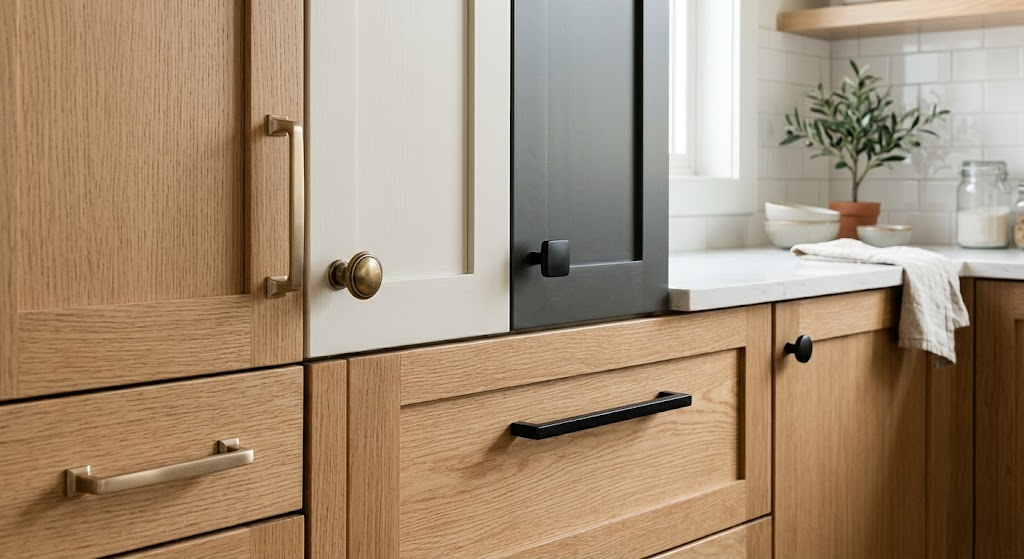
Wood cabinets work with matte black, brushed brass, bronze, stainless steel, and brushed nickel. Black hardware adds definition on oak, maple, walnut, and rift-cut wood. Brass warms walnut and white oak. Stainless steel connects wood cabinets with modern appliances.
Gray cabinets work with brushed nickel, polished nickel, matte black, brass, and chrome. Cool gray pairs well with silver finishes. Warm gray pairs well with brass, bronze, or champagne finishes. Matte black adds definition to light gray cabinets.
Navy cabinets work with brass, polished nickel, brushed nickel, chrome, and matte black. Brass creates warm contrast. Polished nickel creates a classic blue-and-silver pairing. Matte black creates a low-contrast modern look on deeper navy tones.
Black cabinets work with brass, chrome, polished nickel, stainless steel, and black-on-black hardware. Brass creates strong warmth. Chrome and polished nickel create high contrast. Black hardware creates a hidden or minimal appearance.
Green cabinets work with brass, bronze, matte black, brushed nickel, and antique finishes. Brass pairs well with sage, olive, forest green, and deep emerald. Bronze supports earthy green tones. Matte black creates a modern edge.
Two-tone cabinets work best when hardware creates a bridge between colors. A kitchen with white uppers and navy lowers can use brass hardware across both zones. A kitchen with wood lowers and painted uppers can use black hardware to connect both finishes. The same hardware finish across two cabinet colors creates unity.
How do you match cabinet hardware with countertops and backsplash?
Match cabinet hardware with countertops and backsplash by choosing hardware finish and hardware shape that support stone veining, tile pattern, countertop color, and backsplash texture.
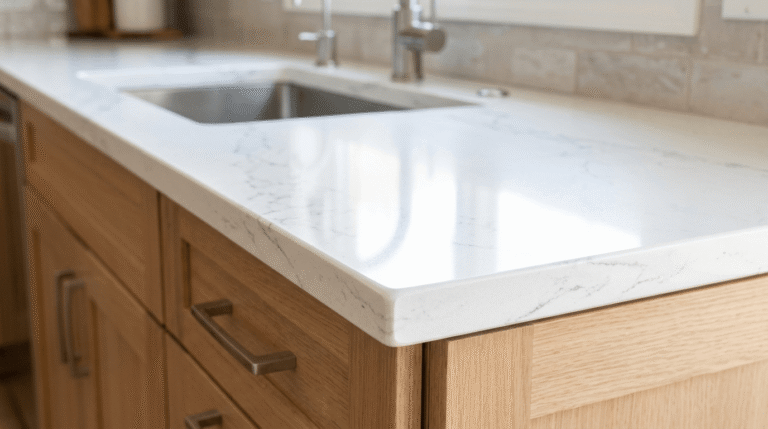
Countertops affect hardware because countertop material sits near cabinet hardware. White quartz with gray veining pairs well with polished nickel, brushed nickel, chrome, matte black, and brass. Warm marble-look quartz pairs well with brass and champagne bronze. Black granite or soapstone pairs well with brass, chrome, stainless steel, and matte black. Butcher block pairs well with black, brass, bronze, and brushed nickel.
Backsplash tile affects hardware because tile pattern adds visual movement. A busy patterned backsplash works better with simple hardware. A plain subway tile backsplash can support more decorative hardware. A glossy backsplash can connect with polished nickel or chrome. A handmade tile backsplash can pair with aged brass, bronze, or matte black because softer finishes match the tile texture.
Stone veining also guides finish choice. Gray veining connects with nickel, chrome, and stainless steel. Gold or beige veining connects with brass, bronze, and champagne finishes. Black veining connects with matte black, oil-rubbed bronze, or polished nickel. Hardware does not need to match veining exactly, but repeated color temperature creates coordination.
Shape matters with surfaces. Linear pulls support linear tile layouts, slab backsplashes, and waterfall countertops. Round knobs soften strong stone movement and rectangular tile grids. Cup pulls work with farmhouse tile, shaker cabinets, and butcher block counters.
A coordinated kitchen look uses 3 repeated signals: one cabinet color signal, one metal finish signal, and one surface pattern signal.
What mistakes should you avoid when picking cabinet hardware?
Avoid cabinet hardware mistakes by preventing wrong size, poor comfort, excess finishes, inconsistent placement, missing samples, and style mismatch.
The wrong size is the most common visual problem. Tiny knobs can disappear on tall pantry doors. Short pulls can look weak on 36-inch drawers. Oversized pulls can crowd small upper cabinets. Hardware scale needs to match cabinet front scale.
Ignoring comfort creates daily use problems. A thin pull can hurt fingers. A knob with a sharp edge can feel awkward. A low-projection handle can trap fingers against cabinet fronts. Hardware needs hand clearance, smooth edges, and stable grip.
Using too many finishes creates visual clutter. A kitchen with black pulls, brass knobs, chrome faucet, bronze lights, stainless appliances, and copper accents can lose finish logic. Two main finishes usually create a cleaner metal plan.
Poor placement makes cabinets look misaligned. Knobs installed at different heights break visual rhythm. Pulls placed too close to drawer edges can look accidental. Hardware placed inside shaker panels can look crowded. A template prevents uneven installation.
Buying without samples creates finish surprises. Online photos can distort brass tone, black sheen, nickel warmth, and bronze depth. Cabinet color, daylight, artificial light, countertop color, and backsplash reflection can change the perceived finish.
Trendy hardware can clash with cabinet style. Ultra-modern edge pulls can look wrong on ornate raised-panel cabinets. Heavily decorative backplates can look wrong on flat slab cabinets. Hardware trend value is lower than style compatibility.
Should you test cabinet hardware before buying it?
Test cabinet hardware before buying it because samples reveal finish color, grip comfort, scale, edge feel, projection, and compatibility with cabinets, faucets, lighting, countertops, and backsplash.
Order 2 to 5 hardware samples before a full kitchen purchase. Include at least 1 knob, 1 short pull, 1 long pull, and 1 alternate finish, if the kitchen uses mixed hardware. Place each sample on the actual cabinet door or drawer front. View the sample in morning daylight, afternoon light, and artificial evening light.
Test grip before choosing. Open a drawer with the pull. Pinch the knob. Place fingers behind the handle. Check whether the pull clears the cabinet face. Check whether the edge feels smooth. Check whether the hardware catches clothing, sleeves, or towels.
Compare hardware near fixed kitchen finishes. Hold the sample near the faucet, sink, appliance handles, pendant lights, backsplash tile, countertop, flooring, and cabinet paint. This comparison shows whether the finish reads warm, cool, bright, dark, glossy, matte, or muted.
Use painter’s tape or a hardware template to test placement. Mark knob and pull locations before drilling. Check alignment across upper cabinets, lower cabinets, drawer stacks, pantry doors, and island cabinets. A sample test costs less than replacing drilled cabinet fronts.
How much should you spend on kitchen cabinet hardware?
Spend on kitchen cabinet hardware based on quantity, material quality, finish durability, cabinet size, and use frequency.
Kitchen cabinet hardware pricing often separates into 3 practical tiers. Budget hardware can cost a few dollars per piece. Mid-range hardware often costs more per piece and adds better finish consistency, heavier weight, and smoother edges. Premium hardware costs more because of solid brass construction, specialty finishes, designer profiles, larger appliance pulls, or custom manufacturing.
Hardware count controls total cost. A kitchen with 25 cabinet doors and drawers uses 25 hardware pieces. A kitchen with 45 cabinet fronts uses 45 hardware pieces. A $6 pull across 40 cabinets equals $240 before screws, templates, shipping, or tax. A $20 pull across 40 cabinets equals $800 before added costs. Large appliance pulls can raise the total because refrigerator panels and pantry doors use longer, stronger hardware.
Quality matters most in high-touch areas. Spend more on trash pull-outs, deep drawers, pantry doors, island drawers, and appliance panels. These locations carry more weight and receive more hand contact. A stronger pull with durable finish performs better than a decorative piece with weak plating.
Cabinet hardware can refresh a kitchen without a full remodel. Replacing dated knobs and pulls can change the appearance of painted cabinets, shaker cabinets, slab cabinets, and wood cabinets. The upgrade works best when the new hardware fits existing hole spacing or when cabinet fronts can be filled, sanded, painted, or refinished.
What is the best cabinet hardware choice for your kitchen?
The best cabinet hardware choice for your kitchen is the knob, pull, handle, or mixed hardware system that matches cabinet style, cabinet color, hardware finish, hardware size, hand comfort, placement accuracy, and budget.
Start with cabinet style. Shaker cabinets can use knobs, pulls, cup pulls, or mixed hardware. Slab cabinets often work better with bar pulls, edge pulls, or low-profile handles. Raised-panel cabinets often work better with knobs, arched pulls, decorative pulls, or backplates.
Choose finish after cabinet color and fixed finishes. White cabinets accept many finishes. Navy and green cabinets often pair well with brass or nickel. Wood cabinets often pair well with black, bronze, brass, or stainless steel. Gray cabinets depend on warm gray or cool gray undertones. Countertops, backsplash, appliances, faucets, and lighting decide whether matching or contrast creates better balance.
Pick size after measuring drawers and doors. Use smaller knobs on small doors. Use longer pulls on wider drawers. Use vertical pulls on pantry doors. Use appliance pulls on panel-ready refrigerators and dishwashers. Confirm center-to-center spacing before purchase, especially when replacing existing hardware.
Test comfort before drilling. A good cabinet handle has comfortable projection, smooth edges, stable grip, and easy-clean surfaces. Cabinet hardware is touched more often than most decorative kitchen elements. Function matters as much as finish.
Install consistently. Align knobs and pulls across cabinet rows. Use a template. Match placement logic between upper cabinets, lower cabinets, drawers, tall doors, slab cabinets, and shaker cabinets. Consistent placement makes the full kitchen look intentional.
A strong final selection combines 6 signals: compatible style, coordinated finish, correct scale, comfortable grip, accurate placement, and realistic budget. Cabinet hardware works best when every knob, pull, handle, and finish choice supports the same kitchen design system.