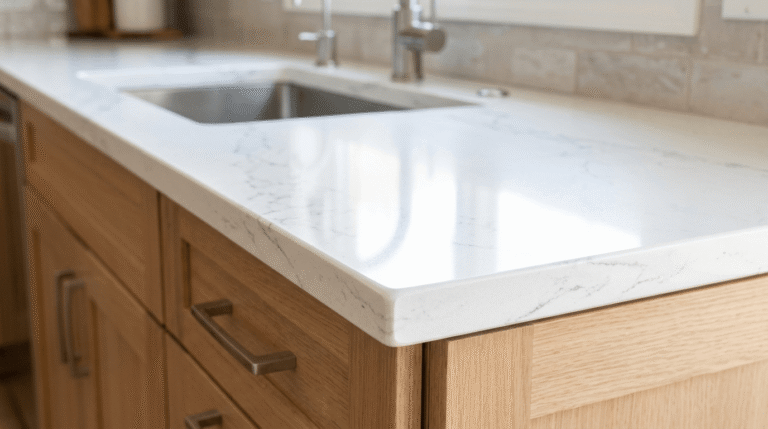
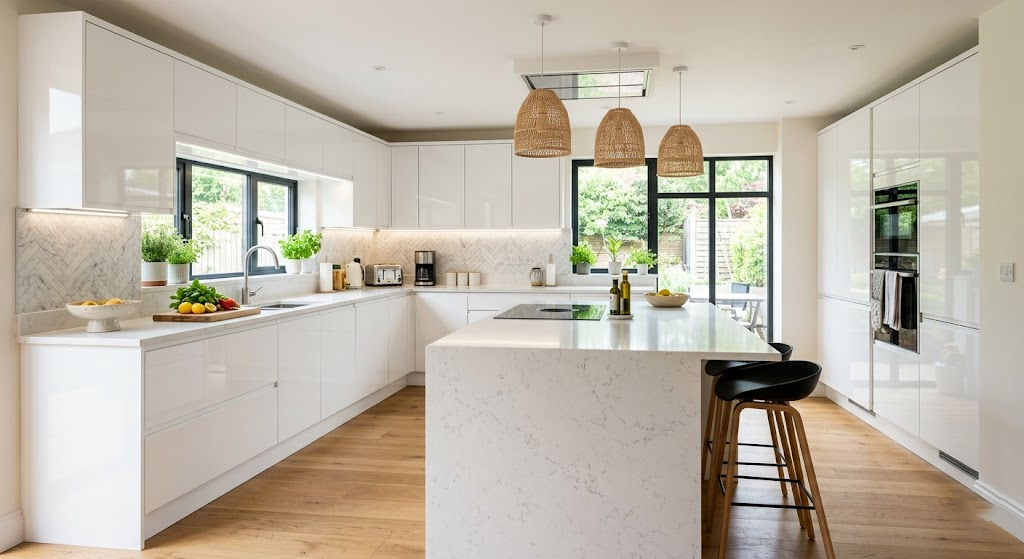
Kitchen cabinet material determines a cabinet’s strength, moisture resistance, weight, appearance, and price. Manufacturers build cabinets from solid wood, engineered wood panels, and non-wood materials such as metal, glass, and acrylic. Each material category performs differently under heat, humidity, daily use, and long-term load-bearing conditions.
Cabinet material also affects the cabinet box, doors, drawer fronts, and interior components separately. A cabinet box built from plywood can pair with door fronts made from solid hardwood, MDF, or laminate, so material choice varies by cabinet part rather than applying uniformly to the entire unit.
Material selection connects directly to budget, kitchen humidity levels, household use patterns, and desired finish. Solid hardwood and marine-grade plywood suit high-moisture or heavy-use kitchens, while MDF and particleboard suit painted finishes and lower budgets.
This article explains the composition, durability, cost, and application of each major kitchen cabinet material, compares them by measurable criteria, and outlines the selection factors relevant to different kitchen conditions.
What Are Kitchen Cabinets Made Of?
Kitchen cabinets are made of solid wood, engineered wood panels, or non-wood materials such as metal, glass, and acrylic. Solid wood includes hardwood species used for cabinet boxes, doors, and face frames. Engineered wood includes plywood, medium-density fiberboard (MDF), and particleboard, each produced by bonding wood fibers, particles, or veneer layers with resin under pressure.
Non-wood materials appear less frequently in residential kitchens and typically serve as accent or specialty components. Stainless steel forms full cabinet units in commercial or industrial-style kitchens. Glass and acrylic function as door panel inserts or door fronts rather than structural cabinet boxes.
Manufacturers often combine materials within a single cabinet unit. A cabinet box may use plywood for structural strength, while the door front uses solid hardwood, MDF, or a laminate-covered panel for a specific finish. This combination allows manufacturers to balance cost, weight, and appearance across different cabinet components.
Wood Materials for Kitchen Cabinets
Wood kitchen cabinet materials consist of solid hardwood and plywood. Both materials originate from timber, but they differ in construction method, dimensional stability, and application within the cabinet structure.
Solid hardwood consists of unprocessed wood cut directly from a tree trunk, while plywood consists of thin wood veneer layers bonded together under heat and pressure. Manufacturers select between the two based on the cabinet component, required strength, and moisture exposure in the installation environment.
Solid Hardwood
Solid hardwood cabinets are built from single pieces of unprocessed wood cut from hardwood tree species. Common hardwood species used in cabinetry include oak, maple, cherry, and birch. Solid hardwood provides high structural strength and supports detailed carving, routing, and panel-style door construction.
Hardwood expands and contracts with humidity changes because the material retains natural wood grain and moisture-absorbing cell structure. This movement can cause panel doors to warp or crack in kitchens with fluctuating humidity unless the wood is properly kiln-dried and sealed. Solid hardwood accepts stain finishes that display natural wood grain, which supports traditional and rustic cabinet styles. Manufacturers typically reserve solid hardwood for cabinet doors, face frames, and drawer fronts rather than full cabinet boxes, since plywood offers greater dimensional stability for large flat panels.
Plywood
Plywood cabinets are built from multiple thin layers of wood veneer bonded together with the grain direction alternating between layers. This cross-grain construction increases the panel’s resistance to warping, splitting, and moisture-related expansion compared with solid wood panels of the same thickness.
Cabinet-grade plywood typically ranges from 5 to 7 layers (plies) in three-quarter-inch panels, and higher ply counts generally increase panel strength and screw-holding capacity. Plywood holds screws and hardware more securely than particleboard or MDF because the layered wood grain resists splitting under fastener pressure. Manufacturers commonly use plywood for cabinet boxes, shelves, and drawer boxes, where flat panel stability and load-bearing strength matter more than surface carving detail. Plywood accepts veneer, laminate, or paint finishes, which allows manufacturers to match the appearance of solid wood while maintaining greater dimensional stability.
Popular Cabinet Wood Species (Oak, Maple, Cherry, Birch)
Oak, maple, cherry, and birch are the four wood species most commonly used in kitchen cabinet manufacturing. Each species differs in grain pattern, hardness, and typical finish compatibility.
- Oak: Oak displays a pronounced, open wood grain and ranks among the hardest common cabinet woods, which supports high resistance to dents and scratches. Oak accepts stain well and shows strong grain contrast after finishing.
- Maple: Maple has a fine, tight grain pattern and a light natural color, which suits both painted and lightly stained finishes. Maple resists denting due to its hardness and provides a smooth surface for detailed door profiles.
- Cherry: Cherry has a smooth, fine grain and darkens naturally over time when exposed to light. Cherry is softer than oak and maple, which makes it more prone to surface dents under heavy impact.
- Birch: Birch has a subtle, uniform grain pattern similar to maple, at a generally lower material cost. Birch accepts paint and stain finishes but shows more color variation between boards than maple.
Non-Wood and Engineered Kitchen Cabinet Materials
Non-wood and engineered kitchen cabinet materials include MDF, particleboard, melamine, laminate, metal, glass, and acrylic. Engineered wood materials are manufactured by bonding wood fibers or particles with resin under heat and pressure, producing panels with different density, weight, and moisture resistance than solid wood or plywood.
Non-wood materials such as metal, glass, and acrylic do not originate from wood fiber and instead rely on sheet metal fabrication, tempered glass panels, or cast acrylic sheets. These materials typically serve specialty or accent roles rather than replacing wood across an entire kitchen.
MDF (Medium-Density Fiberboard)
MDF is an engineered wood panel made by compressing wood fibers with resin under high heat and pressure into a dense, uniform board. MDF has no visible wood grain, which produces a smooth, consistent surface suited to painted cabinet finishes.
MDF density typically ranges from 45 to 55 pounds per cubic foot, which exceeds the density of plywood and particleboard of comparable thickness. This higher density allows MDF to hold a smooth edge profile for routed door details without chipping, unlike plywood, which can splinter along cut edges. MDF absorbs water more readily than solid wood or plywood because the compressed wood fibers lack a natural moisture barrier, so unsealed MDF can swell or deteriorate in high-humidity areas such as near a sink or dishwasher. Manufacturers commonly use MDF for painted shaker-style doors, flat-panel cabinet doors, and interior cabinet components not exposed to direct moisture.
Particleboard
Particleboard is an engineered wood panel made by bonding wood chips, shavings, and sawdust with resin under pressure into a flat board. Particleboard has a lower density and lower manufacturing cost than MDF and plywood, which makes it the least expensive common cabinet material.
Particleboard has lower screw-holding strength than plywood or MDF because the loose particle structure does not resist fastener pressure as effectively as layered or fiber-compressed materials. Particleboard swells and loses structural integrity when exposed to standing water or prolonged humidity, since the wood particles absorb moisture along exposed edges. Manufacturers primarily use particleboard for cabinet boxes and shelving in budget cabinet lines, typically covered with a melamine or laminate surface to reduce moisture exposure and improve appearance.
Melamine and Laminate
Melamine and laminate are surface materials applied over particleboard, MDF, or plywood substrates rather than standalone structural cabinet materials. Melamine consists of a paper layer saturated with melamine resin and fused directly onto the substrate under heat, while laminate consists of a separate plastic layer, such as high-pressure laminate (HPL), adhered to the substrate with adhesive.
Melamine surfaces resist scratches and stains under normal use and require minimal cleaning beyond wiping with a damp cloth. High-pressure laminate generally withstands higher impact and heat exposure than melamine because the layered plastic sheet has greater surface density and thickness. Both surfaces resist moisture penetration at the panel face, though exposed edges and seams remain vulnerable to water damage unless properly sealed. Manufacturers apply melamine and laminate finishes primarily to budget and mid-range cabinet lines to reduce cost while providing a durable, low-maintenance surface.
Metal, Glass, and Acrylic Alternatives
Metal, glass, and acrylic serve as alternative kitchen cabinet materials, typically applied to specific cabinet components rather than full cabinet construction. Stainless steel forms complete cabinet boxes and doors in commercial kitchens and select residential designs, offering high resistance to heat, moisture, and bacterial growth on the surface.
Glass panels replace solid door fronts in upper cabinets to display dishware or add visual openness to a kitchen design, and manufacturers use tempered glass to reduce breakage risk. Acrylic panels provide a high-gloss, non-porous surface for cabinet doors and typically show fingerprints and minor scratches more visibly than matte or textured finishes. Metal, glass, and acrylic cabinet components generally cost more per square foot than standard wood or engineered wood options due to fabrication and material costs.
Types of Kitchen Cabinet Materials at a Glance
The following table compares solid hardwood, plywood, MDF, particleboard, and melamine/laminate by composition, moisture resistance, durability, and typical cabinet application.
| Material | Composition | Moisture Resistance | Durability | Typical Use |
|---|---|---|---|---|
| Solid Hardwood | Single-piece natural wood | Moderate; expands and contracts with humidity | High structural strength; prone to warping if unsealed | Doors, face frames, drawer fronts |
| Plywood | Layered wood veneer, cross-grain bonded | High; resists warping better than solid wood | High; strong screw-holding capacity | Cabinet boxes, shelves, drawer boxes |
| MDF | Compressed wood fibers with resin | Low unless sealed; absorbs water at edges | Moderate to high; smooth surface, prone to swelling | Painted doors, flat-panel fronts |
| Particleboard | Bonded wood chips and sawdust | Low; swells under standing moisture | Low to moderate; weaker screw-holding | Budget cabinet boxes, covered shelving |
| Melamine/Laminate | Resin-paper or plastic surface over substrate | High at surface; vulnerable at exposed edges | Moderate to high; scratch and stain resistant | Surface finish for budget and mid-range cabinets |
Plywood and melamine/laminate surfaces provide the most consistent moisture resistance among the compared materials, while particleboard shows the lowest resistance to standing water. Solid hardwood offers the highest structural strength for detailed door construction but requires sealing to limit humidity-related movement.
Cabinet Finishes and Textures Explained
A cabinet finish is the surface treatment applied over a cabinet material to determine its color, sheen, and texture. Common finishes include paint, stain, thermofoil, laminate, and natural wood veneer, and each finish interacts differently with the underlying material.
Paint finishes work most effectively over MDF and smooth plywood because these materials lack visible grain texture that can telegraph through the paint layer. Stain finishes require a wood substrate with visible grain, such as solid hardwood or wood veneer plywood, since stain relies on grain absorption to produce color variation. Thermofoil is a vinyl film heat-sealed onto an MDF substrate, producing a smooth, seamless surface resistant to moisture at the face but vulnerable to peeling under prolonged heat exposure near ovens or stovetops.
Textures range from smooth and high-gloss to matte and wood-grain embossed surfaces, depending on the finish type and application process. Glossy finishes, common with acrylic and high-pressure laminate, show fingerprints and minor scratches more readily than matte or textured finishes. Matte and textured finishes reduce visible wear marks and are common on painted MDF and lower-sheen laminate surfaces.
Most Durable Kitchen Cabinet Materials
Plywood and solid hardwood rank as the most durable kitchen cabinet materials among common options, based on structural strength, screw-holding capacity, and resistance to moisture-related damage. Plywood’s cross-grain layering resists warping and splitting under normal kitchen humidity and daily use, which supports long-term structural performance in cabinet boxes.
Solid hardwood provides high resistance to denting and structural stress due to its density, particularly with hardwood species such as oak and maple, though it requires sealing to control humidity-related expansion and contraction. Stainless steel offers comparable or higher durability for surface-level wear, heat exposure, and moisture resistance, but its higher cost limits its use to specific cabinet components or commercial-style kitchens rather than full residential installations.
MDF and melamine-covered surfaces provide moderate durability for surface scratches and stains but remain more vulnerable to moisture damage at exposed edges and seams than plywood or solid hardwood. Particleboard ranks lowest in durability among common cabinet materials due to its lower density and reduced resistance to moisture and fastener stress.
Cost of Kitchen Cabinet Materials
Kitchen cabinet material cost varies primarily by material type, wood species, and finish quality. Particleboard and melamine-covered cabinets generally represent the lowest-cost option, while solid hardwood and metal cabinets represent the highest-cost options due to material sourcing and manufacturing complexity.
Material cost typically accounts for a significant portion of total cabinet price, though labor, hardware, and cabinet configuration also affect the final installed cost. Manufacturers price cabinets by linear foot, cabinet unit, or square foot of surface area, depending on whether the cabinets are stock, semi-custom, or fully custom.
Cost by Wood Type
Wood cabinet cost varies by species based on hardness, grain rarity, and regional availability. Birch and maple typically rank among the more affordable hardwood options due to wider availability and easier machining. Oak generally costs more than birch or maple due to higher density and stronger demand for its pronounced grain pattern. Cherry typically ranks as the highest-cost common cabinet wood species, driven by slower tree growth, more selective grading, and higher demand for its natural color development over time.
Plywood generally costs less than solid hardwood of the same species because it uses thin veneer layers rather than solid lumber, reducing raw material volume per panel.
Budget vs. Mid-Range vs. Premium Materials
Budget kitchen cabinets typically use particleboard or MDF cabinet boxes with a melamine or thermofoil surface finish, prioritizing lower material and manufacturing cost over long-term durability. Mid-range cabinets typically combine plywood cabinet boxes with MDF or hardwood veneer doors, balancing durability with moderate cost.
Premium cabinets typically use solid hardwood doors and face frames with plywood cabinet boxes, or incorporate specialty materials such as metal or glass accents. Premium material selection generally increases resistance to warping, denting, and moisture damage compared with budget materials, while also increasing material and labor costs due to more complex construction and higher-grade wood grading.
How to Choose the Best Material for Your Kitchen Cabinets
Choosing the best kitchen cabinet material requires evaluating budget, moisture exposure, household use patterns, and desired finish together rather than selecting based on a single factor. A kitchen with high humidity, such as one near a dishwasher or exterior door, benefits from plywood cabinet boxes and moisture-resistant surface finishes over particleboard or unsealed MDF.
Households with heavy daily cabinet use benefit from materials with higher scratch and dent resistance, such as plywood boxes paired with hardwood or laminate door fronts. A limited budget generally favors particleboard or MDF cabinet boxes with a melamine or thermofoil finish, which reduce upfront cost while remaining functional under moderate use.
Desired finish also narrows material selection, since painted finishes perform best over smooth MDF or plywood, while stained finishes require a wood-grain substrate such as solid hardwood or wood veneer. For a detailed comparison of cabinet configurations, box construction, and layout planning beyond material selection, see choosing kitchen cabinets.
Kitchen Cabinet Parts and What Each Is Made Of
A kitchen cabinet consists of several distinct parts, each commonly built from a different material based on structural and aesthetic requirements. The cabinet box (or carcass) forms the primary structure and is typically made from plywood or particleboard, since this component requires flat panel stability and moderate load-bearing strength rather than decorative detail.
Cabinet doors and drawer fronts are commonly made from solid hardwood, MDF, or laminate-covered panels, since these visible components carry the primary finish and style of the cabinet. The face frame, present in framed cabinet construction, is typically made from solid hardwood to provide structural rigidity around the cabinet box opening. Drawer boxes are commonly built from plywood or solid wood due to the repeated stress of opening, closing, and load-bearing during use, while drawer slides and hinges are made from metal hardware rather than cabinet-grade wood materials.
Cabinet shelves, both fixed and adjustable, are typically made from plywood or particleboard, depending on the cabinet’s price tier and required load capacity.
Kitchen Cabinet Materials by Brand (IKEA, KraftMaid, Hampton Bay)
IKEA, KraftMaid, and Hampton Bay use different primary materials across their kitchen cabinet product lines, reflecting their positioning in the budget, mid-range, and semi-custom cabinet markets. IKEA cabinet boxes are commonly constructed from particleboard, with door and drawer fronts available in a range of finishes including painted MDF, wood veneer, and foil-wrapped surfaces.
KraftMaid, a mid-range to semi-custom cabinet manufacturer, offers cabinet boxes in plywood and door fronts available in multiple solid hardwood species, including maple, cherry, and oak, alongside painted MDF options. Hampton Bay, a stock cabinet brand sold primarily through home improvement retailers, typically uses engineered wood materials such as plywood or MDF for cabinet boxes, with door fronts available in painted MDF and select hardwood veneer finishes.
Material availability and specific construction details vary by product line and collection within each brand, so confirming exact cabinet box and door materials for a specific product remains necessary before purchase.
Kitchen Cabinet Types and Styles
Kitchen cabinet types and styles refer to the structural configuration and design aesthetic of a cabinet, independent of the material used to build it. The two primary structural types are framed cabinets, which include a face frame around the cabinet box opening, and frameless cabinets, which attach doors directly to the cabinet box without a face frame.
Cabinet styles describe the door design and detailing, including shaker, flat-panel (slab), raised-panel, and glass-front configurations. Style selection influences which materials are suitable for construction, since raised-panel and detailed shaker doors require materials capable of routing and carving, such as solid hardwood or MDF, while flat-panel and slab doors accommodate a wider range of materials, including laminate and acrylic. For a detailed breakdown of individual door style options and their design characteristics, see kitchen cabinet door styles.