A kitchen countertop is a fixed horizontal work surface installed above kitchen cabinets or base units. It supports food preparation, appliance placement, storage, and cleaning tasks in residential and commercial kitchens. Homeowners select countertop material based on durability, maintenance requirements, heat and stain resistance, cost, and visual appearance.
Countertop materials fall into two broad categories: natural stone, quarried directly from the earth, and engineered or man-made materials, manufactured from combined raw components. Each category includes several distinct materials with different performance characteristics, price ranges, and suitable applications.
This guide compares the main kitchen countertop materials by durability, cost, maintenance, and best use case, and explains how to select a material that matches a specific kitchen’s function, budget, and household needs.
What Are Kitchen Countertops Made Of?
Kitchen countertops are made of natural stone, engineered stone, solid surface acrylic or polyester compounds, laminate-coated particleboard, wood, concrete, stainless steel, or ceramic and porcelain tile. Each material combines a base substance with a fabrication process that determines the finished surface’s hardness, porosity, and heat tolerance.
Natural stone countertops, including granite and marble, consist of quarried mineral slabs cut and polished to a finished thickness. Engineered stone countertops, commonly marketed as quartz, combine crushed quartz minerals with polymer resins and pigments under high pressure. Solid surface countertops use acrylic or polyester resins blended with mineral fillers to create a non-porous, moldable material. Laminate countertops apply a thin decorative layer over a particleboard or medium-density fiberboard (MDF) core. Wood countertops use hardwood strips or planks joined edge to edge or end to end. Concrete countertops are cast on-site or precast from a cement, aggregate, and reinforcement mixture. Stainless steel countertops consist of a steel sheet bonded to a plywood or particleboard substrate. Tile countertops use ceramic or porcelain tiles set over a cement backer board.
Types of Kitchen Countertop Materials
The main kitchen countertop material categories are granite, quartz, solid surface, laminate, butcher block and wood, marble, concrete, stainless steel, and tile. These materials divide into natural stone (granite, marble), engineered materials (quartz, solid surface, laminate, concrete), and metal or ceramic materials (stainless steel, tile). Each category differs in composition, hardness, porosity, and typical installation cost.
The main kitchen countertop materials include:
- Granite — natural igneous stone with high heat and scratch resistance
- Quartz (engineered stone) — manufactured stone with low porosity and no sealing requirement
- Solid surface — acrylic or polyester composite with seamless joints
- Laminate — plastic laminate bonded to a particleboard core
- Butcher block and wood — solid hardwood surfaces suited to food preparation
- Marble — natural stone valued for veining and light color
- Concrete — cast or precast cement-based surface
- Stainless steel — metal surface common in commercial kitchens
- Tile — ceramic or porcelain units set in a grid pattern
Granite
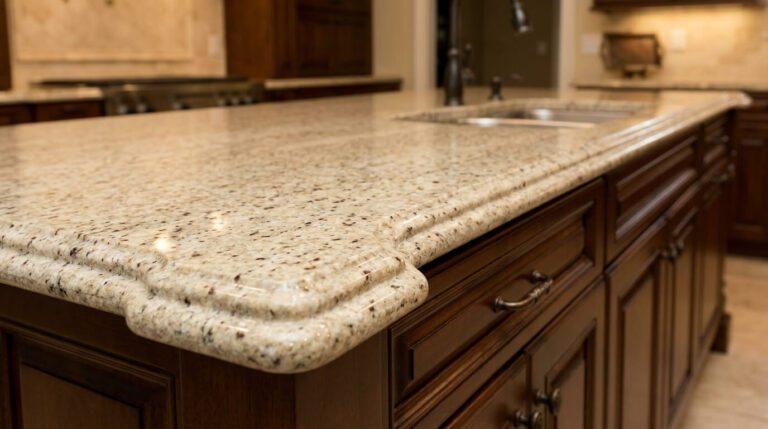
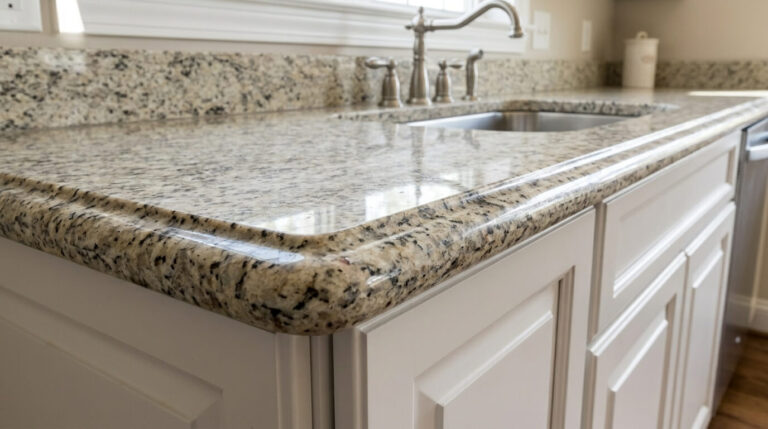
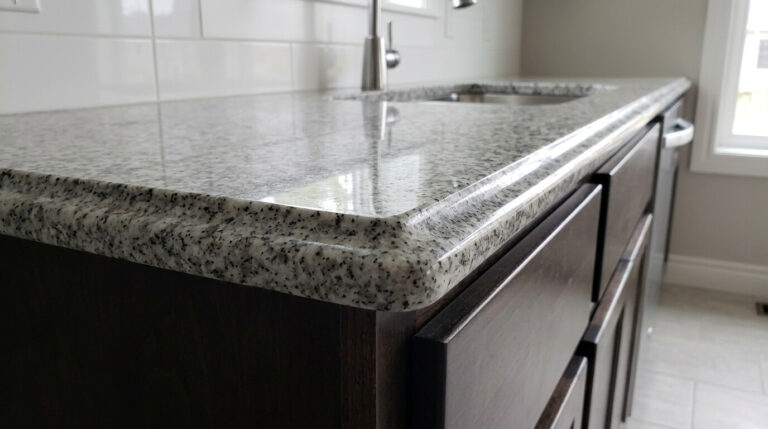
Granite is a natural igneous stone countertop material known for high scratch resistance and heat tolerance up to approximately 480°F (250°C) for brief direct contact. Granite forms from cooled magma and contains quartz, feldspar, and mica crystals, which give the surface its characteristic speckled or veined pattern.
Granite slabs range from 2 to 3 centimetres in thickness for standard kitchen installation. Because granite is porous, an unsealed surface can absorb liquids and stain over time. A sealed granite surface resists most kitchen liquids for one to three years before resealing becomes necessary.
Granite offers the following advantages:
- Resists scratches from knives and kitchen tools
- Withstands direct heat from hot pans for brief contact
- Provides a unique, non-repeating pattern in each slab
- Adds resale value in most residential markets
Granite carries the following limitations:
- Requires periodic sealing to prevent staining
- Can chip at edges and corners under sharp impact
- Costs more than laminate or solid surface materials
- Adds significant weight, requiring reinforced cabinetry
Best Use Case: Granite suits kitchens where heavy cooking, heat exposure, and long-term durability outweigh sealing maintenance.
Quartz (Engineered Stone)
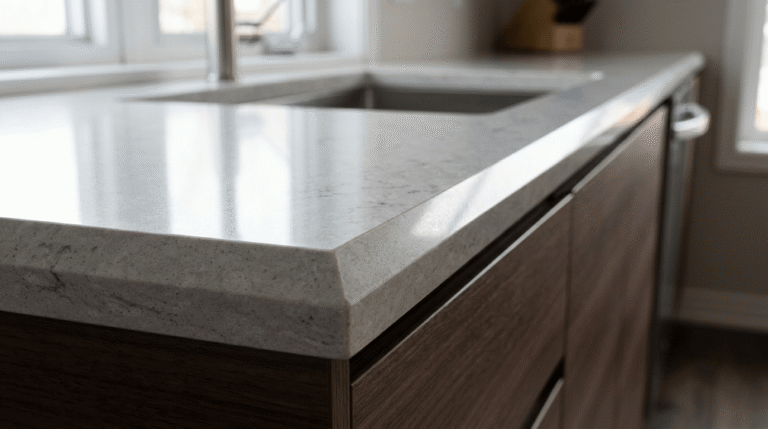
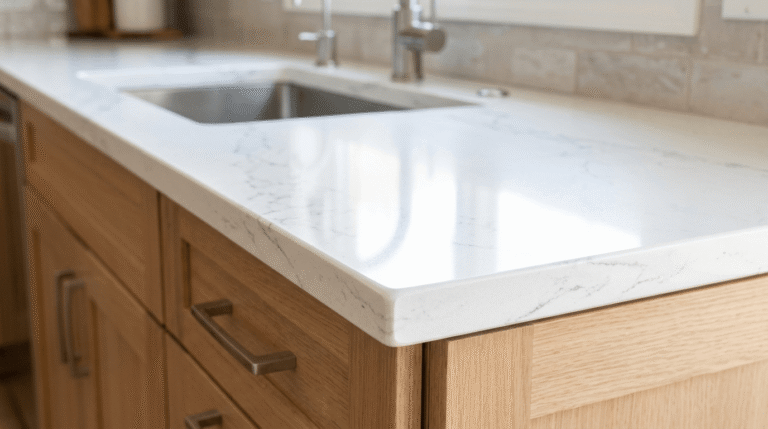
Quartz countertops are engineered stone surfaces made from approximately 90% to 94% crushed quartz minerals combined with polymer resins and pigments. The manufacturing process compresses these materials under heat and pressure, producing a dense, low-porosity slab that does not require sealing.
Quartz surfaces resist scratches and stains under normal kitchen use, though the polymer resin component softens or discolors when exposed to direct heat above approximately 300°F (150°C). Manufacturers offer quartz in consistent color and pattern options, unlike the natural variation found in granite or marble.
Quartz offers the following advantages:
- Requires no periodic sealing due to non-porous composition
- Resists staining from wine, oil, and acidic foods
- Provides consistent color and pattern across the slab
- Resists bacterial growth on the non-porous surface
Quartz carries the following limitations:
- Softens or discolors under direct high heat
- Costs more than laminate and most solid surface options
- Shows visible seams on larger countertop spans
- Fades gradually under prolonged direct sunlight
Best Use Case: Quartz suits households that want low maintenance and consistent appearance without a sealing routine.
Solid Surface
Solid surface countertops are non-porous composite surfaces made from acrylic or polyester resin blended with mineral fillers. The material is cast into sheets, allowing fabricators to create seamless joints, integrated sinks, and curved edges that are difficult to achieve with slab materials.
Because solid surface is homogeneous throughout its thickness, minor scratches and burns can be sanded out rather than requiring full replacement. The material does not require sealing and resists stains from common kitchen liquids.
Solid surface offers the following advantages:
- Allows seamless installation with integrated sinks
- Supports minor scratch and burn repair through sanding
- Resists staining without a sealing requirement
- Offers flexibility for curved or custom edge profiles
Solid surface carries the following limitations:
- Scratches more easily than granite or quartz
- Can discolor or melt under direct high heat
- Costs vary widely by brand and finish
- Shows scratches more visibly in matte finishes
Best Use Case: Solid surface suits kitchens that prioritize a seamless appearance and integrated sink design over maximum heat resistance.
Laminate
Laminate countertops consist of a thin plastic laminate layer bonded to a particleboard or MDF core. The laminate layer is printed to imitate stone, wood, or solid-color finishes at a lower material and installation cost than natural or engineered stone.
Laminate resists staining under normal use but does not resist heat or sharp impact as effectively as stone materials. Direct contact with hot cookware or a knife blade can burn or cut through the surface layer, exposing the core material beneath.
Laminate offers the following advantages:
- Costs less than nearly all other countertop materials
- Installs quickly with minimal specialized labor
- Offers a wide range of colors and printed patterns
- Requires no sealing or specialized cleaning products
Laminate carries the following limitations:
- Burns or scorches under direct contact with hot cookware
- Scratches and cuts more easily than stone surfaces
- Cannot be repaired once the surface layer is damaged
- Shows visible seams at joints between sections
Best Use Case: Laminate suits budget-focused kitchens, rental properties, and short-term renovation projects.
Butcher Block and Wood
Butcher block countertops are made from hardwood strips joined edge to edge, end to end, or face to face, commonly using maple, oak, walnut, or cherry. Wood countertops provide a surface suitable for direct food preparation, including cutting and chopping, when finished with a food-safe oil rather than polyurethane sealant.
Wood countertops require regular oiling to prevent moisture absorption, which can otherwise cause warping, cracking, or bacterial growth. Surface scratches and minor burns can typically be sanded and refinished, extending the countertop’s usable life.
Butcher block and wood offer the following advantages:
- Provides a food-safe surface for direct cutting and chopping
- Supports sanding and refinishing to remove scratches or stains
- Adds warmth and natural texture to kitchen design
- Weighs less than stone or concrete alternatives
Butcher block and wood carry the following limitations:
- Requires regular oiling to prevent moisture damage
- Scratches and dents more easily than stone surfaces
- Can warp or crack if exposed to standing water
- Is not heat-resistant near stovetops without added protection
Best Use Case: Butcher block suits kitchen islands and food-preparation zones where direct cutting and a warm appearance are priorities.
Marble
Marble is a natural metamorphic stone countertop material recognized for its light background color and distinctive veining. Marble forms from recrystallized limestone under heat and pressure, producing a softer stone than granite with a Mohs hardness of approximately 3 to 4.
Marble is highly porous and reacts with acidic substances such as lemon juice, wine, and vinegar, which can etch the polished surface even after sealing. Marble requires more frequent sealing and careful cleaning than granite or quartz to limit staining and etching.
Marble offers the following advantages:
- Provides a distinctive, high-end veined appearance
- Stays cooler than most materials, suiting baking tasks
- Increases resale appeal in many residential markets
- Accepts a range of edge and finish styles
Marble carries the following limitations:
- Etches when exposed to acidic foods and liquids
- Requires more frequent sealing than granite
- Scratches and chips more easily than harder stones
- Costs more than most engineered alternatives
Best Use Case: Marble suits dedicated baking areas and design-focused kitchens where appearance takes priority over acid resistance.
Concrete, Stainless Steel, and Tile
Concrete, stainless steel, and tile are countertop materials used less frequently in residential kitchens than granite, quartz, or laminate, each offering distinct performance characteristics suited to specific applications.
Concrete countertops are cast on-site or precast from a cement, aggregate, and reinforcement mixture, then ground and sealed to a finished surface. Concrete offers high design flexibility, including custom shapes, integrated features, and pigmented finishes, but requires sealing to limit porosity and can develop hairline cracks over time.
- Supports custom shapes, thicknesses, and integrated sinks
- Requires sealing to reduce porosity and staining
- Can develop hairline cracks as the material cures and ages
- Best Use Case: Concrete suits custom kitchen designs where a unique, industrial appearance is a priority.
Stainless steel countertops consist of a steel sheet bonded to a plywood or particleboard substrate, commonly used in commercial kitchens for hygiene and heat resistance. Stainless steel resists heat, stains, and bacterial growth, but shows scratches and dents more visibly than other materials.
- Resists heat, staining, and bacterial growth
- Shows scratches, dents, and fingerprints readily
- Costs more than laminate for comparable surface area
- Best Use Case: Stainless steel suits kitchens prioritizing hygiene and heat resistance, including commercial-style residential kitchens.
Tile countertops use ceramic or porcelain tiles set over a cement backer board with grouted joints between units. Tile resists heat well at the tile surface, though grout lines absorb liquids and require regular sealing and cleaning.
- Resists heat directly beneath cookware
- Requires grout sealing to limit staining and bacterial growth
- Can crack individual tiles under heavy impact
- Best Use Case: Tile suits budget-conscious kitchens where individual tiles can be replaced if damaged.
How Durable Is Each Countertop Material?
Countertop durability depends on scratch resistance, impact resistance, and resistance to daily wear, and it varies significantly by material hardness and composition. Granite and quartz rank among the most durable kitchen countertop materials, each resisting scratches and daily wear for several decades under normal use. Marble ranks lower in durability due to its softer composition, which makes it more prone to scratching, chipping, and etching.
Solid surface and laminate offer moderate durability. Solid surface resists staining and supports minor repair through sanding, but it scratches more easily than stone. Laminate resists everyday wear adequately for its cost but is vulnerable to burns, cuts, and moisture at seams, and damage typically requires full replacement rather than repair.
Wood and concrete offer variable durability depending on maintenance. Butcher block resists daily use when oiled regularly but is vulnerable to water damage and cutting scratches. Concrete resists heavy impact well but can develop hairline cracks as the material cures and ages. Stainless steel resists heat and staining but shows visible dents and scratches over time. Tile resists heat effectively at the surface but individual tiles can crack under concentrated impact.
Countertop Material Cost Comparison
Kitchen countertop material costs typically range from $10 to $40 per square foot installed for laminate, $40 to $100 per square foot for butcher block and tile, and $50 to $200 per square foot for granite, quartz, marble, solid surface, concrete, and stainless steel, depending on material grade, thickness, and fabrication complexity. Total project cost depends on material selection, slab or sheet size, edge profile, cutouts for sinks and cooktops, and regional labor rates.
Laminate remains the lowest-cost countertop material, followed by tile and butcher block, which vary based on wood species or tile grade. Granite and quartz occupy a mid-to-high price range, with cost increasing for premium slab patterns, larger thicknesses, and complex edge details. Marble typically costs as much as or more than granite due to quarrying and fabrication requirements for softer stone. Concrete and stainless steel costs vary widely based on custom fabrication, with hand-finished concrete often reaching the higher end of the range.
Long-term ownership cost includes sealing products for granite, marble, and concrete, oil treatments for wood, and potential replacement costs for laminate once the surface layer is damaged. Quartz, solid surface, and stainless steel generally carry lower long-term maintenance costs due to their non-porous or wipeable surfaces.
Maintenance and Care Requirements by Material
Countertop maintenance requirements depend on each material’s porosity, hardness, and heat sensitivity, ranging from simple wipe-down cleaning for quartz and solid surface to periodic sealing for granite, marble, and concrete. Wood countertops require regular oiling, while laminate and stainless steel require only routine cleaning without sealing.
Daily maintenance across all materials involves wiping spills promptly and using cutting boards to limit surface contact with knives. Material-specific care, including sealing frequency, appropriate cleaning products, and heat protection, varies based on the surface’s porosity and composition, as detailed in the following sections.
Sealing and Porosity
Granite, marble, and concrete countertops require periodic sealing because their porous surfaces absorb liquids without a protective coating. Quartz, solid surface, laminate, and stainless steel do not require sealing due to their non-porous composition.
Sealing frequency depends on the stone’s natural porosity and the sealant type applied. Granite typically requires resealing every one to three years, while more porous marble often requires resealing every six to twelve months. A water-absorption test, performed by placing a few drops of water on the surface and timing how quickly the stone darkens, indicates when resealing is necessary. Concrete countertops require sealing at installation and periodic resealing to maintain resistance to staining and moisture absorption.
Stain and Heat Resistance
Quartz and stainless steel provide the highest stain and heat resistance among common kitchen countertop materials, though quartz’s polymer resin can soften under direct high heat. Granite resists both staining, when sealed, and heat well, tolerating brief direct contact with hot cookware.
Marble resists heat but has low stain and acid resistance, making it prone to etching from citrus, wine, and vinegar. Solid surface resists staining effectively but has lower heat resistance than stone, requiring trivets for hot pans. Laminate has moderate stain resistance but low heat resistance, as direct contact with hot cookware can scorch the surface layer. Wood resists moderate heat briefly but stains and absorbs moisture without regular oil treatment. Tile resists heat directly at the surface, while grout lines remain more vulnerable to staining.
Easiest Countertop Materials to Maintain
Quartz and solid surface rank among the easiest kitchen countertop materials to maintain because both resist staining without requiring periodic sealing. Laminate and stainless steel also require minimal maintenance, needing only routine cleaning with mild soap and water.
Granite and marble require more maintenance due to periodic sealing needs, with marble requiring more frequent attention because of its higher porosity and acid sensitivity. Wood countertops require the most consistent maintenance among common materials, needing regular oiling to prevent moisture damage. Concrete requires sealing similar to natural stone, and tile requires attention to grout lines to prevent staining and bacterial buildup.
Countertop Materials Compared
Countertop materials differ most significantly in porosity, heat resistance, cost, and maintenance requirements, which determine suitability for specific kitchen uses. The following comparisons evaluate common material pairings and groupings using matching criteria to clarify which option fits particular kitchen needs.
Granite vs. Quartz vs. Solid Surface
Granite offers the highest heat resistance among the three materials, quartz offers the lowest maintenance due to its non-porous surface, and solid surface offers the most design flexibility through seamless joints and integrated sinks. Granite requires periodic sealing, while quartz and solid surface do not.
In terms of durability, granite and quartz resist scratches more effectively than solid surface, which scratches more easily but supports sanding repair that granite and quartz do not. Cost ranges overlap across all three materials, with final price depending on slab or sheet quality, fabrication complexity, and regional labor rates. Granite provides the most natural, non-repeating pattern, quartz provides the most consistent manufactured pattern, and solid surface provides the most seamless overall appearance.
Wood vs. Granite Countertops
Wood countertops provide a food-safe cutting surface and lighter weight, while granite countertops provide higher heat resistance and greater durability against scratches and moisture. Wood requires regular oiling to prevent water damage, whereas granite requires periodic sealing to prevent staining.
Granite withstands direct heat from cookware for brief contact, while wood can scorch or char under similar exposure. Wood supports sanding and refinishing to remove scratches and stains, extending its usable life, while granite chips rather than sands when damaged. Granite typically costs more than butcher block per square foot, though pricing varies by wood species and stone grade.
Butcher Block vs. Laminate
Butcher block offers a food-safe, refinishable surface, while laminate offers a lower material and installation cost with a wider range of printed color and pattern options. Butcher block requires regular oiling, while laminate requires no sealing but cannot be repaired once the surface layer is damaged.
Laminate resists staining better than unsealed wood but has lower heat resistance, as direct contact with hot cookware can scorch the surface. Butcher block adds a natural, textured appearance, while laminate replicates the appearance of stone or wood at a lower cost. Laminate typically costs less than butcher block, though hardwood species and laminate grade both affect final pricing.
Natural Stone vs. Engineered and Man-Made Countertops
Natural stone countertops, including granite and marble, are quarried directly from the earth and display unique, non-repeating patterns, while engineered and man-made countertops, including quartz, solid surface, laminate, and concrete, are manufactured to achieve controlled consistency, lower porosity, or lower cost. Natural stone generally requires periodic sealing, while most engineered materials, particularly quartz and solid surface, do not.
Natural stone offers higher heat resistance in the case of granite, while engineered stone offers greater consistency in color and pattern across an entire kitchen. Man-made materials such as laminate and solid surface allow more design flexibility in shaping, including curved edges and integrated sinks, than rigid natural stone slabs. Cost comparisons vary: laminate ranks among the lowest-cost options overall, while premium natural stone and premium engineered stone occupy similar upper price ranges depending on slab selection and fabrication complexity.
How to Choose the Best Countertop Material for Your Kitchen
Choosing the best kitchen countertop material depends on matching a household’s cooking habits, budget, and maintenance capacity to a material’s heat resistance, porosity, and durability. A household that cooks frequently with hot cookware benefits from granite, quartz, or stainless steel, while a household focused on budget or short-term use benefits from laminate or tile.
Households with young children or limited time for sealing routines benefit from low-maintenance materials such as quartz, solid surface, or laminate, which do not require periodic sealing. Households prioritizing a natural food-preparation surface benefit from butcher block, provided regular oiling fits the household’s maintenance routine. Kitchens designed for resale value often benefit from granite, quartz, or marble due to buyer familiarity with these materials in residential markets.
Budget constraints narrow material choices toward laminate, tile, or entry-level solid surface, while flexible budgets allow selection based on appearance, heat resistance, or design flexibility rather than cost alone. Matching the chosen material’s maintenance requirements to the household’s realistic cleaning and sealing routine reduces the likelihood of premature staining, etching, or surface damage.
Kitchen Countertop Trends and Popular Styles
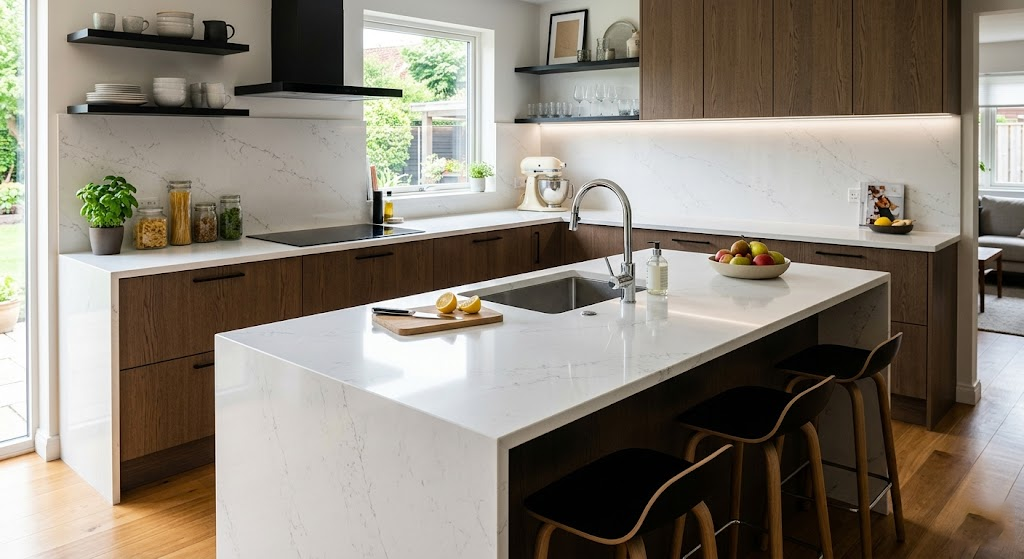
Current kitchen countertop trends include large-format quartz slabs with minimal visible veining, waterfall edges that extend the countertop material down the side of an island, and mixed-material kitchens that combine two or more countertop types for different work zones. Matte and honed stone finishes have grown in popularity alongside traditional polished finishes, offering a softer visual texture with similar durability.
Neutral and warm-toned color palettes, including cream, taupe, and soft gray quartz and granite patterns, remain popular alternatives to high-contrast black-and-white designs. Butcher block accents on kitchen islands continue to pair with quartz or granite perimeter counters, combining a food-safe cutting surface with a low-maintenance primary work area. Thicker slab profiles and integrated drainboards represent additional style choices that affect both appearance and functional use.
Countertops for Special Situations
Certain kitchen situations, including rental properties and dedicated baking zones, require countertop materials selected for specific priorities rather than general-purpose performance. The following sections address material selection for these two common special situations.
Best Countertops for Rental Properties
Laminate and tile rank among the best countertop materials for rental properties because both offer low installation cost and straightforward replacement if damaged during a tenancy. Both materials avoid the sealing maintenance that granite, marble, and concrete require, reducing the maintenance burden on property owners and tenants.
Solid surface also suits rental properties in some cases, offering better stain resistance than laminate at a moderate cost increase, with the added benefit of sanding repair for minor scratches or burns. Materials requiring frequent maintenance, such as wood and marble, are generally less suitable for rental properties because inconsistent tenant care can accelerate surface damage.
Heat-Resistant Countertops for Baking
Marble and granite rank among the best heat-resistant countertops for baking because both natural stone materials stay cooler than engineered alternatives, aiding tasks such as rolling pastry dough. Granite additionally withstands brief direct contact with hot bakeware without damage.
Quartz and solid surface are less suited to direct heat exposure during baking because their resin components can soften or discolor under high temperatures, requiring trivets or cooling racks for hot bakeware. Stainless steel also withstands heat well and provides a hygienic surface for baking preparation, though it lacks the naturally cool surface temperature that benefits pastry work.
How to Identify the Material of an Existing Countertop
To identify an existing countertop material, examine the surface pattern, test for heat sensitivity, and check for seams, then compare the results against known material characteristics. A surface with a consistent manufactured pattern and no visible pores typically indicates quartz or solid surface, while a surface with unique, non-repeating veining or speckling typically indicates granite or marble.
Perform a simple water-absorption test by placing a few drops of water on the surface. A porous surface that darkens within minutes typically indicates unsealed or under-sealed natural stone, such as granite, marble, or concrete. A surface unaffected by the water test typically indicates quartz, solid surface, or laminate.
Check for seams and edge profiles, since laminate typically shows a visible seam where the laminate sheet meets the substrate edge, while solid surface displays seamless, color-matched joints. Tap the surface lightly: natural stone produces a denser, less hollow sound than laminate over particleboard. Inspect the underside of the countertop where accessible, since the substrate material, such as particleboard, plywood, or solid stone thickness, provides a direct indicator of the surface type.
Mixing Countertop Materials in One Kitchen
Mixing countertop materials in one kitchen involves assigning different materials to different work zones based on each zone’s primary function, such as pairing a heat-resistant material near the stovetop with a food-safe wood surface on a preparation island. This approach allows a kitchen to combine the specific performance benefits of multiple materials rather than relying on one material for every task.
Common material pairings include a quartz or granite perimeter counter combined with a butcher block island for direct food preparation, or a stainless steel zone near professional-style cooking equipment combined with quartz elsewhere for lower maintenance. Mixed-material kitchens require coordinated edge profiles, thicknesses, and color palettes to maintain visual consistency across the different surfaces. Cost planning for mixed-material kitchens should account for separate fabrication and installation processes for each material, which can affect total project timeline and labor cost compared with a single-material installation.