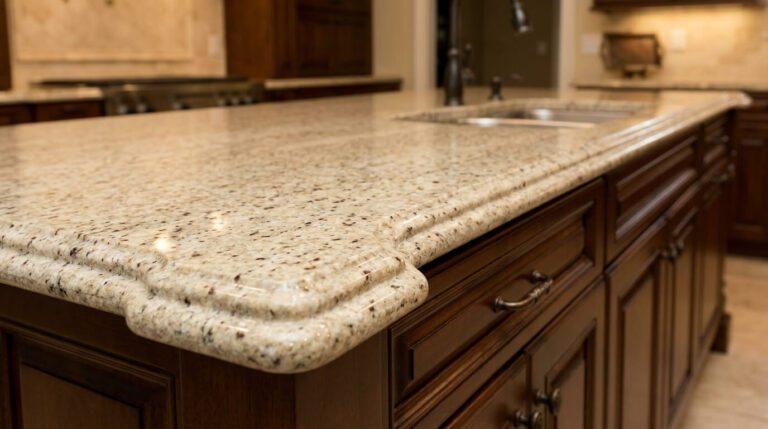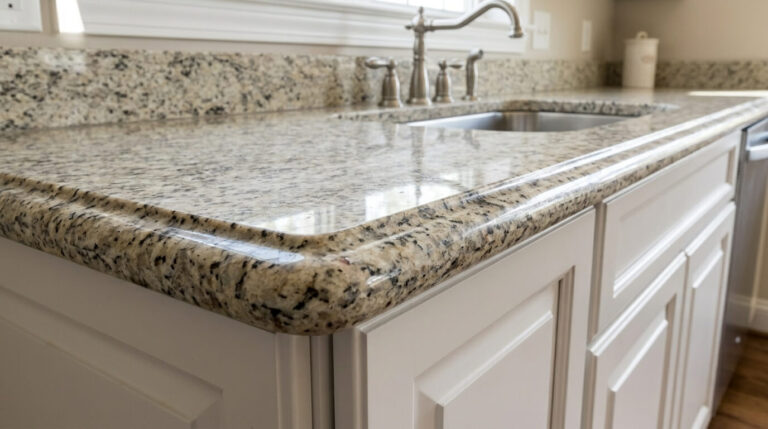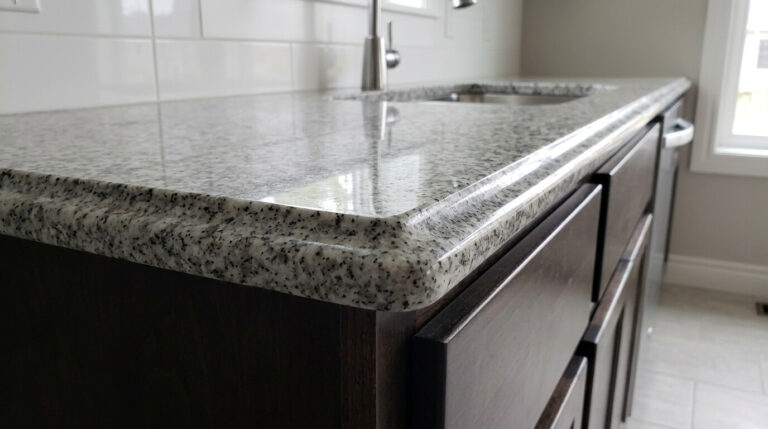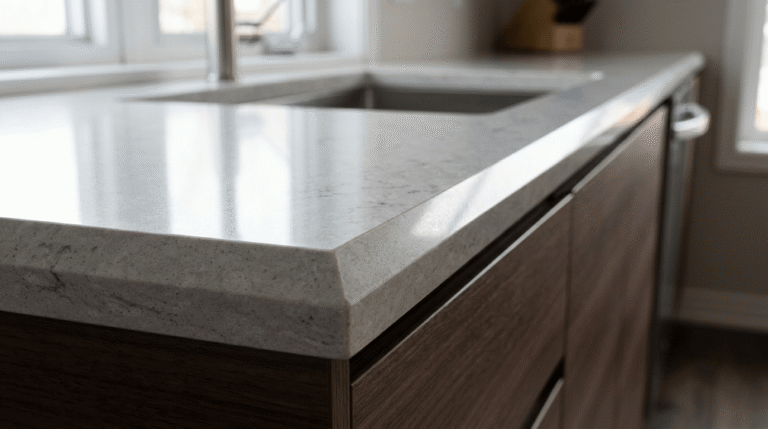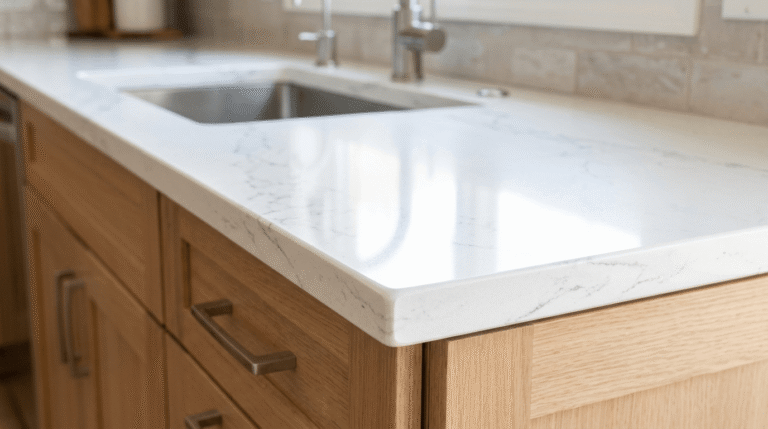
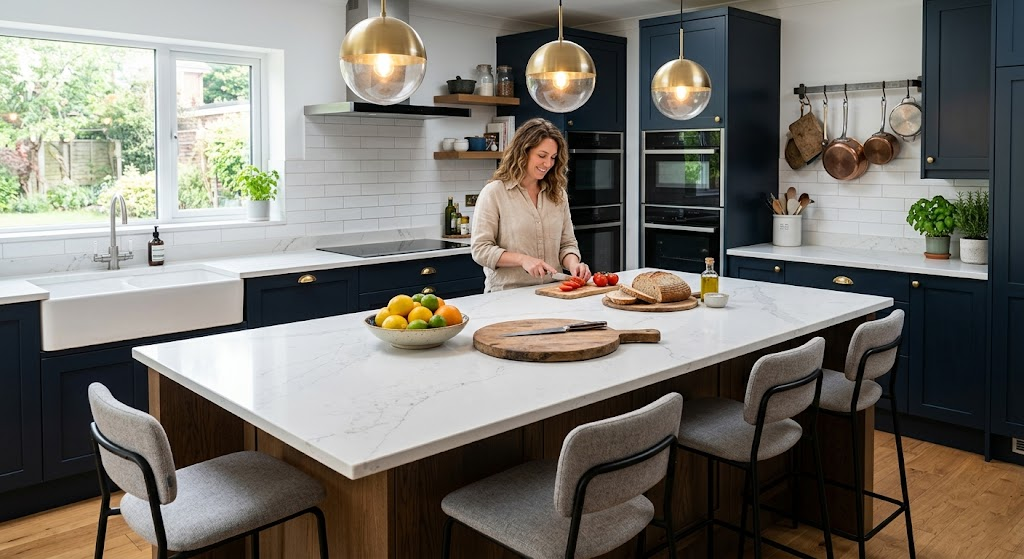
A kitchen countertop is a flat horizontal work surface installed over base cabinets at a standard height of 36 inches, covering 30 to 40 square feet in a typical kitchen. Kitchen countertops exist in 8 primary material types: quartz, granite, marble, quartzite, porcelain slab, laminate, butcher block, and concrete. Each material type carries distinct size configurations, edge profile options, and installation costs ranging from $20 to $250 per square foot.
According to the 2023/2024 Houzz U.S. Kitchen Trends Study, 46% of homeowners selected engineered quartz for current or planned kitchen renovations. The U.S. countertop market reached $28.65 billion in 2024, per Arizton Research. This guide covers kitchen countertop types by material, standard dimensions, the 8 common edge profiles, and full cost data by material and project size.
What Are the Different Types of Kitchen Countertop Materials?
There are 9 different types of kitchen countertop materials: quartz, granite, quartzite, marble, laminate, butcher block, porcelain, solid surface, and concrete. Each material differs across 6 performance dimensions: durability, heat resistance, stain resistance, scratch resistance, ease of cleaning, and sealing requirement.
- Quartz (engineered stone) consists of 90% to 94% ground natural quartz bound with polymer resins. Quartz countertops carry a Mohs hardness rating of 7, resist stains without sealing, and withstand surface temperatures up to 150°F (65°C) before resin discoloration occurs. According to the National Kitchen and Bath Association (NKBA) 2023 Design Trends Report, quartz ranks as the most-installed countertop material in U.S. kitchens, appearing in 42% of kitchen remodels. Quartz suits high-traffic kitchens and homeowners who prioritize low maintenance, as quartz requires no annual sealing and cleans with mild soap and water.
- Granite (natural igneous rock) carries a Mohs hardness rating of 6 to 7 and withstands heat up to 1,200°F (648°C) directly from pots and pans. Granite countertops require sealing once every 1 to 3 years, depending on porosity level. A standard water absorption test measures granite porosity by leaving water on the surface for 30 minutes. A dark spot forming on the surface confirms the granite slab requires immediate sealing. Granite resists scratches from knives but chips at the edges under impact. Granite suits homeowners who prefer natural stone variation and accept an annual sealing schedule.
- Quartzite (natural metamorphic rock) carries a Mohs hardness rating of 7 to 8, making quartzite harder than granite and marble. Quartzite withstands heat up to 1,650°F (899°C) and resists scratches at a higher threshold than quartz. Quartzite requires sealing every 1 to 2 years due to higher porosity compared to granite. Quartzite countertops cost between $60 and $200 per square foot installed, making quartzite one of the 3 most expensive natural stone countertop options. Quartzite suits homeowners seeking marble-like aesthetics with superior durability.
- Marble (natural metamorphic limestone) carries a Mohs hardness rating of 3 to 5, making marble the softest natural stone countertop material among the 9 types. Marble etches on contact with acidic substances including lemon juice (pH 2.0), vinegar (pH 2.4), and tomato sauce (pH 4.0), each causing permanent surface dullness within 15 minutes of contact. Marble requires sealing every 6 to 12 months. According to a 2022 study published by the Building and Construction Materials Journal, marble countertops show etching damage in 78% of residential kitchens within the first 2 years of use. Marble suits low-traffic kitchens, baking stations, and homeowners who accept high maintenance in exchange for premium aesthetics.
- Laminate (high-pressure decorative laminate, HPDL) consists of kraft paper layers saturated with phenolic resin and bonded to a particleboard substrate. Laminate carries a wear surface rating of 0.4 mm to 1.5 mm thickness. Laminate countertops resist stains and require no sealing, but laminate sustains permanent damage from heat above 275°F (135°C) and from standing water at seams. Laminate costs between $10 and $40 per square foot installed, making laminate the least expensive countertop material among the 9 types. Laminate suits budget-conscious kitchens, rental properties, and homeowners who prioritize cost over longevity.
- Butcher block (edge-grain or end-grain hardwood) consists of maple, walnut, oak, or teak strips bonded under pressure. Butcher block carries a Janka hardness rating of 1,450 lbf for hard maple and 1,010 lbf for walnut. Butcher block requires oiling with food-safe mineral oil every 1 to 3 months and sanding every 3 to 5 years to remove knife cuts and surface stains. Butcher block sustains water damage from prolonged moisture exposure and swells at joint lines when unsealed. Butcher block suits farm-style kitchens, prep areas, and homeowners who accept high maintenance for a warm, natural aesthetic.
- Porcelain (ceramic tile fired at 2,300°F / 1,260°C) carries a Mohs hardness rating of 7 to 8 and a water absorption rate below 0.5%, making porcelain the most water-resistant countertop material among the 9 types. Porcelain large-format slabs (available up to 126 × 63 inches / 320 × 160 cm) eliminate grout lines when installed as a single slab, unlike tiled porcelain applications. Porcelain resists UV fading, making porcelain one of 2 countertop materials rated for exterior installation, alongside concrete. Porcelain requires no sealing and withstands direct heat from cookware. Porcelain suits modern kitchens and homeowners prioritizing hygiene and heat resistance.
- Solid surface (acrylic or polyester resin blend, e.g., Corian by DuPont) carries a Mohs hardness rating of 1 to 2, making solid surface the softest countertop material among the 9 types. Solid surface countertops allow seamless integration of sinks and backsplashes without visible joints, a fabrication advantage over all natural stone and laminate options. Minor scratches in solid surface countertops repair with 220-grit sandpaper, unlike granite or quartz where scratches require professional refinishing. Solid surface costs between $35 and $100 per square foot installed. Solid surface suits healthcare-inspired kitchens and homeowners prioritizing seamless hygiene surfaces.
- Concrete (fiber-reinforced cement mix) allows fully custom shaping, integrated drain boards, and embedded aggregate. Concrete countertops require sealing with penetrating sealer every 1 to 3 years and waxing every 3 to 6 months to prevent staining. Concrete absorbs acidic liquids within 10 minutes of contact if unsealed. Concrete countertop installation cost ranges from $65 to $135 per square foot for custom cast-in-place fabrication. Concrete suits industrial-style kitchens and homeowners seeking fully customized countertop configurations.
What Countertop Material Requires Regular Maintenance?
Marble, butcher block, concrete, and quartzite require regular maintenance. Marble requires sealing every 6 to 12 months and etches on acid contact. Butcher block requires oiling every 1 to 3 months. Concrete requires sealing every 1 to 3 years and waxing every 3 to 6 months. Quartzite requires sealing every 1 to 2 years due to natural porosity levels above 0.5%.
What Countertop Material Requires the Least Maintenance?
Quartz, laminate, porcelain, and solid surface require the least maintenance. Quartz needs no sealing and cleans with soap and water. Laminate needs no sealing. Porcelain carries a water absorption rate below 0.5% requiring no sealing. Solid surface repairs minor scratches with 220-grit sandpaper without professional intervention.
What Countertop Height, Depth, and Thickness Should You Choose?
Kitchen countertops come in a standard height of 36 inches (91.4 cm), a standard depth of 25 to 26 inches (63.5 to 66 cm), and a standard thickness of 3 cm (1.18 inches) for natural stone slabs. These 3 dimensions, height, depth, and thickness, directly affect ergonomic usability, storage capacity underneath, and structural slab integrity over time.
Standard countertop overhang for base cabinets measures 1.5 inches (3.8 cm) beyond the cabinet face. Kitchen island countertop overhang for seating areas measures 12 inches (30.5 cm) for knee clearance at bar-height stools and 15 to 18 inches (38 to 45.7 cm) for comfortable leg room at counter-height stools. According to the American National Standards Institute (ANSI) A117.1 accessibility standard, countertop height for accessible kitchens measures 28 to 34 inches (71 to 86.4 cm) to accommodate wheelchair users.
What Is the Standard Height for a Kitchen Countertop?
The standard height for a kitchen countertop is 36 inches (91.4 cm) from finished floor to countertop surface, a dimension established by the National Kitchen and Bath Association (NKBA) to suit adults of average standing height (5 feet 6 inches / 167.6 cm). Counter-table height, used at kitchen tables or low prep areas, measures 28 to 30 inches (71 to 76.2 cm). Counter bar height, used at kitchen island bars and peninsula seating areas, measures 42 inches (106.7 cm) from finished floor to countertop surface, requiring bar stools with seat heights of 28 to 30 inches (71 to 76.2 cm).
What Is the Standard Depth for a Kitchen Countertop?
The standard depth of a kitchen countertop is 25 to 26 inches (63.5 to 66 cm), which aligns with the standard base cabinet depth of 24 inches (61 cm) plus the 1.5-inch (3.8 cm) front overhang. Kitchen island countertop depth ranges from 24 to 48 inches (61 to 122 cm) depending on island function. Prep-only islands use 24-inch depths, while islands with seating on one side use 36 to 48-inch depths to accommodate the 12 to 15-inch seating overhang without reducing prep surface area.
What Is the Standard Thickness for a Kitchen Countertop?
The standard thickness for a kitchen countertop is 3 cm (1.18 inches) for natural stone and engineered stone slabs. This dimension provides structural rigidity without requiring a plywood substrate for spans up to 30 inches (76.2 cm). A 2 cm (0.79 inch) slab requires a plywood backer for all unsupported spans. The following 4 primary materials each carry a defined standard thickness range:
- Granite: 2 cm or 3 cm slabs. A 3 cm granite slab does not require a plywood substrate for standard base cabinet spans of 24 to 30 inches.
- Quartz: 2 cm or 3 cm slabs. A 3 cm quartz engineered slab resists flexural cracking over unsupported spans up to 36 inches (91.4 cm).
- Marble: 2 cm or 3 cm slabs. A 2 cm marble slab requires full plywood backing due to marble’s lower flexural strength rating of 7 MPa versus granite’s 14.7 MPa.
- Butcher block: 1.5 inches to 4 inches (3.8 cm to 10.2 cm). End-grain butcher block requires a minimum 3-inch (7.6 cm) thickness for structural stability over base cabinet spans.
A 3 cm slab costs 15% to 25% more than a 2 cm slab of the same material due to higher raw material volume and increased fabrication time for thicker profiles. Fabricators charge a lamination fee of $10 to $20 per linear foot to build up a 2 cm slab edge to match the visual profile of a 3 cm slab, eliminating most of the price difference between 2 cm and 3 cm options.
What Is a Countertop Edge Profile?
A countertop edge, or edge profile, is the finished shape applied to the exposed front edge of a countertop slab during fabrication. This design element affects the visual style of the countertop and adds $5 to $30 per linear foot to fabrication cost depending on profile complexity. There are 13 standard countertop edge profiles available from most fabricators:
- Eased edge: A square-cut edge with a slight 1/8-inch (3.2 mm) corner break on the top and bottom edges. Eased edge costs the least among the 13 profiles, is typically included in base fabrication pricing, and suits contemporary, minimalist, and transitional kitchen styles.
- Waterfall edge: A 90-degree vertical drop from countertop surface to cabinet or island side, creating a continuous slab appearance. Waterfall edge requires additional slab material for the vertical panel and adds $50 to $150 per linear foot to total material cost. Waterfall edge suits ultra-modern and high-end kitchen designs.
- Bevel edge: A single angled cut at 45 degrees across the top edge, measuring 1/4 inch to 1/2 inch (6.4 to 12.7 mm) in width. Bevel edge adds $5 to $10 per linear foot to fabrication cost and suits transitional and contemporary kitchens.
- Half bullnose edge: A rounded top edge with a flat bottom, creating a half-circle profile on the upper corner. Half bullnose adds $8 to $15 per linear foot and suits traditional and transitional kitchen styles.
- Double radius edge: A curved profile on both the top and bottom edges of the countertop, creating a softened rectangular appearance. Double radius adds $10 to $18 per linear foot and suits child-friendly kitchens due to the absence of sharp corners.
- Bullnose edge: A fully rounded edge profile forming a complete half-circle (180 degrees) across the full thickness of the slab. Bullnose adds $10 to $20 per linear foot, eliminates sharp edges entirely, and suits traditional kitchens and households with young children.
- Double bevel edge: Angled 45-degree cuts on both the top and bottom edges of the slab. Double bevel adds $12 to $20 per linear foot and suits contemporary and modern kitchen styles.
- Classic ogee edge: An S-curve profile combining a concave arc with a convex arc, creating a decorative profile with a 1-inch (2.54 cm) design height. Classic ogee adds $15 to $25 per linear foot and suits traditional and ornate kitchen styles.
- Step half bullnose edge: A two-tier profile with a stepped flat section below the half bullnose top curve, creating a layered appearance. Step half bullnose adds $15 to $22 per linear foot and suits transitional kitchens seeking decorative detail at a moderate cost.
- Bevel bullnose edge: A combination profile with a beveled top corner and a bullnose bottom curve. Bevel bullnose adds $15 to $22 per linear foot and suits contemporary kitchens with mixed design elements.
- Double ogee edge: A mirrored S-curve profile with two ogee arcs: one on the top half and one on the bottom half of the slab edge. Double ogee adds $20 to $30 per linear foot and suits formal, traditional kitchens with ornate cabinetry.
- Triple pencil edge: Three parallel 1/8-inch (3.2 mm) grooves routed into the slab edge face, creating a three-line decorative detail. Triple pencil adds $18 to $25 per linear foot and suits traditional and craftsman kitchen styles.
- Dupont bullnose edge: A combination profile with a flat top, a curved mid-section, and a flat bottom, creating a stepped waterfall appearance. Dupont bullnose adds $20 to $30 per linear foot and represents one of the 3 most expensive standard edge profiles due to multi-pass CNC fabrication requirements.
What Is the Most Popular Countertop Edge Profile?
Eased edge profile is the most popular countertop edge profile, selected in approximately 60% of residential kitchen countertop installations according to fabrication industry data compiled by the Marble Institute of America (MIA). Eased edge suits contemporary and transitional design styles, carries no additional fabrication surcharge over base pricing, and maintains the cleanest sightline between countertop surface and cabinet face. Eased edge is the default profile specification for most kitchen remodels across all countertop material types.
How Much Does a Kitchen Countertop Cost?
Kitchen countertop installation costs between $15 and $200 per square foot, with an average total project cost of $2,500 to $4,500 for a standard 30 to 40 square foot kitchen countertop surface. According to Remodeling Magazine’s 2024 Cost vs. Value Report, countertop material and installation represent 10% to 15% of a full kitchen remodel budget, which averages $26,790 for a mid-range kitchen remodel and $77,939 for a major upscale kitchen remodel in the United States.
The following table shows cost per square foot by material for supply, fabrication, and installation combined:
| Material | Cost per Sq Ft (Low) | Cost per Sq Ft (High) | Average Total (30 Sq Ft) |
|---|---|---|---|
| Laminate | $10 | $40 | $750 |
| Solid Surface | $35 | $100 | $2,025 |
| Butcher Block | $40 | $100 | $2,100 |
| Quartz | $50 | $120 | $2,550 |
| Granite | $45 | $150 | $2,925 |
| Porcelain | $55 | $130 | $2,775 |
| Concrete | $65 | $135 | $3,000 |
| Marble | $60 | $180 | $3,600 |
| Quartzite | $60 | $200 | $3,900 |
The table above reflects installed cost per square foot including material, templating, fabrication, delivery, and standard installation labor. Costs exclude cutouts, seam charges, edge profile upgrades, backsplash installation, and removal of existing countertops.
Slab thickness directly affects material cost: a 3 cm slab costs 15% to 25% more per square foot than a 2 cm slab of the same material. 8 additional cost factors beyond base material price determine the final installed cost of a kitchen countertop:
- Templating: Costs $150 to $300 per project for CNC laser measuring of cabinet dimensions before slab cutting.
- Fabrication: Costs $10 to $30 per square foot for CNC cutting, edge profiling, and surface finishing beyond base material pricing.
- Delivery: Costs $100 to $300 depending on slab weight. A 3 cm granite slab weighs approximately 18 to 20 lbs per square foot, requiring 2-person delivery crews for slabs over 40 square feet.
- Installation labor: Costs $10 to $30 per square foot for adhesive setting, shimming, and seam alignment.
- Sink cutouts: Cost $100 to $300 per cutout. Undermount sink cutouts cost 20% to 40% more than drop-in cutouts due to polished interior edge requirements.
- Cooktop cutouts: Cost $80 to $200 per cutout for gas cooktop or electric cooktop openings.
- Seams: Cost $100 to $300 per seam. Each seam requires color-matched epoxy, clamp alignment, and a 24-hour cure period. Kitchen layouts exceeding one slab width, typically 65 inches (165 cm), require at least 1 seam.
- Old countertop removal and disposal: Costs $150 to $500 depending on material weight and disposal regulations. Granite and concrete removal costs 30% to 50% more than laminate removal due to weight-related labor requirements.
Sink cutout placement, cooktop cutout placement, seam location, slab layout direction, and countertop shape complexity (L-shape, U-shape, peninsula, island) each add fabrication time at a rate of $50 to $150 per hour for CNC programmer and fabricator labor. A U-shaped kitchen countertop layout with 3 seams, 2 sink cutouts, and 1 cooktop cutout costs 35% to 55% more than a straight-run layout of equal square footage, based on fabrication complexity pricing from the Marble Institute of America (MIA) 2023 Fabrication Cost Survey.
Buying a kitchen countertop requires evaluating material durability, sealing frequency, standard dimensions (36-inch height, 25 to 26-inch depth, 3 cm thickness), edge profile selection from 13 available styles, and a total installed cost between $15 and $200 per square foot. Quartz covers 42% of U.S. kitchen remodels due to zero sealing requirements and a Mohs hardness of 7. Marble, butcher block, concrete, and quartzite carry the highest maintenance schedules among the 9 material types. Eased edge profile appears in approximately 60% of residential installations as the lowest-cost and most versatile edge option. Final countertop cost depends on 8 factors beyond material price: templating, fabrication, delivery, installation, sink cutouts, cooktop cutouts, seams, and removal. Total project budgeting before material selection determines the final installed cost accurately.