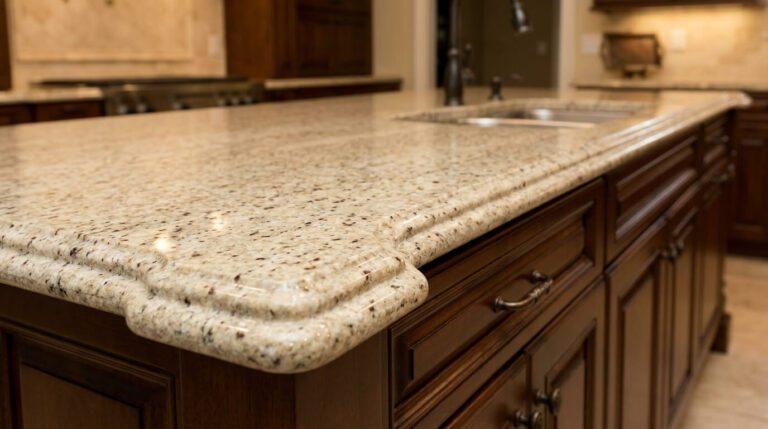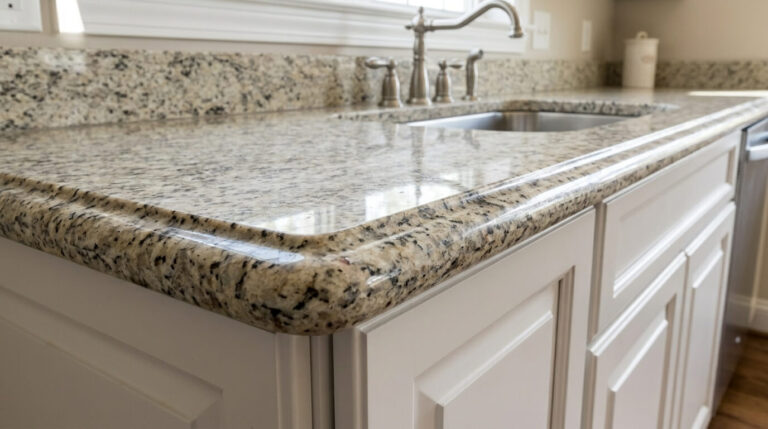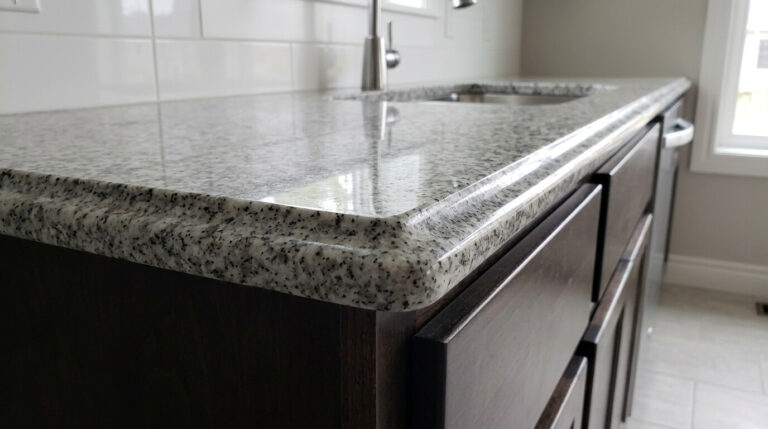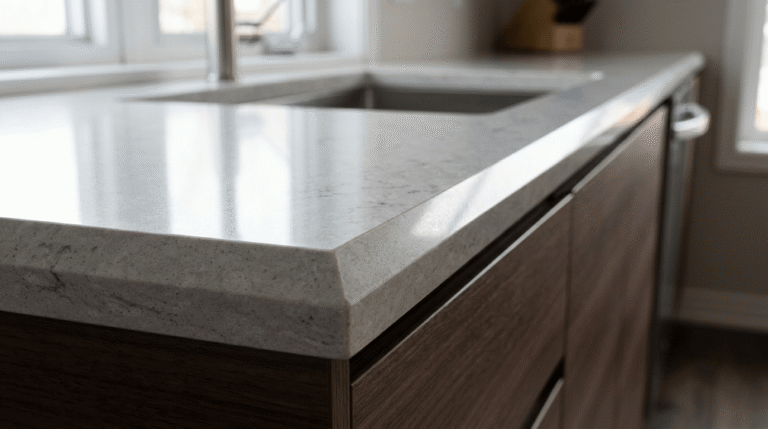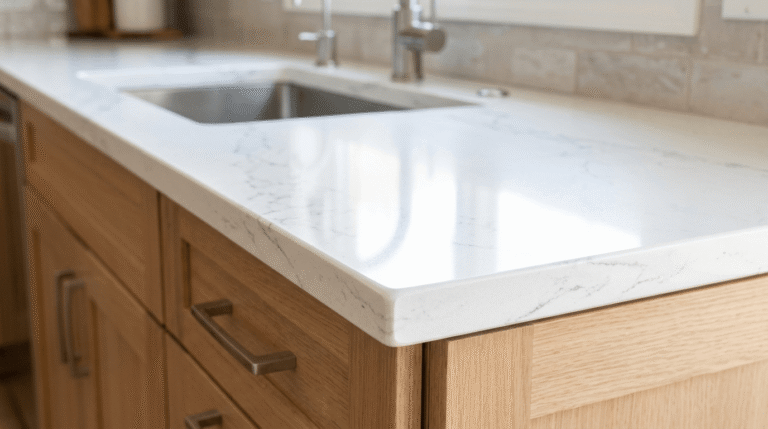
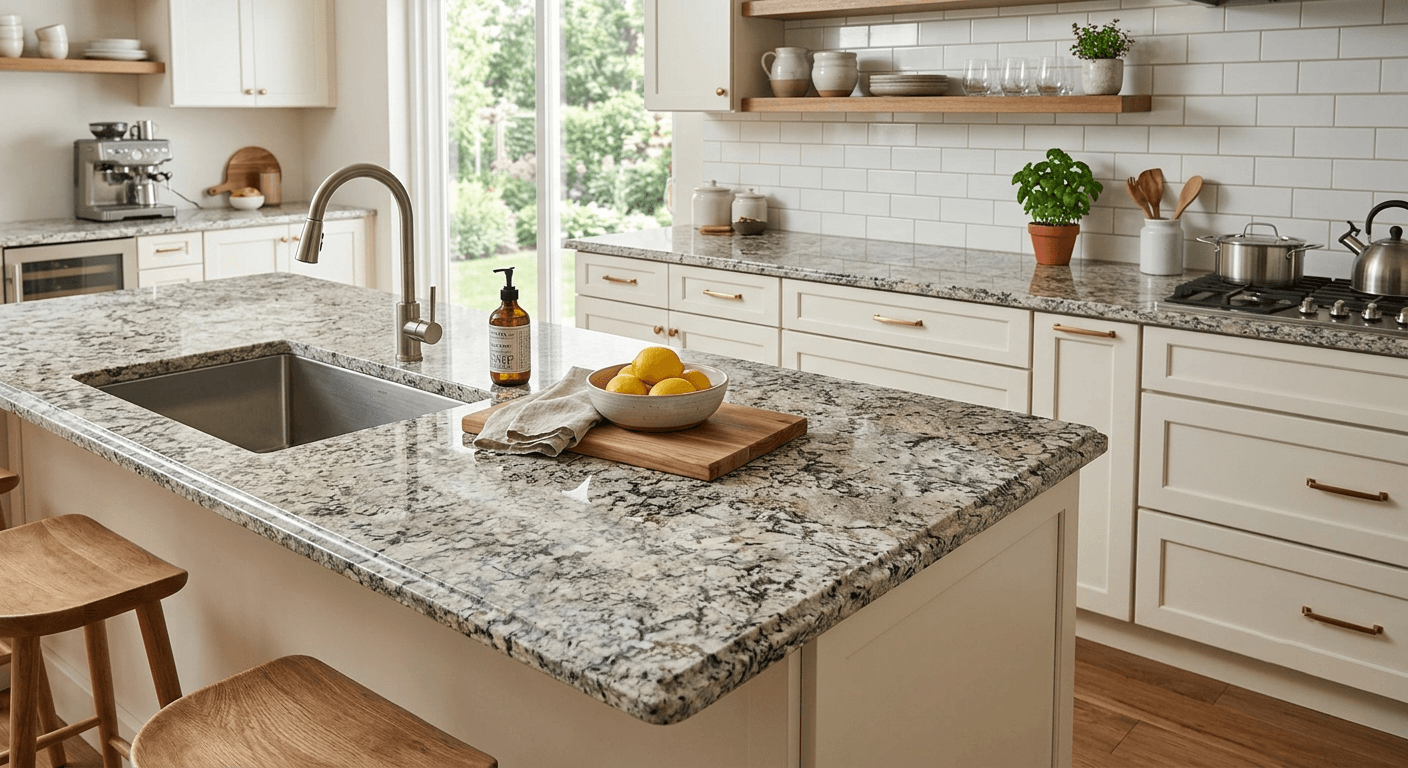
Granite countertop thickness determines how a slab performs, how much it weighs, and how it must be supported. Fabricators produce granite slabs in two primary thicknesses, 2 centimeters and 3 centimeters, and each thickness suits different applications, edge treatments, and structural conditions.
Thickness affects more than appearance. It changes the weight per square foot, the load a cabinet box must carry, the number of seams a layout requires, and the edge profiles available to a homeowner or fabricator. A countertop that uses the wrong thickness for its application can crack under load, require additional plywood backing, or exceed the weight limit of standard cabinetry.
This guide covers standard granite thickness options, how thickness applies to kitchen countertops, slab size and dimensions, granite weight by thickness, and the factors that determine the right thickness for a given project.
What Is Standard Granite Countertop Thickness?
Standard granite countertop thickness is 2 centimeters (0.79 inch) or 3 centimeters (1.18 inches). Fabricators and stone suppliers stock both thicknesses as the industry-standard sizes for slab granite, and most quarries cut raw blocks to these two dimensions before polishing.
The 2cm slab measures roughly 20 millimeters thick and typically requires a plywood substrate for support on horizontal surfaces such as kitchen countertops. The 3cm slab measures roughly 30 millimeters thick and carries its own weight across standard cabinet spans without added backing. Trade documentation commonly rounds these measurements to 3/4 inch and 1 1/4 inch, though the precise metric-to-imperial conversion produces slightly different decimal values.
The table below lists standard granite thickness in centimeters, millimeters, and inches, along with the common trade name used by fabricators and suppliers.
| Centimeters | Millimeters | Inches (measured) | Common Trade Reference |
|---|---|---|---|
| 2 cm | 20 mm | 0.79 in | “3/4 inch” granite |
| 3 cm | 30 mm | 1.18 in | “1 1/4 inch” granite |
Fabricators use these two thicknesses as the baseline for pricing, edge fabrication, and structural planning. Thicker profiles, such as laminated or mitered edges that appear 4cm or 6cm thick, build on a 2cm or 3cm base slab rather than representing a separate quarried thickness.
2cm vs. 3cm Granite: What’s the Difference?
2cm granite and 3cm granite differ in thickness, weight, support requirements, and edge appearance. The 3cm slab weighs roughly 50% more per square foot than the 2cm slab and does not require plywood backing on standard countertop spans, while the 2cm slab needs a plywood substrate to prevent flexing and cracking.
The thickness difference also changes the visible edge profile. A 3cm slab produces a thicker, more substantial-looking edge without lamination, while a 2cm slab requires a mitered or built-up edge to achieve the same visual thickness. Fabrication cost per square foot generally runs higher for 3cm granite because it consumes more raw material and adds weight to transport and installation, though exact pricing varies by supplier and region.
Granite Thickness in Inches (cm-to-Inch Conversion)
2cm granite converts to 0.79 inch, and 3cm granite converts to 1.18 inches. The metric-to-imperial conversion uses the standard formula of 1 centimeter equal to 0.3937 inch, applied directly to the slab thickness.
| Metric Thickness | Exact Inch Conversion | Trade-Rounded Value |
|---|---|---|
| 2 cm | 0.79 in | 3/4 in |
| 3 cm | 1.18 in | 1 1/4 in |
Suppliers and fabricators typically use the trade-rounded values in sales materials and cut sheets, since the rounded figures align with standard lumber and substrate measurements used during installation. The exact decimal values matter most when a project requires precise clearance calculations, such as fitting a slab against an existing appliance or cabinet edge.
Granite Thickness for Kitchen Countertops
Kitchen countertops in the United States most commonly use 3cm granite. The thicker slab supports the weight of cookware, appliances, and overhang sections without additional plywood backing, which reduces labor during installation.
Some kitchens use 2cm granite over a plywood substrate to reduce material cost and overall weight, particularly in regions or store lines where 2cm is the standard stocked thickness. Both thicknesses meet structural requirements for kitchen use when installed with proper support, and the choice between them depends on budget, desired edge appearance, and cabinet load capacity.
Thin Granite Countertop Options (and When They Work)
Thin granite countertop options include 2cm and, in some product lines, 1.2cm slabs, and they work best when installed over a plywood substrate or on vertical and low-load surfaces. The plywood backing distributes weight and prevents the thinner stone from flexing under point loads.
Thin granite suits backsplashes, vertical wall applications, and budget-conscious kitchen or bathroom projects where the plywood substrate is factored into the installation plan. It also reduces total countertop weight, which benefits projects with older cabinetry or lighter-duty base structures. Thin granite is less suitable for large unsupported overhangs, since the reduced thickness lowers the slab’s resistance to cracking under concentrated weight.
Thick Granite Countertops for Waterfall Edges & Islands
Thick granite countertops for waterfall edges and islands use 3cm slabs, often mitered or laminated to produce a visual thickness of 4cm to 6cm along exposed edges. The mitered technique joins two pieces of 3cm granite at a 45-degree angle so the seam remains hidden, creating a solid-looking thick edge.
Waterfall edges extend the countertop material vertically down the side of an island or cabinet run, and this application requires the added strength of 3cm stock to support the extended, unsupported drop. Kitchen islands also commonly use laminated 3cm edges because islands carry more foot traffic, leaning weight, and seating use than perimeter counters, and the additional edge thickness improves both durability and visual proportion.
Granite Slab Size and Dimensions
Standard granite slabs measure approximately 9 to 10 feet long and 5.5 to 6.5 feet wide, though exact dimensions vary by quarry and stone type. Fabricators cut countertop pieces from these larger slabs based on the project’s layout and the slab’s usable area.
Slab size directly limits how large a single countertop section can be without a seam. Granite quarries produce slabs in these general ranges because larger blocks become difficult to extract, transport, and handle without cracking, which sets a practical upper limit on slab dimensions across the industry.
Standard Slab Length and Width
Standard granite slab length ranges from about 9 feet to 10 feet, and standard width ranges from about 5.5 feet to 6.5 feet. These dimensions apply to full slabs before a fabricator cuts them into countertop sections, sink cutouts, and edge pieces.
Slab dimensions vary by stone origin and quarry equipment, so two granite colors from different regions may yield slightly different maximum slab sizes. A fabricator confirms exact slab dimensions for a specific granite selection before finalizing a layout, since actual usable dimensions run smaller than the raw slab size once damaged edges and natural fissures are excluded.
How Slab Size Relates to Your Countertop Layout
Slab size determines how many continuous feet of countertop a single piece of granite can cover before a seam becomes necessary. A kitchen layout that exceeds the slab’s usable length or width requires at least one seam, typically placed at a low-visibility location such as beside a sink or cooktop.
Layouts with large islands, long runs, or waterfall edges consume more of a slab’s total area, which increases the number of slabs a project requires and affects how much usable material remains for other sections. A fabricator maps the countertop layout against the slab’s actual dimensions, accounting for the sink cutout, seam placement, and natural pattern variation, before cutting the stone.
How Much Does a Granite Countertop Weigh?
A granite countertop weighs approximately 12 to 13 pounds per square foot at 2cm thickness and approximately 18 to 19 pounds per square foot at 3cm thickness. Total countertop weight scales directly with the square footage of the installed area and the slab’s thickness.
Granite’s density, roughly 175 pounds per cubic foot, drives this weight calculation across both standard thicknesses. A typical 30-square-foot kitchen countertop in 3cm granite weighs approximately 540 to 570 pounds before accounting for sink cutouts, which reduce total weight slightly.
Weight by Thickness (2cm vs. 3cm per Square Foot)
2cm granite weighs approximately 12 to 13 pounds per square foot, and 3cm granite weighs approximately 18 to 19 pounds per square foot. The roughly 50% weight increase from 2cm to 3cm follows directly from the 50% increase in material thickness.
| Thickness | Approximate Weight per Square Foot |
|---|---|
| 2 cm | 12–13 lbs |
| 3 cm | 18–19 lbs |
These figures apply to solid, unlaminated granite. Laminated or mitered edges that build up to 4cm or 6cm add localized weight along the edge without increasing the weight of the field area, which fabricators account for separately when calculating cabinet load.
What Granite Weight Means for Cabinet Support
Granite weight determines whether standard cabinetry can support a countertop without reinforcement. Standard kitchen base cabinets are built to carry the weight of 2cm or 3cm granite across typical spans, but overhangs, islands, and peninsulas often need additional support.
Unsupported overhangs beyond 6 to 12 inches, depending on thickness and local fabrication standards, typically require corbels, brackets, or a plywood buildout to prevent the slab from cracking under its own weight or applied pressure. Heavier 3cm installations and waterfall-edge islands place greater load on the base structure, so a fabricator or contractor evaluates cabinet construction, floor support, and overhang distance before finalizing the thickness and layout.
How to Choose the Right Granite Thickness
The right granite thickness depends on the application, the required support structure, the desired edge appearance, and the budget for material and installation. Kitchen countertops generally favor 3cm for its self-supporting strength, while budget projects, vertical surfaces, and plywood-backed installations can use 2cm effectively.
Fabricators also weigh cabinet load capacity, overhang length, and edge style when recommending a thickness, since these factors interact directly with the weight and support differences between 2cm and 3cm stone. For a broader comparison of thickness standards across countertop materials, see the countertop thickness guide.
When 2cm Makes Sense
2cm granite makes sense when the project uses a plywood substrate, prioritizes lower weight, or targets a lower material cost. It suits kitchens with lighter-duty cabinetry, bathroom vanities, and backsplash applications where the plywood backing supplies the structural support the thinner stone lacks on its own.
When 3cm Makes Sense
3cm granite makes sense when the countertop needs to span standard cabinet distances without plywood backing, support overhangs, or form a waterfall edge or island. Kitchens, islands, and any layout with unsupported edges benefit from 3cm’s added thickness and self-supporting strength.
Common Problems With Granite Thickness Choices
Choosing the wrong granite thickness for a given application creates several recurring problems.
- Cracking under overhangs: A 2cm slab installed without plywood backing or adequate support brackets can crack under an unsupported overhang beyond a few inches.
- Excess cabinet load: Installing 3cm granite over cabinetry rated for lighter loads can stress the cabinet frame, particularly on long runs or large islands.
- Visible seams from slab-size mismatches: A layout that ignores standard slab length and width forces additional seams, which increases visible joints and installation cost.
- Edge appearance mismatches: Selecting 2cm granite for a waterfall edge or thick-profile island without lamination produces a thin, less substantial edge than the design intended.
- Underestimated weight during planning: Failing to calculate total weight for a large 3cm island can result in a base structure that cannot support the finished countertop without reinforcement.
Each of these problems traces back to a mismatch between the selected thickness and the structural or aesthetic demands of the installation.
Granite vs. Other Stone Countertop Thickness Standards
Granite’s standard 2cm and 3cm thicknesses align closely with the thickness standards used for other natural and engineered stone countertop materials, though support requirements and typical applications vary by material.
| Material | Standard Thicknesses | Typical Support Requirement |
|---|---|---|
| Granite | 2 cm, 3 cm | Plywood backing at 2cm; self-supporting at 3cm |
| Marble | 2 cm, 3 cm | Plywood backing recommended at 2cm due to marble’s lower impact resistance |
| Quartzite | 2 cm, 3 cm | Similar to granite; self-supporting at 3cm |
| Engineered Quartz | 2 cm, 3 cm | Often self-supporting at both thicknesses due to resin binding |
Natural stones such as granite, marble, and quartzite share the same 2cm and 3cm industry-standard thicknesses because fabricators cut all three from quarried blocks using comparable equipment. Engineered quartz differs slightly in structural behavior: its resin-bound composition often allows 2cm slabs to span standard cabinet distances with less risk of cracking than natural stone at the same thickness, though manufacturers still recommend backing for larger spans or overhangs.