Quartz countertop thickness determines a slab’s weight, structural strength, edge appearance, and compatibility with cabinets and support systems. Fabricators produce quartz slabs in a limited range of standard thicknesses, and each option affects cost, durability, and installation requirements differently.
Homeowners and contractors select quartz thickness based on the countertop’s location, the span between supports, the desired edge profile, and the load the surface must carry. A kitchen island with an unsupported overhang requires different thickness considerations than a bathroom vanity or a backsplash.
This article explains standard quartz thickness measurements, the available thickness options, how thickness affects weight and slab dimensions, and the factors that determine the right thickness for a given installation.
What Is the Standard Thickness for Quartz Countertops?
The standard thickness for quartz countertops is 2 centimeters (3/4 inch) or 3 centimeters (1 1/4 inches). Quartz fabricators manufacture slabs almost exclusively in these two thicknesses for residential and commercial countertops.
The 2cm option produces a slimmer profile and requires a plywood substrate for structural support in most installations. The 3cm option produces a thicker, heavier slab that does not require a substrate and shows a more substantial edge when viewed from the front.
The following table lists standard quartz countertop thicknesses in inches, centimeters, and millimeters.
| Thickness Category | Inches | Centimeters | Millimeters |
|---|---|---|---|
| Thin quartz | 1/2 in | 1.2 cm | 12 mm |
| Standard (thin) | 3/4 in | 2 cm | 20 mm |
| Standard (thick) | 1 1/4 in | 3 cm | 30 mm |
The 2cm and 3cm thicknesses cover the majority of residential quartz installations. Manufacturers reserve the 1.2cm option for specific applications such as vertical surfaces, cladding, or projects that require a lightweight slab.
Quartz Countertop Thickness Options
Quartz countertops are available in three primary thickness categories: 2cm, 3cm, and thin profiles under 2cm. Each category serves a distinct set of applications based on required strength, weight, and appearance.
Fabricators select a thickness category based on the countertop’s function, the span it must cover, and the edge style the project requires. A single kitchen can combine multiple thickness categories, such as 3cm for the main counters and thinner quartz for a backsplash.
2cm Quartz Countertops
2cm quartz countertops measure 3/4 inch thick and represent one of the two most common quartz thickness options for kitchens and bathrooms. A 2cm slab requires a plywood substrate underneath to reinforce the surface and support standard countertop loads.
The substrate adds rigidity that the thinner slab does not provide on its own, which allows a 2cm countertop to span standard cabinet widths without excessive flexing. Fabricators typically build up the front edge of a 2cm countertop by laminating a second strip of quartz underneath, creating the visual appearance of a thicker slab without the added material cost of a full 3cm top.
2cm quartz costs less per square foot than 3cm quartz because it uses less raw material. The reduced weight also simplifies transport and installation on upper-level projects.
3cm Quartz Countertops
3cm quartz countertops measure 1 1/4 inches thick and form the second standard thickness used throughout the quartz countertop industry. A 3cm slab does not require a plywood substrate because its greater mass provides sufficient structural rigidity on its own.
The thicker profile produces a more substantial visual edge, which many kitchen designs use as a design feature without additional edge lamination. 3cm quartz costs more per square foot than 2cm quartz and adds more weight to cabinets and support structures.
Fabricators commonly recommend 3cm quartz for kitchen islands, waterfall edges, and countertops with wider unsupported overhangs, since the added thickness resists deflection under load.
Thin Quartz Countertops (Under 2cm)
Thin quartz countertops measure less than 2cm, most commonly 1.2cm (12mm), and serve applications where reduced weight and slimness take priority over maximum structural strength. Thin quartz requires continuous substrate support across its entire surface, unlike 2cm and 3cm slabs that can span standard cabinet openings.
Fabricators use thin quartz for wall cladding, shower surrounds, furniture surfaces, and renovation projects where an existing countertop is overlaid rather than replaced. Thin quartz is not standard for load-bearing kitchen countertops because its reduced mass increases the risk of cracking under point loads or impact.
How Thickness Affects Quartz Countertop Weight
Quartz countertop thickness directly affects weight, since a thicker slab contains more engineered stone material per square foot. A 3cm slab weighs approximately 50% more than a 2cm slab of the same surface area, because the additional 1cm of material adds proportional mass.
Weight becomes a critical factor when planning cabinet support, floor loading for upper-level installations, and the number of people required to move and install a slab safely. Fabricators calculate total countertop weight before installation to confirm that existing cabinets and framing can support the finished surface.
Quartz Weight by Thickness (2cm vs 3cm)
2cm quartz weighs approximately 12 to 13 pounds per square foot, while 3cm quartz weighs approximately 18 to 20 pounds per square foot. The exact weight varies by manufacturer because quartz composition (the ratio of crushed quartz to polymer resin) differs slightly between brands.
A typical 30-square-foot kitchen countertop in 2cm quartz weighs approximately 360 to 390 pounds, while the same area in 3cm quartz weighs approximately 540 to 600 pounds. The weight difference affects the number of installers required and the type of lifting equipment used during installation.
Weight per Square Foot (for Cabinet & Structural Planning)
Cabinet manufacturers and structural planners use weight-per-square-foot figures to confirm that base cabinets, support brackets, and floor framing can carry the finished countertop load. Standard kitchen base cabinets support 3cm quartz without modification in most residential installations, since cabinet construction accounts for typical stone countertop loads.
Overhangs and islands require additional support when the unsupported span exceeds the manufacturer’s recommended limit for the selected thickness. Corbels, brackets, or a plywood support structure distribute the weight of the overhanging quartz and prevent stress on the front edge of the cabinet run.
Quartz Slab Sizes and Dimensions
Quartz slabs are manufactured in standard rectangular dimensions that determine how much continuous countertop a single slab can cover. Slab size, combined with thickness, determines whether a countertop layout requires seams and where fabricators can place them.
Manufacturers produce standard slabs and jumbo slabs, with jumbo sizes reducing the need for seams on larger kitchen layouts. Slab availability varies by brand and quarry, so exact dimensions differ slightly across manufacturers.
Standard Slab Length and Width
Standard quartz slabs typically measure 120 inches (305 cm) in length by 55 inches (140 cm) in width. Jumbo quartz slabs typically measure 126 inches (320 cm) in length by 63 inches (160 cm) in width, providing additional surface area for larger countertop runs.
Slab dimensions apply regardless of thickness, since manufacturers produce both 2cm and 3cm slabs in the same length and width categories. The usable surface area of a slab is slightly smaller than its full dimensions because fabricators trim the outer edges to remove manufacturing imperfections.
How Slab Size and Thickness Affect Seams and Layout
Slab size determines the maximum continuous countertop length a single piece of quartz can cover, while thickness affects how visible a seam appears once two slabs are joined. A kitchen layout that exceeds the slab’s length or width requires a seam, positioned by the fabricator to minimize visibility and avoid high-stress areas such as sink cutouts.
Thicker 3cm slabs produce a more visible seam line along the front edge because the seam spans a greater vertical surface. Fabricators typically place seams near the back of the countertop, away from sinks and cooktops, to reduce both visual impact and exposure to water and heat.
How to Choose the Right Thickness for Your Kitchen
Choose quartz thickness based on the countertop’s location, the span between cabinet supports, the desired edge appearance, and budget constraints. 3cm quartz suits kitchen islands, waterfall edges, and countertops with wide overhangs because its added mass resists deflection without extra support.
2cm quartz suits standard perimeter counters over continuous cabinet runs, where a plywood substrate provides the necessary support and the front edge can be built up to match the appearance of a thicker slab. Bathroom vanities and smaller countertop sections also commonly use 2cm quartz, since the shorter spans require less structural reinforcement.
Budget affects thickness selection because 3cm quartz costs more per square foot due to higher material use. A kitchen that combines both thicknesses, using 3cm for visible islands and 2cm for perimeter counters, balances appearance and cost across the overall project. For related guidance on how these dimensions apply to other stone types, see countertop thickness for related countertop materials.
Countertop and Backsplash Edge Thickness
Countertop and backsplash edge thickness refers to the visible vertical measurement along the front of the countertop and the surface behind the sink and cooktop area. Edge thickness depends on the slab thickness selected and any additional lamination applied during fabrication.
Fabricators distinguish edge thickness from slab thickness because lamination techniques allow a thinner slab to display a thicker front edge without increasing the material cost of the entire countertop.
Standard Edge Thickness
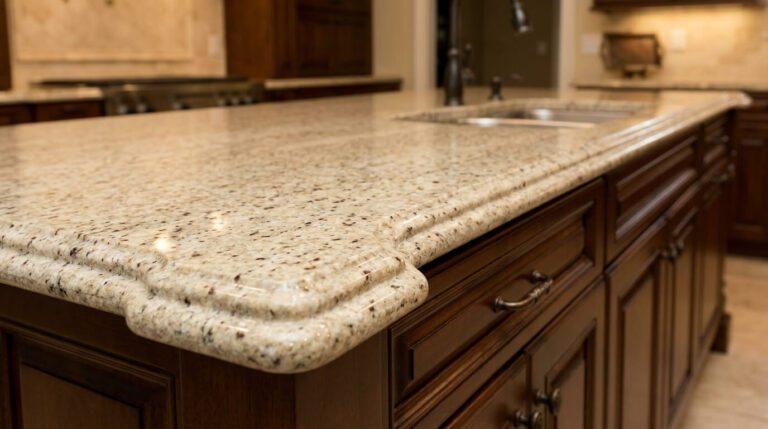
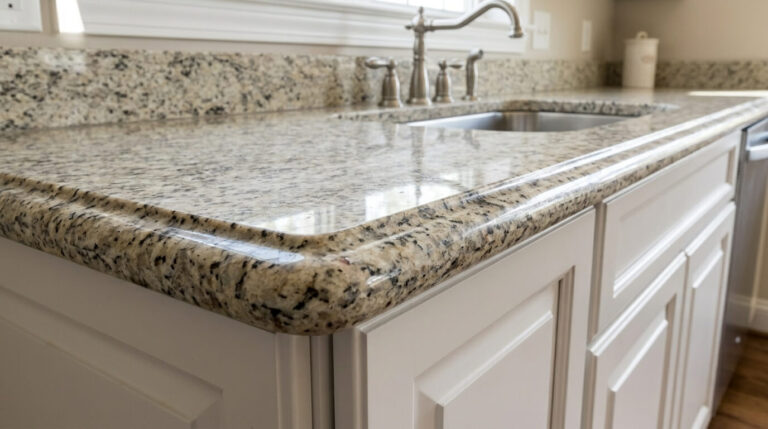
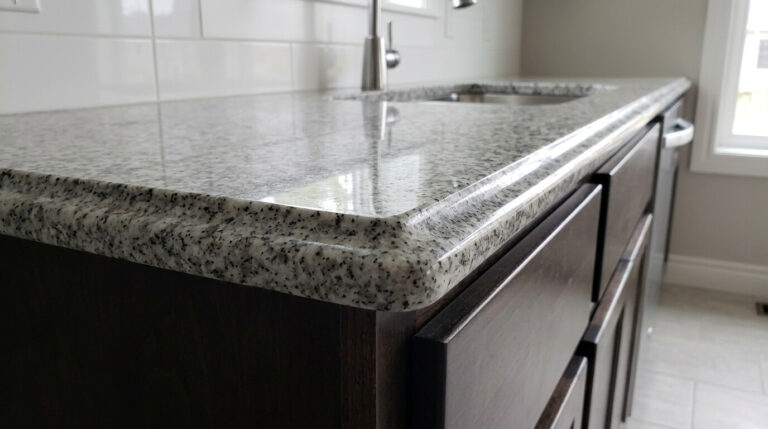
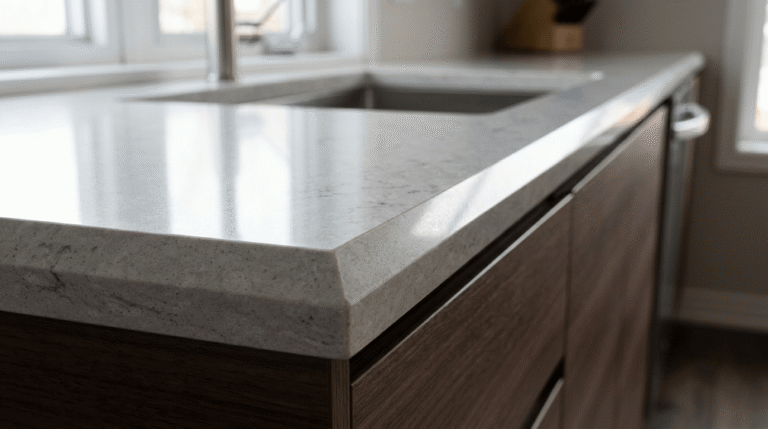
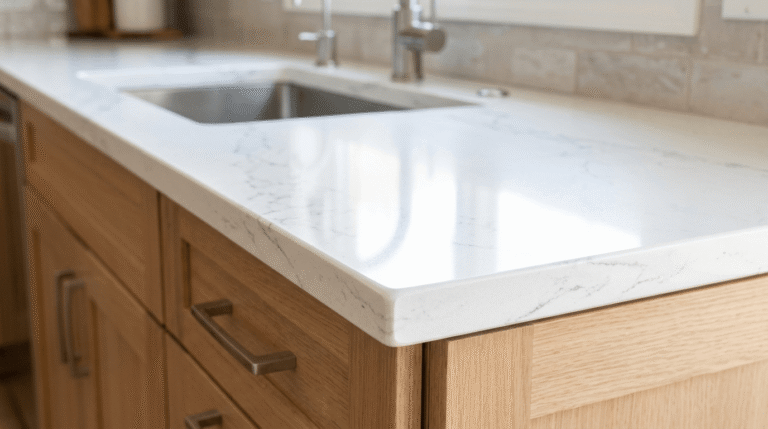
Standard edge thickness matches the slab thickness of 2cm or 3cm unless the fabricator applies a laminated edge. A laminated 2cm countertop commonly displays a 4cm edge by bonding a second strip of quartz underneath the front edge, while a laminated 3cm countertop can reach a 6cm edge using the same technique.
Edge thickness affects the visual weight of the countertop and the choice of edge profile, since thicker edges accommodate detailed profiles such as bullnose, ogee, or waterfall styles more effectively than thin edges.
Backsplash Thickness
Backsplash thickness commonly ranges from 3/8 inch (10mm) to the full thickness of the countertop slab, depending on the design. A standard 4-inch backsplash typically uses a thinner offcut of quartz, while a full-height backsplash matches the countertop’s slab thickness for visual consistency.
Fabricators select backsplash thickness based on available offcut material from the countertop slab and the design requirement for a seamless transition between the countertop and wall surface.
How to Measure for a Quartz Countertop
To measure for a quartz countertop, record the length and depth of each countertop section, the location of sink and cooktop cutouts, and the overhang distance for any unsupported edges. Measure from wall to wall for each run, and record cabinet depth separately from the finished countertop depth, since quartz typically overhangs the cabinet face by 1 to 1.5 inches.
Include the thickness specification in the measurement plan, since 2cm and 3cm slabs affect the total weight the cabinets must support and the clearance needed under appliances such as dishwashers and cooktops. Professional fabricators typically perform a final template measurement using digital or physical templates after cabinet installation to confirm exact dimensions before cutting the slab.
Is Quartz Strong Enough at Thinner Thicknesses?
Quartz remains structurally strong at 2cm thickness when installed with a plywood substrate, but thinner profiles under 2cm require continuous support to prevent cracking under load. The polymer resin binder in engineered quartz provides flexibility that natural stone lacks, which allows thinner quartz slabs to resist cracking better than comparably thin natural stone.
2cm quartz with proper substrate support performs reliably for standard kitchen and bathroom use, including everyday impacts and typical countertop loads. Thin quartz under 2cm, such as 1.2cm slabs, requires full substrate backing across the entire surface and is not recommended for unsupported spans, overhangs, or areas subject to heavy point loads, since the reduced material thickness lowers resistance to impact and flexing.