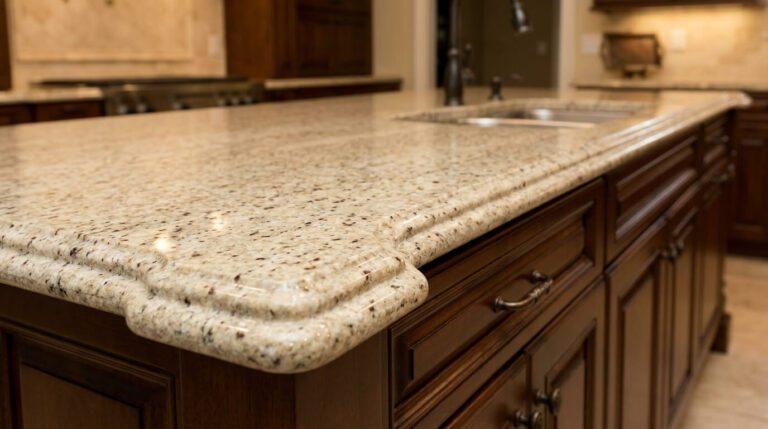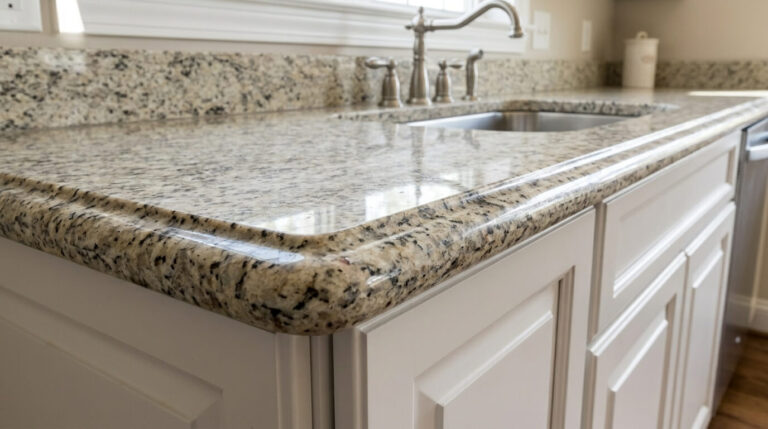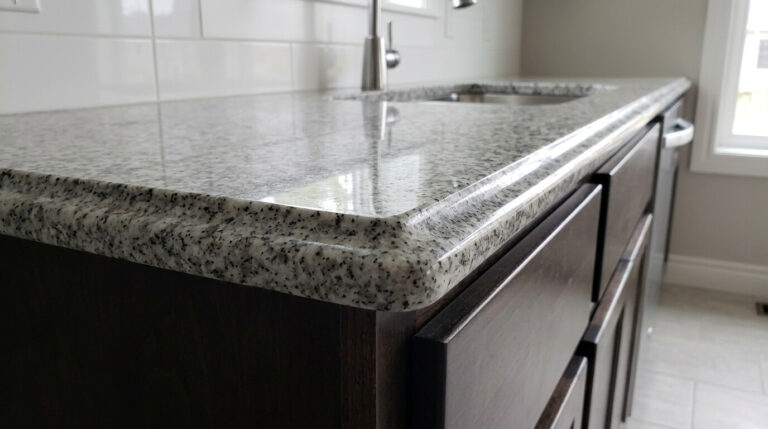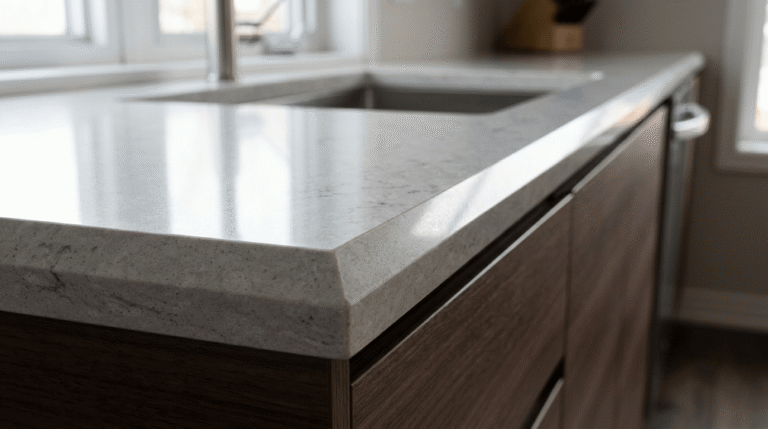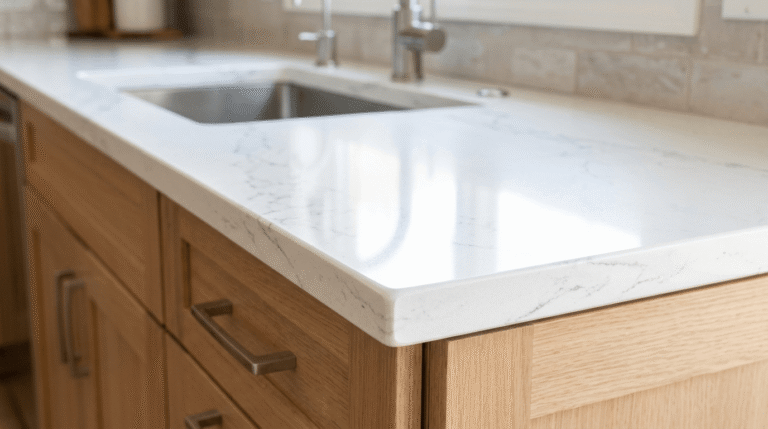
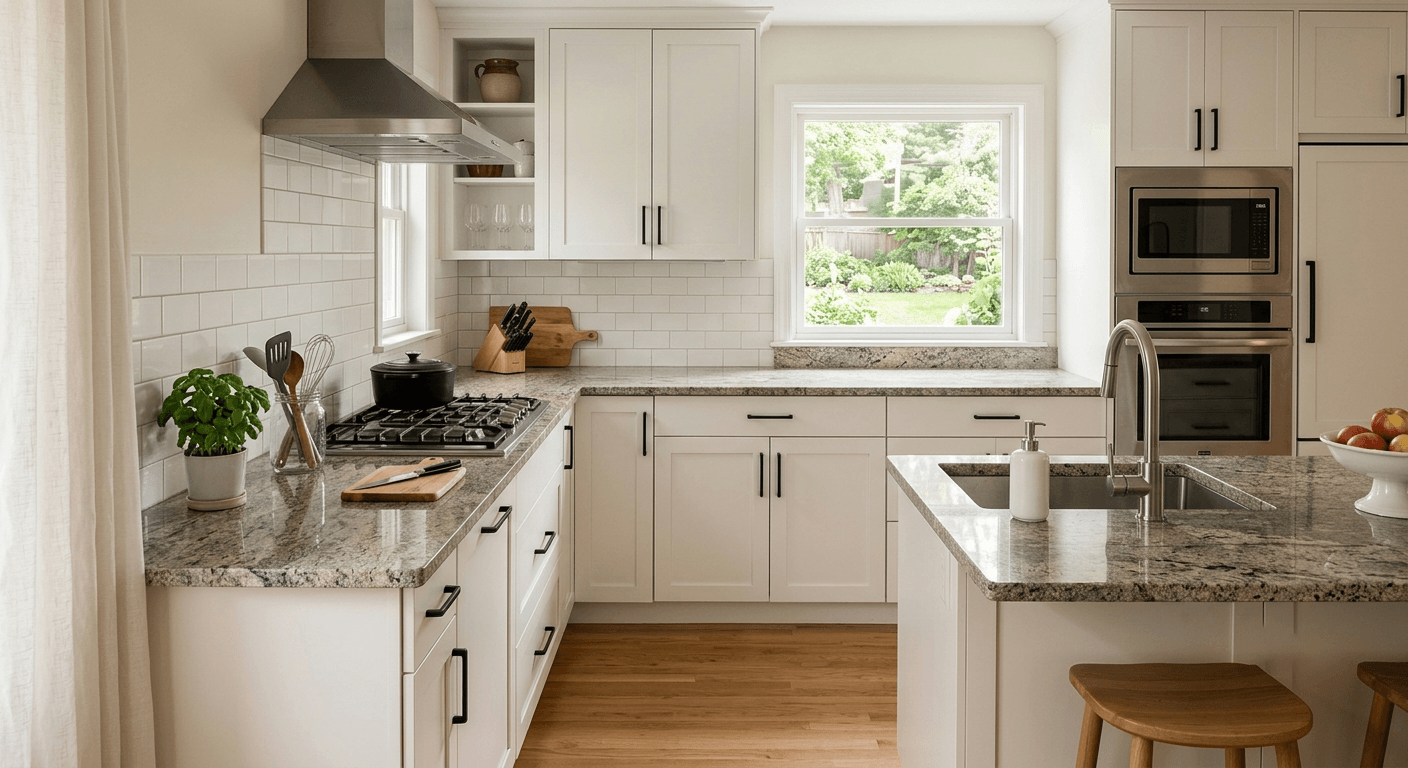
Quartz and granite rank among the most common countertop materials in North American kitchens and bathrooms. Granite is a natural stone quarried in large slabs and cut for individual installations. Quartz is an engineered stone made from crushed quartz minerals bound with polymer resin.
Homeowners choosing between the two materials typically evaluate cost, durability, maintenance, and appearance. Granite offers unique natural veining and high heat resistance, while quartz offers consistent patterns and lower maintenance requirements. Both materials perform well in kitchen and bathroom environments when installed and maintained correctly.
This comparison examines quartz and granite countertops across price, durability, care requirements, design options, installation factors, and suitability for different households. Each section addresses one specific comparison criterion to help homeowners match the material to their budget, lifestyle, and design preferences.
The sections below also compare quartz and granite with related materials, including marble, quartzite, concrete, soapstone, and solid surface, to place both options within the broader countertop material category.
What’s the Difference Between Quartz and Granite Countertops?
Granite and quartz differ primarily in origin and composition. Granite is a natural stone cut directly from quarried rock, while quartz is an engineered material manufactured from crushed quartz minerals and resin. This difference in origin affects each material’s appearance, porosity, maintenance needs, and manufacturing consistency.
Natural formation gives granite unique mineral patterns that vary from slab to slab. Manufacturing control gives quartz uniform color and pattern across production batches. The distinction in origin extends to every later comparison category, including cost, durability, and maintenance.
Granite Is a Natural Stone
Granite is an igneous rock formed from cooled magma, composed mainly of quartz, feldspar, and mica. These minerals create granite’s characteristic speckled or veined appearance and its high density.
Quarries cut granite into raw blocks, which are then sliced into slabs and polished for countertop use. Each granite slab has a distinct pattern because mineral composition varies within the quarried rock. Granite’s natural porosity allows some liquid absorption, which affects sealing requirements and stain resistance addressed in later sections.
Quartz Is an Engineered Stone
Quartz countertops are manufactured surfaces made from approximately 90% crushed quartz minerals combined with polymer resins and pigments. Manufacturers blend, compress, and cure this mixture into slabs under controlled factory conditions.
This manufacturing process produces a non-porous surface with consistent color and pattern across an entire slab and between slabs from the same production run. Quartz manufacturers can replicate stone-like patterns or produce solid colors unavailable in natural stone. The engineered composition reduces the need for sealing, a factor addressed in the maintenance section below.
Quartz vs Granite Countertops: Cost Comparison
Granite and quartz countertops fall within a similar overall price range, though the exact cost for each material depends on grade, slab origin, and installation complexity. Material cost typically represents only part of the total project price; installation, edging, and fabrication add to the final figure.
Buyers should request quotes based on the specific slab or grade under consideration, since published price ranges vary by region and supplier.
Average Price Per Square Foot
Granite countertops typically cost between $40 and $100 per square foot installed, while quartz countertops typically cost between $50 and $120 per square foot installed. These ranges include material and standard installation but exclude custom edging, premium colors, and structural modifications.
Premium granite slabs with rare veining can exceed $150 per square foot. Quartz brands offering designer patterns or larger slab formats can reach similar premium pricing.
What Affects the Final Cost (Installation, Edging, Grade)
Final countertop cost depends on material grade, edge profile, slab size, and installation complexity. Higher-grade granite slabs with rare patterns cost more than commercial-grade slabs with common patterns. Quartz pricing varies by brand and by the complexity of the pattern being replicated.
Edge profiles affect labor cost because decorative edges such as bullnose, ogee, or waterfall require additional fabrication time compared with a standard eased edge. Installation cost increases with the number of seams, cutouts for sinks and cooktops, and the need to remove existing countertops. Kitchen layouts with unusual shapes or large islands typically require more slabs and more fabrication labor than standard rectangular counters.
Which Is Cheaper: Quartz or Granite?
Granite is generally cheaper than quartz at the entry-level and mid-range price points, though pricing overlaps significantly at higher grades. Standard-grade granite slabs often start lower than comparable quartz options because granite sourcing and fabrication costs vary by quarry and availability.
Quartz pricing remains more predictable because manufacturers standardize production costs across a product line. Granite pricing fluctuates more, since rare or imported slabs command higher prices than common domestic slabs. Buyers comparing exact cost should request quotes for equivalent grades within their local market.
Durability: Which Material Holds Up Better?
Granite and quartz both perform well in daily kitchen and bathroom use, but each material has different strengths depending on the type of stress applied. Granite offers superior heat resistance, while quartz offers more consistent scratch and chip resistance due to its engineered composition.
The durability comparison below evaluates hardness, heat resistance, and chip resistance separately, since each factor affects long-term performance under different conditions.
Hardness and Scratch Resistance
Granite ranks between 6 and 7 on the Mohs hardness scale, while quartz countertops rank close to 7, since crushed quartz mineral itself measures 7 on the same scale. Both materials resist scratching from typical kitchen knives and utensils under normal use.
Granite’s natural mineral variation means hardness can differ slightly across a single slab, depending on mineral concentration in a given area. Quartz maintains consistent hardness throughout the slab because manufacturing blends the material uniformly. Neither material eliminates the risk of scratching from harder materials such as diamond-tipped or carbide tools.
Heat Resistance
Granite withstands direct contact with hot cookware without damage, since natural granite forms under extreme heat and pressure during its geological formation. Placing a hot pan directly on granite typically causes no visible harm under normal cooking temperatures.
Quartz countertops resist moderate heat but can suffer discoloration or cracking from prolonged direct contact with high heat, because the polymer resin binding the quartz particles is heat-sensitive. Manufacturers generally recommend using a trivet or hot pad under hot cookware on quartz surfaces to prevent resin damage.
Chip and Crack Resistance
Quartz countertops resist chipping and cracking under normal use because the resin binder adds flexibility that natural stone lacks. This flexibility helps quartz absorb minor impacts without fracturing.
Granite can chip at edges or corners from a hard, sharp impact, since natural stone lacks the same flexible binding structure. Thicker granite slabs and rounded edge profiles reduce chip risk at vulnerable points. Both materials can crack under extreme structural stress, such as inadequate cabinet support or impact from a heavy dropped object.
Maintenance and Care Requirements
Granite and quartz differ in ongoing maintenance because of their porosity difference. Granite requires periodic sealing to prevent staining, while quartz requires no sealing due to its non-porous engineered surface.
The sections below separate porosity, sealing, and daily cleaning, since each maintenance task addresses a different aspect of surface care.
Porosity and Staining
Granite is a porous material that can absorb liquids such as oil, wine, or coffee if left unsealed or under-sealed, leading to visible staining. Porosity varies by granite slab, since mineral density differs across quarried stone.
Quartz is a non-porous material because the resin binder fills the spaces between quartz particles during manufacturing. This non-porous structure prevents most liquids from penetrating the surface, which reduces staining risk compared with granite under equivalent spill conditions.
Sealing Requirements
Granite countertops typically require sealing once every 1 to 3 years, depending on the specific stone’s porosity and the sealant product used. A simple water-droplet test indicates when resealing is needed: water that absorbs into the surface within a few minutes signals reduced sealant protection.
Quartz countertops do not require sealing at any point after installation, since the manufacturing process already seals the surface with resin. This difference removes a recurring maintenance task from quartz ownership that granite owners must perform.
Everyday Cleaning
Both granite and quartz countertops require only mild soap and water for routine cleaning. Wiping spills promptly limits staining risk on granite and preserves the surface finish on quartz.
Granite owners should avoid acidic cleaners, such as vinegar or citrus-based products, because acidic substances can etch the sealed surface over time. Quartz owners should avoid high-pH cleaners and abrasive scouring pads, since these can dull the polished resin finish. Manufacturers of both materials generally recommend against bleach-based cleaners for daily use.
Appearance and Design Options
Granite and quartz differ visually because of their origin. Granite displays natural, non-repeating veining and mineral variation, while quartz displays consistent, manufactured patterns that repeat predictably across a slab.
This visual distinction affects design planning, since granite slabs require in-person selection for pattern matching, while quartz allows more predictable ordering from sample chips or digital catalogs.
Natural Veining (Granite) vs Consistent Patterns (Quartz)
Granite displays unique veining and mineral speckling because natural geological processes create random variation within the stone. No two granite slabs display identical patterns, even when cut from the same quarry block.
Quartz displays consistent, repeatable patterns because manufacturers control pigment distribution during production. This consistency allows homeowners to order quartz remotely with confidence that the delivered slab will closely match a sample or catalog image, an assurance granite cannot offer to the same degree.
Color and Pattern Range
Granite color options depend on the minerals present in a given quarry, producing natural tones such as black, gray, white, brown, and red with mineral flecking. Granite’s color range remains limited to what natural geology produces.
Quartz offers an expanded color and pattern range because manufacturers add pigments during production, including solid colors, marble-look veining, and concrete-inspired textures unavailable in natural granite. This manufacturing flexibility allows quartz to match a wider range of interior design styles.
Weight and Installation Considerations
Granite and quartz both require professional installation due to their substantial weight and the precision needed for seams, cutouts, and support. Standard granite and quartz slabs weigh approximately 18 to 20 pounds per square foot at typical countertop thickness, requiring reinforced cabinetry or additional support for large spans.
Both materials require a flat, level substrate to prevent cracking after installation. Installers typically apply a plywood or cabinet-grade support layer beneath the slab to distribute weight evenly. Large islands or peninsula counters may require additional bracing or corbels to support unsupported overhangs beyond 10 to 12 inches.
Granite slabs vary in thickness consistency due to natural quarrying, which can require additional fabrication time for uniform edges. Quartz slabs maintain consistent thickness from manufacturing, which can simplify fabrication for standard edge profiles. Both materials require specialized cutting tools, such as diamond-blade saws, due to their hardness.
Pros and Cons of Granite Countertops
Granite countertops offer high heat resistance, unique natural patterns, and long-term durability when properly sealed. The material withstands direct contact with hot cookware and resists scratching from normal kitchen use.
Granite countertops require periodic sealing to prevent staining, since the stone’s natural porosity allows liquid absorption without adequate sealant protection. Slab-to-slab pattern variation can complicate matching multiple slabs in large kitchens. Granite can chip at exposed edges from hard impacts, and premium slabs with rare veining carry higher costs than standard-grade options.
Pros and Cons of Quartz Countertops
Quartz countertops offer non-porous, stain-resistant surfaces that require no sealing, along with consistent color and pattern across an entire installation. The engineered composition resists chipping and cracking better than natural stone under normal impact conditions.
Quartz countertops are more vulnerable to heat damage than granite, since prolonged direct contact with hot cookware can discolor or crack the polymer resin. Quartz cannot fully replicate the exact random veining of natural stone, and premium designer patterns can cost as much as high-grade granite. Direct sunlight exposure over extended periods can cause some quartz colors to fade, making quartz less suitable for uncovered outdoor installations.
Quartz vs Granite for Kitchen Countertops
Granite and quartz both suit kitchen environments, though each material favors slightly different kitchen habits. Granite favors kitchens with frequent direct contact between hot cookware and the countertop surface, since its natural heat resistance eliminates the need for trivets. Quartz favors kitchens where liquid spills, food acids, and staining risks occur regularly, since its non-porous surface resists absorption without sealing.
Kitchen islands and heavily used prep areas benefit from quartz’s chip resistance under frequent utensil contact and cutting activity near the edge. Kitchens prioritizing a one-of-a-kind natural appearance benefit from granite’s unique veining, since no two granite installations look identical. Both materials support undermount and drop-in sink installations, standard cooktop cutouts, and integration with common kitchen cabinetry heights.
How to Tell if a Countertop Is Granite or Quartz
Identify granite by its irregular, non-repeating pattern and small light-reflecting mineral flecks visible under close inspection. Granite surfaces feel slightly cool and show natural pattern breaks where mineral veins shift direction unpredictably across the slab.
Identify quartz by its uniform, repeating pattern and lack of naturally occurring mineral inclusions. A magnified inspection of quartz reveals small, evenly distributed particles within a resin matrix, rather than granite’s larger, irregular mineral grains. Testing with a small amount of water can help distinguish the two: water beads longer on sealed granite before slow absorption, while water beads and wipes away cleanly on quartz due to its non-porous surface. A professional fabricator can confirm material identity through direct slab inspection when visual and water testing remain inconclusive.
Quartz vs Granite: Which Should You Choose?
Choosing between quartz and granite depends on priorities related to maintenance tolerance, heat exposure habits, and desired appearance. Homeowners who prefer low-maintenance ownership and consistent patterns typically favor quartz, while homeowners who prioritize natural appearance and heat resistance typically favor granite.
Budget, kitchen usage patterns, and design goals should guide the final decision, since both materials perform reliably when matched to appropriate conditions.
Choose Granite If…
Choose granite for kitchens with frequent direct contact between hot cookware and the countertop, since granite resists heat damage without added protection. Choose granite when a unique, natural pattern is a design priority, since no two granite slabs display identical veining. Granite also suits homeowners willing to perform periodic sealing to maintain stain resistance over the countertop’s lifespan.
Choose Quartz If…
Choose quartz for households prioritizing low maintenance, since quartz requires no sealing and resists staining without regular upkeep. Choose quartz when consistent color matching across a large kitchen or multiple rooms is important, since manufactured slabs replicate patterns predictably. Quartz also suits households with frequent food preparation involving acidic ingredients, given its non-porous resistance to staining.
How Quartz and Granite Compare to Other Countertop Materials
Quartz and granite represent two options within a broader category of countertop materials that includes marble, quartzite, concrete, soapstone, and solid surface. Each alternative material offers a different balance of appearance, durability, porosity, and cost compared with quartz and granite.
The comparisons below evaluate quartz and granite against these related materials using consistent criteria: composition, durability, maintenance, and typical application.
Quartz vs Granite vs Marble
Marble is a natural metamorphic stone valued for its distinctive white-and-gray veining, but it ranks softer than both granite and quartz on the Mohs hardness scale, at approximately 3 to 4. This lower hardness makes marble more prone to scratching and etching from acidic substances than granite or quartz.
Granite outperforms marble in heat and scratch resistance, while quartz outperforms marble in stain resistance due to its non-porous surface. Marble remains popular for its appearance in low-traffic areas such as bathroom vanities and decorative surfaces, where its softer, more delicate surface faces less daily wear than a kitchen countertop.
Quartz vs Granite vs Quartzite
Quartzite is a natural metamorphic stone formed from sandstone under heat and pressure, distinct from engineered quartz despite the similar name. Quartzite ranks among the hardest natural countertop stones, often exceeding granite’s hardness on the Mohs scale.
Quartzite shares granite’s need for periodic sealing due to natural porosity, while manufactured quartz remains non-porous and seal-free. Quartzite typically costs more than granite due to more complex quarrying and fabrication requirements, positioning it as a premium natural-stone alternative for buyers seeking greater hardness than granite provides.
Granite/Quartz vs Concrete, Soapstone, and Solid Surface
Concrete countertops are custom-poured or precast surfaces that offer design flexibility but require sealing similar to granite and remain prone to hairline cracking as the material cures and ages. Soapstone is a natural stone with a soft, smooth texture that resists staining but scratches more easily than granite or quartz due to its lower hardness.
Solid surface countertops are engineered from acrylic or polyester resins, offering seamless installation and easy repair of scratches through sanding, unlike granite or quartz, which cannot be sanded to remove damage. Solid surface lacks the heat resistance of granite and the hardness of quartz, making it less suitable for direct contact with hot cookware or heavy cutting activity.
Affordable Alternatives to Granite Countertops
Laminate countertops offer the lowest-cost alternative to granite, typically ranging from $10 to $40 per square foot installed, though laminate lacks the heat resistance and long-term durability of natural or engineered stone. Butcher block countertops provide a mid-range alternative between $30 and $75 per square foot, offering a warm appearance but requiring regular oiling to prevent water damage.
Tile countertops present another budget-friendly option, generally priced between $20 and $50 per square foot installed, though grout lines require regular sealing and cleaning to prevent staining. Recycled glass countertops fall in a similar range to mid-grade granite, offering an eco-conscious alternative with a distinctive appearance, though availability varies by region and installer.