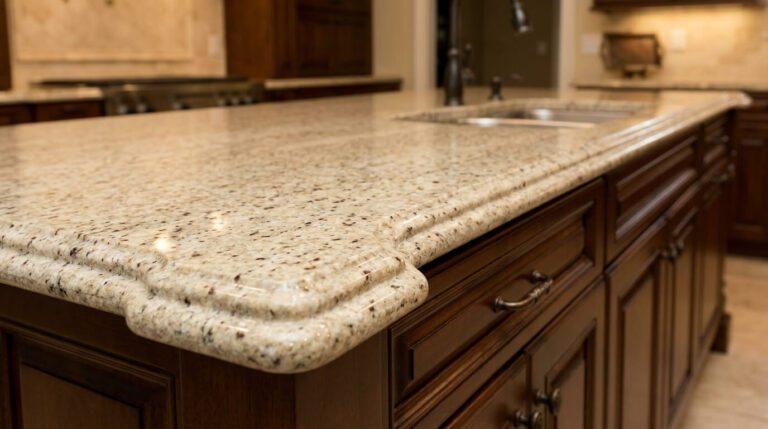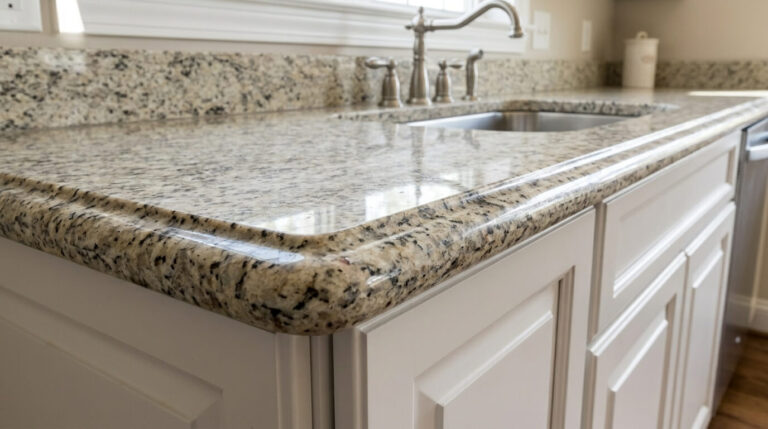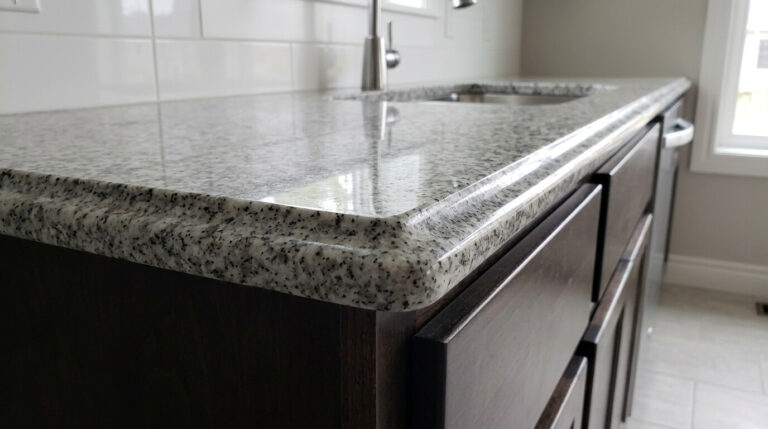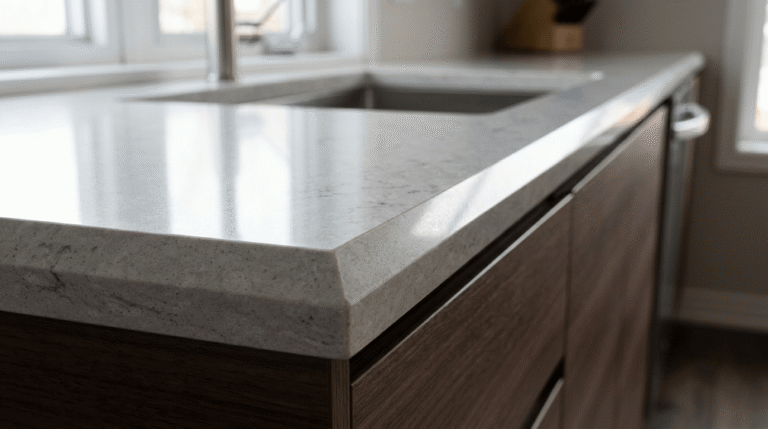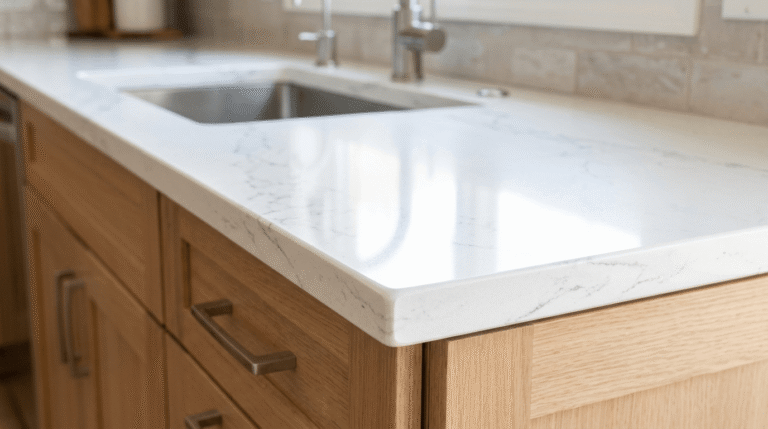
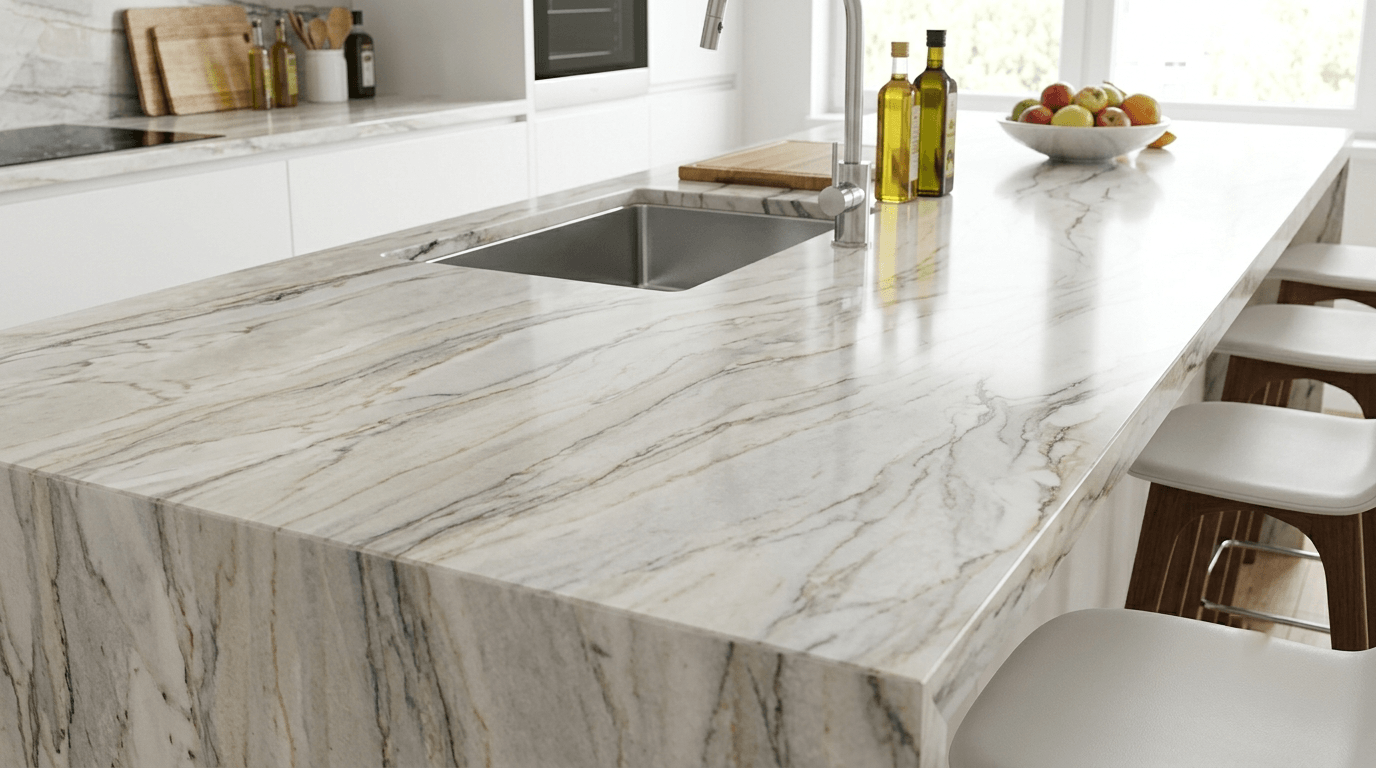
Quartzite and quartz countertops rank among the most requested surfaces for kitchens and bathrooms, yet the two materials differ in origin, composition, hardness, maintenance, and cost. Quartzite forms underground through natural heat and pressure, while quartz countertops are manufactured from crushed quartz minerals bound with resin. This distinction affects how each surface resists heat, stains, and scratches, and it determines the sealing and cleaning routine each material requires.
Homeowners choosing between quartzite and quartz typically weigh durability against maintenance, and natural appearance against color consistency. Quartzite offers a stone-quarried look with unique veining, while quartz offers a controlled, uniform pattern with fewer maintenance demands. Price also separates the two materials, since slab rarity, fabrication complexity, and sealing requirements affect the final installed cost.
This guide compares quartzite and quartz across hardness, heat resistance, porosity, cleaning requirements, design options, and suitability for kitchens and bathrooms. It also positions both materials against granite, marble, dolomite, soapstone, sandstone, and leading quartz brands, so a homeowner can match the correct surface to a specific room, budget, and maintenance capacity.
What Is Quartzite vs. Quartz?
Quartzite is a natural metamorphic rock, and quartz countertops are engineered surfaces made from crushed quartz combined with resin. The two materials share a mineral name but differ in formation process, composition, and manufacturing. Quartzite forms in the earth’s crust over millions of years, while quartz slabs are manufactured in a factory within days. This origin difference directly affects each material’s veining pattern, color range, hardness, and porosity, which the following sections address in detail.
Quartzite: A Natural Metamorphic Stone
Quartzite is a natural metamorphic rock formed when sandstone recrystallizes under intense heat and pressure. The recrystallization process fuses quartz grains into a dense, interlocking structure, which gives quartzite its hardness and its natural veining. Quartzite forms in mountain ranges through tectonic activity, and quarries extract it as large blocks before cutting the blocks into slabs. Each quartzite slab displays unique veining and color variation, because natural mineral deposits differ across quarry locations. Common quartzite deposits include sites in Brazil, India, and the United States.
Quartz: An Engineered Stone Made from Ground Quartz and Resin
Quartz is an engineered stone manufactured from approximately 90% to 94% ground natural quartz combined with polymer resins and pigments. Manufacturers mix crushed quartz with resin binders, compress the mixture under vacuum, and cure it into slabs of consistent thickness. This engineered process allows manufacturers to control color, pattern, and slab uniformity, unlike quarried quartzite, which varies by natural deposit. The resin binder also fills microscopic pores, which reduces porosity compared with natural stone. Manufacturing occurs in controlled facilities rather than quarries.
Is Quartzite the Same as Quartz?
Quartzite is not the same as quartz. Quartzite is a natural stone quarried from the earth, while quartz is an engineered material manufactured from crushed quartz and resin. The shared name causes confusion at showrooms, but the two materials differ in formation, composition, porosity, and maintenance requirements. Quartzite requires periodic sealing because natural stone contains microscopic pores, while quartz resists staining without sealing because resin fills its surface. Quartzite also displays unique, non-repeating veining, while quartz offers a controlled, repeatable pattern across slabs from the same production batch.
The following table compares quartzite and quartz by origin, composition, porosity, maintenance, hardness, and heat resistance.
| Attribute | Quartzite | Quartz |
|---|---|---|
| Origin | Natural metamorphic stone, quarried | Engineered stone, manufactured |
| Composition | Nearly pure quartz mineral | 90%–94% crushed quartz with polymer resin |
| Porosity | Porous; requires sealing | Non-porous; resin fills surface pores |
| Pattern | Unique veining, varies by slab | Controlled, consistent pattern |
| Hardness (Mohs scale) | 7 | 7 (resin lowers overall hardness slightly) |
| Heat resistance | High; withstands direct heat better | Moderate; resin softens under high heat |
| Maintenance | Periodic sealing required | Routine cleaning only, no sealing |
Quartzite outperforms quartz in heat resistance and hardness at the mineral level, while quartz outperforms quartzite in stain resistance and maintenance simplicity. Quartzite slabs vary in appearance from one quarry batch to another, while quartz slabs remain consistent across a manufacturer’s production run.
Quartzite vs. Quartz Cost Comparison
Quartzite generally costs more than quartz per square foot, because natural slab rarity and fabrication difficulty raise material and labor costs. Quartzite pricing varies by quarry origin, slab rarity, and color, while quartz pricing depends on brand, pattern complexity, and edge profile. Both materials require professional fabrication and installation, which adds labor costs beyond the raw material price.
Average Price Per Square Foot
Quartzite typically costs $70 to $200 per square foot installed, while quartz typically costs $50 to $150 per square foot installed. Premium quartzite slabs with rare veining or exotic coloring can exceed $200 per square foot, while entry-level quartz colors from mainstream brands often start near $50 per square foot. Installed pricing includes the slab, fabrication, and standard installation, though edge details, cutouts, and backsplash additions increase the total project cost.
What Drives Quartzite’s Price Higher
Quartzite’s price rises above quartz because of slab rarity, quarry location, and fabrication difficulty. Quartzite forms in limited natural deposits, so rare colors and veining patterns command higher prices due to limited supply. Quartzite’s hardness also increases fabrication time, because cutting and polishing a harder natural stone requires specialized diamond-tipped tools and additional labor hours. Import costs add further expense when quarries are located outside the country of installation.
Installation and Fabrication Cost Differences
Quartzite installation costs more than quartz installation because quartzite’s hardness and slab irregularity require more fabrication time. Fabricators cut quartz slabs with predictable, uniform thickness, which speeds cutting and edge-polishing. Quartzite slabs vary in thickness and density across a single piece, which slows cutting and increases the risk of cracking during fabrication. Both materials require professional installation due to slab weight, though quartzite’s additional hardness extends labor time and raises fabrication fees.
Durability and Hardness: Which Holds Up Better?
Quartzite and quartz both offer high durability for daily countertop use, though quartzite’s natural hardness gives it a slight advantage in scratch and heat resistance. Quartz compensates with a non-porous surface that resists staining without sealing. Durability depends on the specific property being measured, including hardness, scratch resistance, chip resistance, and heat resistance, which the following sections address separately.
Quartzite and Quartz on the Mohs Hardness Scale
Quartzite and quartz both measure approximately 7 on the Mohs hardness scale, matching the hardness of natural quartz mineral. This hardness places both materials above granite (6 to 6.5) and well above marble (3 to 4) in scratch resistance. Quartz’s resin content can lower its effective surface hardness slightly below pure quartzite, because resin is softer than crystalline quartz. A material at 7 on the Mohs scale resists scratching from common kitchen items such as knives, ceramic, and glass, which typically measure below 6.
Scratch and Chip Resistance
Quartzite resists scratches and chips better than quartz under normal kitchen use, due to its higher mineral density and interlocking crystal structure. Quartz resists surface scratches from typical utensils but can chip at edges and corners under sharp impact, because its resin content is softer than solid quartzite. Both materials withstand routine cutting, sliding cookware, and daily food preparation without visible damage, though heavy or sharp impacts can chip either surface at unsupported edges.
Heat, Stain, and Scratch Resistance in Daily Use
Quartzite withstands higher direct heat than quartz, while quartz resists staining more consistently than unsealed quartzite. Both materials perform well against daily scratching from utensils and cookware. These differences affect how each surface performs near stovetops, with acidic foods, and during food preparation, which the following sections detail by specific use case.
Heat Resistance: Can You Put a Hot Pan on It?
Quartzite withstands direct contact with a hot pan better than quartz, because quartzite contains no resin that can soften or discolor under heat. Quartz countertops can discolor, crack, or develop heat marks when a pan exceeds approximately 150°C (300°F) directly on the surface, because the polymer resin softens under sustained high heat. Manufacturers and fabricators recommend using a trivet or hot pad on quartz surfaces to prevent thermal damage, even though quartzite tolerates brief direct heat exposure more reliably.
Is Quartzite Porous? Staining and Sealing Needs
Quartzite is porous and can absorb liquids unless sealed, which makes it susceptible to staining from oil, wine, and acidic substances. The natural mineral structure contains microscopic gaps that allow liquid penetration over time. A sealant fills these pores and creates a protective barrier that reduces staining risk. Quartz, by contrast, contains resin that fills its surface pores during manufacturing, which makes it non-porous and resistant to staining without any sealing requirement.
Can You Cut Directly on Quartzite or Quartz?
Cutting directly on quartzite or quartz is not recommended, because knife blades can dull and both surfaces can develop fine scratches from repeated blade contact. Quartzite’s higher hardness resists visible scratching better than quartz during occasional direct cutting, though repeated use still risks blade damage. Fabricators and manufacturers recommend a cutting board on both surfaces to protect knife edges and preserve the countertop’s polished finish.
Maintenance Requirements for Quartzite vs. Quartz
Quartzite requires periodic sealing in addition to routine cleaning, while quartz requires only routine cleaning without sealing. This maintenance gap stems directly from each material’s porosity, since quartzite’s natural pores need a protective barrier that quartz’s resin-filled surface does not require. The following sections detail the specific sealing schedule for quartzite and the shared cleaning routine for both materials.
Sealing Frequency for Quartzite
Quartzite requires sealing approximately once every 6 to 12 months, depending on the stone’s porosity and daily use. Denser quartzite varieties with lower porosity may require sealing only once a year, while more porous varieties need sealing every six months. A water-absorption test, performed by placing a few drops of water on the surface, indicates when resealing is necessary if the water absorbs within a few minutes instead of beading on the surface.
Everyday Cleaning for Both Materials
Quartzite and quartz both require only mild soap, warm water, and a soft cloth for everyday cleaning. Abrasive cleaners, acidic cleaning agents, and harsh chemicals can dull the polished finish on either material and should be avoided. Spills should be wiped promptly on both surfaces, since quartzite’s porosity allows gradual staining and quartz’s resin can discolor under prolonged exposure to strong pigments such as dye or ink.
Appearance and Design Options
Quartzite offers natural, non-repeating veining, while quartz offers controlled, consistent patterns manufactured to match a specific design. This difference affects how each material suits a design goal, whether a homeowner wants a one-of-a-kind natural surface or a predictable, uniform look across a large kitchen or multiple rooms.
Natural Veining vs. Engineered Consistency
Quartzite displays natural veining and mineral variation that differs from slab to slab, while quartz displays a manufactured pattern that repeats consistently across slabs from the same production batch. Quartzite’s veining results from mineral deposits and pressure during formation, so no two slabs match exactly. Quartz’s consistency results from a controlled manufacturing process, which allows a designer to match countertops across multiple rooms or replace a damaged section with a closely matching slab.
Popular Quartzite Colors and Patterns
Popular quartzite colors include white, gray, taupe, and blue-gray, often featuring dramatic veining that resembles marble. Varieties such as Taj Mahal, Fantasy Brown, and White Macaubas are widely available and display soft veining with subtle color movement. Some quartzite deposits produce bolder patterns with dark gray or gold veining, which suit design schemes that favor a natural stone appearance.
Light, Neutral, and Warm-Toned Options
Both quartzite and quartz offer light, neutral, and warm-toned color options suited to a range of interior design styles. Light quartzite tones include white and pale gray, while quartz manufacturers reproduce similar light tones with added color consistency. Warm-toned options in both materials include beige, taupe, and soft brown, which suit traditional and transitional kitchen designs. Neutral gray tones remain popular in both materials for contemporary and minimalist designs.
Quartzite vs. Quartz for Kitchen Countertops
Quartzite suits kitchen countertops that require high heat tolerance near stovetops, while quartz suits kitchens that prioritize low maintenance and stain resistance. A kitchen countertop faces daily exposure to hot cookware, acidic foods, oils, and frequent cutting, which makes heat resistance and stain resistance primary selection factors. Quartzite’s natural heat tolerance reduces the risk of damage near a range or oven, though its porosity requires sealing to prevent staining from cooking oils and acidic ingredients such as citrus and wine. Quartz’s non-porous surface resists staining without sealing, which suits a kitchen with frequent spills, though a trivet remains necessary to protect the surface from direct high heat. Both materials withstand daily food preparation, cutting board use, and routine cleaning in a kitchen environment.
Quartzite vs. Quartz for Bathroom Vanities
Quartz suits bathroom vanities that require low maintenance and consistent color matching, while quartzite suits vanities where a natural stone appearance is the primary design goal. A bathroom vanity faces less heat exposure than a kitchen countertop, which reduces the practical advantage of quartzite’s heat resistance in this application. Quartz’s non-porous surface resists staining from cosmetics, hair dye, and cleaning products without sealing, which simplifies maintenance in a bathroom setting. Quartzite remains a suitable vanity material when sealed on schedule, and its natural veining suits bathrooms designed to match a marble-inspired aesthetic. Both materials resist moisture damage when properly installed and maintained.
Pros and Cons of Quartzite vs. Quartz
Quartzite offers superior heat resistance and a natural appearance, balanced against sealing requirements and higher cost. Quartz offers low maintenance and consistent design, balanced against lower heat tolerance and a manufactured appearance. These trade-offs affect which material suits a specific homeowner’s priorities, budget, and maintenance capacity, detailed by material below.
Quartzite Pros and Cons
Quartzite provides high heat resistance, high hardness, and a unique natural appearance, while requiring periodic sealing and commanding a higher price than quartz.
- Heat resistance: Quartzite withstands direct contact with hot cookware better than quartz.
- Hardness: Quartzite resists scratching and chipping due to its dense mineral structure.
- Appearance: Quartzite displays unique, non-repeating natural veining.
- Sealing requirement: Quartzite requires sealing every 6 to 12 months to prevent staining.
- Cost: Quartzite typically costs more than quartz due to slab rarity and fabrication difficulty.
- Slab consistency: Quartzite slabs vary in pattern, which complicates matching multiple pieces.
Quartz Pros and Cons
Quartz provides low maintenance, stain resistance, and consistent design, while offering lower heat tolerance than quartzite and a manufactured rather than natural appearance.
- Maintenance: Quartz requires no sealing, reducing long-term upkeep.
- Stain resistance: Quartz resists staining from oils, wine, and acidic substances.
- Consistency: Quartz slabs match closely across a single production batch.
- Cost: Quartz typically costs less than quartzite at comparable quality tiers.
- Heat tolerance: Quartz can discolor or crack under sustained direct heat above approximately 150°C (300°F).
- Appearance: Quartz displays a manufactured pattern rather than natural stone variation.
How to Choose Between Quartzite and Quartz
Choosing between quartzite and quartz depends on a homeowner’s priorities for heat resistance, maintenance, appearance, and budget. A homeowner who values natural stone appearance and higher heat tolerance typically favors quartzite, while a homeowner who values low maintenance and consistent design typically favors quartz. The following sections outline specific conditions that favor each material.
Choose Quartzite If…
Choose quartzite if heat resistance, natural stone appearance, and unique veining are primary priorities. Quartzite suits homeowners who cook frequently near the countertop, who prefer a one-of-a-kind natural pattern, and who accept a periodic sealing routine as part of ongoing maintenance. Quartzite also suits design projects that aim to replicate a marble aesthetic with greater durability than marble provides.
Choose Quartz If…
Choose quartz if low maintenance, stain resistance, and consistent color matching are primary priorities. Quartz suits homeowners who prefer a sealing-free routine, who need to match countertops across multiple rooms or replacement pieces, and who want a wide range of controlled colors and patterns. Quartz also suits budget-conscious projects where a lower price point matters more than natural stone origin.
Quartzite and Quartz vs. Other Countertop Stones
Quartzite and quartz compete with granite, marble, dolomite, soapstone, and sandstone as countertop materials, each offering a different balance of hardness, porosity, appearance, and cost. Comparing quartzite and quartz against these alternative stones clarifies which material best fits a specific hardness requirement, maintenance capacity, or design goal, detailed below by comparison.
Quartzite/Quartz vs. Granite
Granite measures 6 to 6.5 on the Mohs hardness scale, slightly below quartzite and quartz’s hardness of approximately 7. Granite is porous like quartzite and requires periodic sealing, while quartz remains non-porous without sealing. Granite displays natural speckled patterns, distinct from quartzite’s veining and quartz’s engineered consistency. Granite typically costs less than quartzite but occupies a similar price range to mid-tier quartz.
Quartzite/Quartz vs. Marble
Marble measures 3 to 4 on the Mohs hardness scale, well below quartzite and quartz, which makes marble more prone to scratching and etching from acidic substances. Marble is highly porous and requires more frequent sealing than quartzite. Marble’s veining resembles quartzite’s natural patterns, which makes quartzite a common marble alternative for homeowners who want a similar look with greater scratch and etch resistance. Quartz manufacturers also produce marble-look patterns that replicate marble’s appearance without marble’s maintenance demands.
Quartzite vs. Dolomite, Soapstone, and Sandstone
Dolomite measures 3.5 to 4 on the Mohs hardness scale and resembles marble in appearance and porosity, making it softer and more stain-prone than quartzite. Soapstone measures 2.5 to 3.5 on the Mohs hardness scale, softer than quartzite, though soapstone resists staining due to its non-porous composition and develops a natural patina over time. Sandstone measures 6 to 7 on the Mohs hardness scale, close to quartzite in hardness, but sandstone remains more porous and less dense than quartzite due to its looser sediment structure prior to metamorphism.
Popular Quartz Brands Compared to Quartzite (Caesarstone, Silestone, Cambria)
Caesarstone, Silestone, and Cambria are leading quartz brands that offer engineered consistency and warranty coverage, distinguishing them from quartzite’s natural, quarry-sourced slabs. Caesarstone manufactures quartz surfaces in a range of colors, including patterns designed to replicate quartzite and marble veining. Silestone incorporates antimicrobial surface treatments in select product lines, a feature unavailable in natural quartzite. Cambria manufactures quartz slabs domestically in the United States and offers an extensive color and pattern catalog with consistent batch matching. Unlike these branded quartz products, quartzite slabs come directly from natural quarries without brand-controlled color matching, which means quartzite selection depends on available slab inventory rather than a standardized product line.